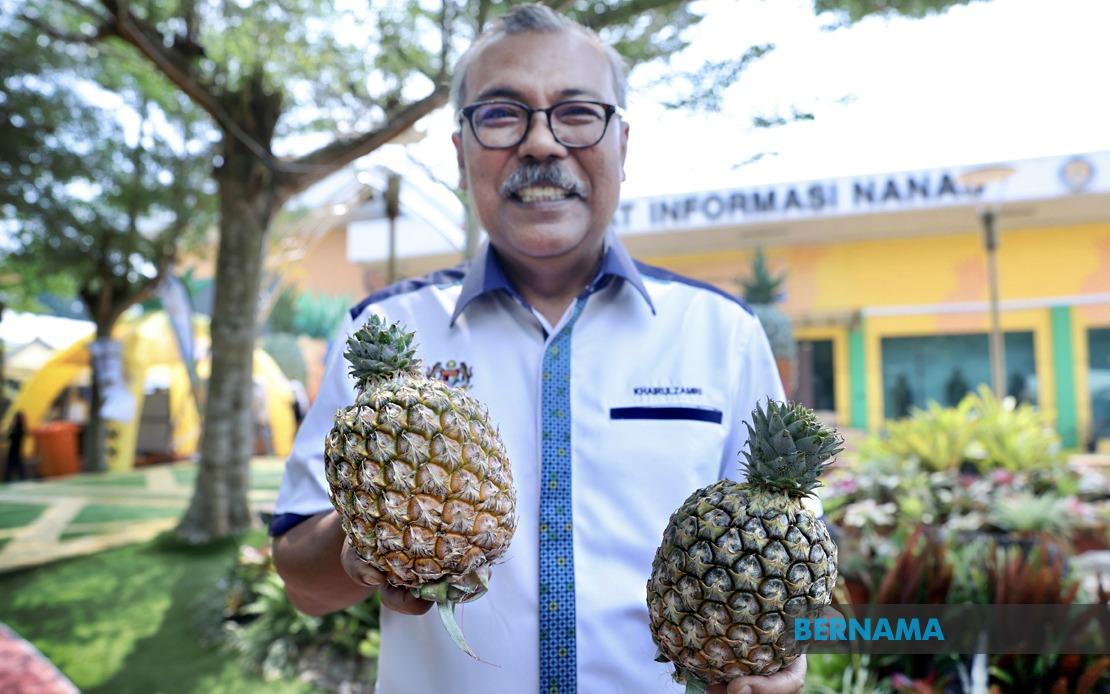
A newly developed pineapple variety originating from Sarawak is capturing considerable attention at the Malaysia Agriculture Expo Park (MAEPS) during MAHA 2026, which runs through early September at Serdang. The SG1 pineapple, discovered and first cultivated in Miri, represents what industry officials describe as a premium offering with substantial commercial viability for both domestic and international markets. Seven tonnes of the fruit have been transported from Sarawak to the Laman Nanas exhibition space, providing visitors with direct access to experience the variety's distinctive characteristics and taste profile.
According to Mohd Khairuzamri M. Salleh, director-general of the Malaysian Pineapple Industry Board (LPNM), the SG1 addresses several limitations that have constrained Malaysia's pineapple sector competitiveness. The new variety achieves sweetness levels comparable to MD2, the current industry standard globally, while displaying a distinctive rose-shaped crown that sets it apart visually in consumer markets. More significantly, the fruit maintains uniform quality and flavour consistency throughout, a characteristic that appeals strongly to export markets where product standardisation directly influences commercial viability and buyer confidence.
The SG1's most compelling advantage lies in its accelerated maturation timeline. Traditional MD2 pineapples require fourteen months from planting to harvest, creating extended capital lock-up for growers and delayed revenue recovery. In contrast, SG1 reaches maturity in merely nine months, substantially reducing the production cycle and enabling farmers to generate returns considerably faster. This compressed timeline has immediate implications for cash flow management on smallholder farms throughout Malaysia, where rapid income generation often determines operational sustainability.
Planting density represents another transformative characteristic of the SG1 variety. Whereas conventional pineapple cultivation operates within lower density parameters, SG1 can be cultivated at between 25,000 and 30,000 plants per acre. This extraordinary density substantially amplifies output per unit of land, addressing a persistent constraint in Malaysia's agricultural sector where arable land availability continues to tighten. Growers can therefore achieve significantly higher productivity without requiring proportionally larger land holdings, potentially making pineapple farming economically viable for an expanded base of agricultural entrepreneurs.
The LPNM is actively pursuing expansion of SG1 cultivation beyond its Sarawak birthplace into Peninsular Malaysia. Distribution of SG1 seedlings to growers across the nation is anticipated to commence next year, representing a critical phase in scaling production. This expansion strategy reflects confidence in the variety's adaptability to diverse Malaysian growing conditions and suggests that sector planners envision SG1 becoming a mainstream offering rather than a specialised niche product. The deliberate phasing of introduction also allows for knowledge transfer and farmer familiarisation before widespread adoption.
International trade prospects have already demonstrated encouraging momentum. Trial export shipments from Sarawak to Singapore have successfully navigated regulatory and logistical hurdles, establishing proof of concept for regional commerce. Industry assessments suggest that SG1's robust disease resistance and consistent quality position it favourably for penetration into larger Asian markets, particularly China and New Zealand. Successfully entering these premium markets would generate substantially higher export revenues compared to traditional pineapple sales and would strengthen Malaysia's positioning within global fresh produce trade networks.
The broader exhibition narrative surrounding pineapple promotion at MAHA 2026 extends beyond fresh fruit sales to encompass comprehensive value chain transformation. Under the theme "Value Creation for Food Security," organisers are advancing the concept of "one planting, three harvests," emphasising that pineapple cultivation yields returns across multiple product categories. Beyond the fresh fruit harvest, growers can monetise plant crowns and secondary plant material, while processing waste streams into ruminant feed, textile fibres, and paper products. This integrated approach to pineapple valorisation positions the crop not simply as a commodity but as a platform for creating multiple revenue streams and reducing agricultural waste.
The exhibition's focus on value addition reflects evolving global consumer preferences toward sustainability and resource efficiency. Malaysian pineapple growers who successfully transition toward multi-product extraction models will enhance their competitive positioning against producers in lower-cost jurisdictions. By capturing value across the entire plant biomass, domestic producers can justify premium pricing and reduce environmental impact, two factors increasingly driving purchasing decisions in developed markets. This strategic reorientation also aligns with Malaysia's broader agricultural modernisation objectives.
MAHA 2026 itself presents an unprecedented platform for industry engagement, featuring approximately 2,000 exhibitors and projected attendance exceeding four million visitors. The sheer scale of the event ensures that the SG1 pineapple receives exposure among agricultural professionals, government policymakers, commercial buyers, and domestic consumers. This visibility accelerates awareness and adoption trajectories compared to traditional marketing channels. The concentrated exhibition environment enables direct interaction between growers, distributors, exporters, and technology providers, potentially catalysing partnerships and investment commitments that would require substantially longer timeframes to materialise through dispersed networking approaches.
For Malaysian agriculture more broadly, the SG1 represents a tangible example of domestic innovation addressing productivity and profitability challenges that have constrained sector performance. The variety demonstrates that Malaysia possesses the scientific capacity and institutional frameworks to develop globally competitive agricultural solutions without dependency on imported genetic material or technology transfer. Successful commercialisation of SG1 could establish momentum for comparable crop improvement initiatives across other commodity sectors, potentially reigniting investor and farmer confidence in Malaysian agriculture as an economic growth engine.
The timing of SG1's introduction carries strategic significance within regional agricultural contexts. Southeast Asia's agricultural sectors face mounting pressure from climate variability, labour constraints, and intensifying global competition. Crop varieties that compress production cycles, enhance yield density, and demonstrate robust resilience provide immediate competitive advantages. If SG1 successfully establishes market presence across Malaysia and subsequently gains traction in regional markets, it could establish Sarawak and Malaysia more broadly as sources of agricultural innovation rather than primarily as commodity producers following established parameters.
Looking forward, the success of SG1 commercialisation will depend on coordinated effort across multiple domains. Technical extension services must effectively disseminate cultivation protocols to growers accustomed to MD2 systems. Export certification frameworks must adapt to accommodate the variety within existing trade agreements and phytosanitary requirements. Market development initiatives must build buyer awareness and cultivate demand premium sufficient to reward growers for transitioning production systems. These interconnected requirements demand sustained coordination between government agencies, industry associations, and commercial operators—a complex undertaking that will determine whether SG1 achieves its evident potential or remains a promising innovation with limited market penetration.

