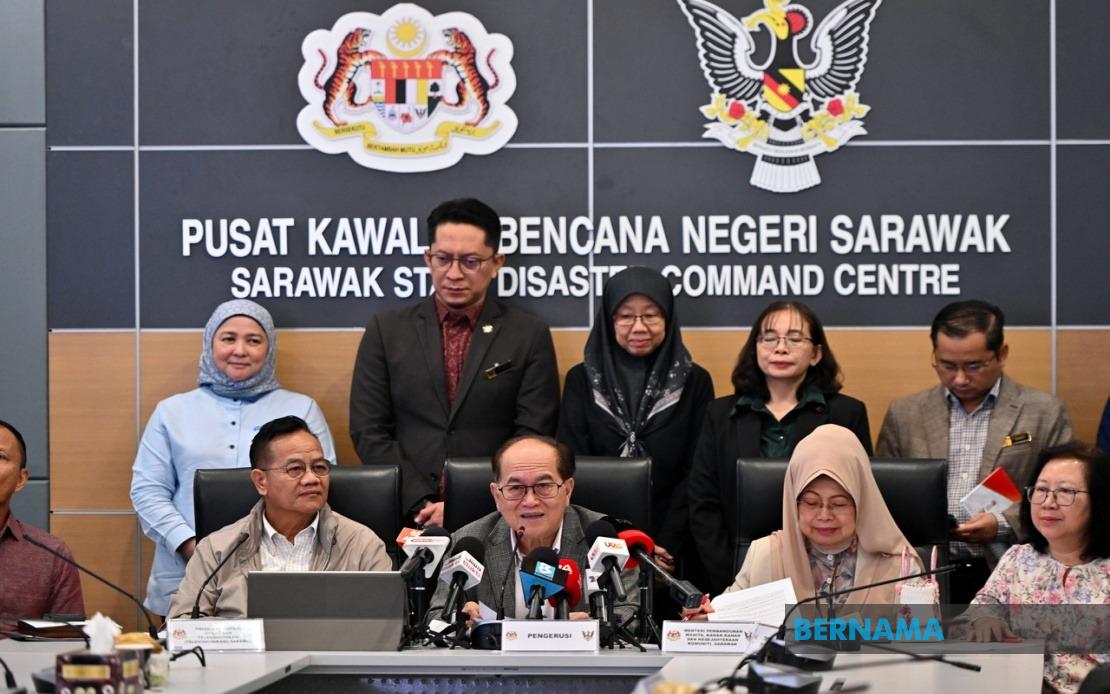
Sarawak's government has established a clear threshold for declaring a state of emergency in response to hazardous air quality, with Deputy Premier Datuk Amar Douglas Uggah Embas announcing that an Air Pollutant Index reading of 500 will trigger immediate protective measures across the state. The announcement, made following a Sarawak State Disaster Management Committee meeting in Kuching on August 31, reflects growing concerns about transboundary pollution affecting the region and underscores the need for structured emergency response protocols.
Once such a critical reading is recorded, the situation will be escalated to the National Disaster Management Agency in Kuala Lumpur for coordination at the federal level. This multi-tiered approach ensures that Sarawak's emergency response aligns with national disaster management frameworks and allows for coordinated action across state and federal authorities. The escalation mechanism demonstrates recognition that severe air pollution events require resources and coordination beyond individual state capacity.
The emergency declaration, if activated, would result in widespread disruption to normal economic and social activity. All government offices, as well as public and private sector establishments in the affected zones, would shut their doors to the general public. However, essential services deemed critical to public safety and welfare—such as hospitals, utilities, security forces, and emergency response units—would continue operations to maintain basic societal functions. This selective closure approach balances the need to protect public health with maintaining critical infrastructure.
Uggah emphasized that the haze situation transcends state boundaries and constitutes a regional concern requiring diplomatic engagement with neighbouring countries through established channels. He highlighted that the issue cannot be resolved unilaterally by Sarawak but demands coordinated response from all governments in the region whose activities contribute to transboundary pollution. This acknowledgment reflects the broader Southeast Asian reality that environmental challenges respect no political borders.
To facilitate higher-level engagement, Sarawak's disaster management committee has contacted Natural Resources and Environmental Sustainability Minister Datuk Seri Arthur Joseph Kurup, who serves as deputy chairman of the committee. Kurup's involvement is intended to elevate discussions regarding the current haze situation and enable engagement with Indonesian authorities through established ASEAN regional mechanisms. This approach positions the issue within existing diplomatic frameworks rather than attempting bilateral negotiations outside formal channels.
The state government has committed to maintaining cooperation with federal authorities to ensure that Sarawak's concerns and recommendations are transmitted through appropriate national and ASEAN channels. Any proposals to provide humanitarian or technical assistance to neighbouring countries will similarly be managed and coordinated by the federal government, ensuring consistency with Malaysia's overall diplomatic posture and international obligations. This coordination prevents jurisdictional confusion and maintains unified national messaging.
Beyond emergency declarations, Sarawak is pursuing proactive measures to mitigate haze impacts and address concurrent environmental challenges. Cloud seeding operations are scheduled to commence on September 3 and continue through September 5, contingent upon prevailing weather conditions at the time of implementation. The decision to proceed reflects optimism about favourable atmospheric conditions, though acknowledging that weather patterns may require schedule adjustments closer to the operational window.
The cloud seeding initiative serves dual purposes that extend beyond simple haze suppression. While the operations aim to reduce suspended particulates in the atmosphere, they simultaneously contribute to replenishing water resources across the state. This multifunctional approach proves particularly valuable given that Sarawak is currently experiencing a prolonged dry spell that has stressed water availability in critical areas. By addressing both air quality and water security simultaneously, cloud seeding represents efficient resource management.
Four water catchment areas have been identified as facing concerning depletion levels: Simunjan, Lingga, Spaoh, and Lijok. These reservoirs and water sources supply populations and economic activities across their respective regions, making their depletion a matter of public concern beyond environmental considerations. The extended dry period has compounded normal seasonal variation, creating urgency around water replenishment efforts. Cloud seeding operations thus represent an intervention addressing genuine resource scarcity rather than mere precaution.
The comprehensive approach outlined by Uggah demonstrates sophisticated disaster management thinking that integrates multiple environmental and public health concerns. Rather than treating air quality, water availability, and emergency preparedness as isolated issues, Sarawak's framework recognizes their interconnection and designs responses that simultaneously address multiple challenges. This integrated approach reflects lessons learned from previous transboundary haze episodes and represents evolution in regional environmental governance.
For Malaysian businesses and residents in affected areas, particularly in Sarawak, the announced protocols provide clarity regarding potential disruptions while establishing measurable thresholds for emergency action. The API 500 trigger point allows stakeholders to prepare contingency plans and adjust operational schedules accordingly. Meanwhile, the diplomatic engagement with Indonesia through regional channels signals that Malaysian authorities are pursuing formal resolution mechanisms rather than allowing unilateral measures to dominate the response landscape.
The situation also highlights Southeast Asia's broader vulnerability to transboundary environmental challenges. As economic development accelerates across the region, activities in one country increasingly affect neighbours' air quality, water resources, and public health. Sarawak's measured response—combining emergency preparedness with diplomatic engagement and environmental intervention—offers a template for addressing similar challenges that other Malaysian states and neighbouring countries may face.

