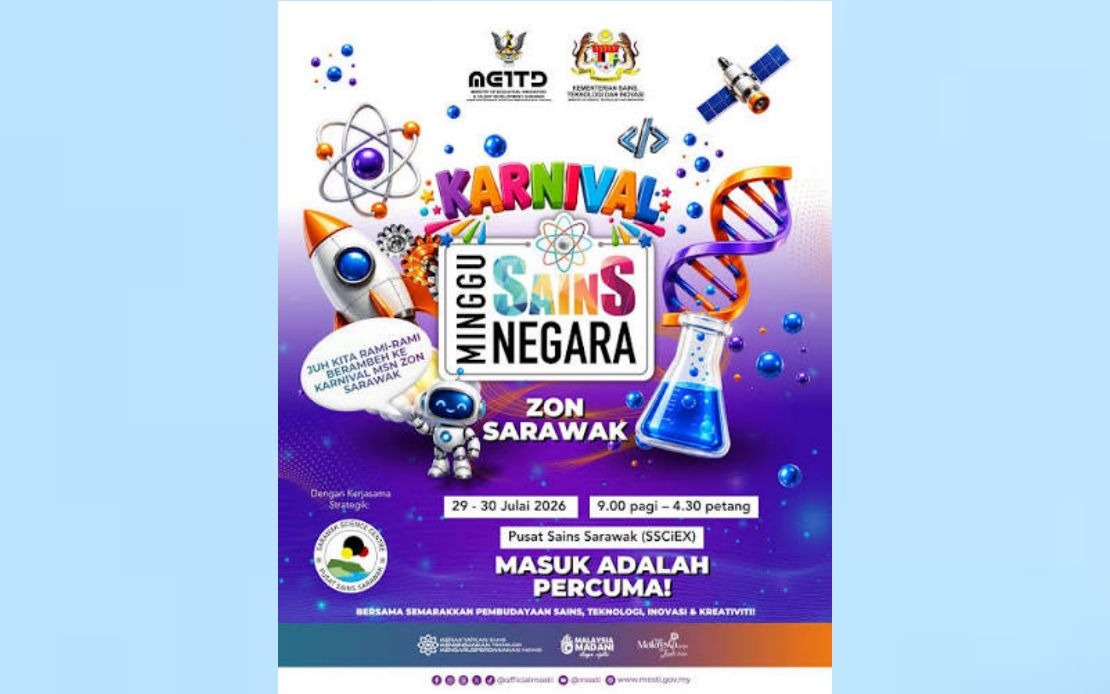
The Ministry of Science, Technology and Innovation formally inaugurated the National Science Week Carnival 2026 for Sarawak on July 30, with organisers emphasising their commitment to democratising access to scientific learning across the state's geographically dispersed population. The two-day physical carnival, hosted at the Sarawak Science Centre in Kuching and officially opened by Sarawak's Minister of Education, Innovation and Talent Development Datuk Seri Roland Sagah Wee Inn, represents a deliberate effort to ensure that communities beyond urban centres benefit from structured engagement with contemporary scientific advancement.
The initiative addresses a persistent challenge in Malaysia's science education landscape: the concentration of STEM resources, facilities, and programmes in metropolitan areas, leaving rural populations at a disadvantage in building technological literacy. By situating the carnival in Kuching but explicitly targeting outreach activities to interior districts, the ministry signals recognition that meaningful progress in science adoption requires intentional efforts to bridge geographical divides. This approach aligns with broader Malaysian development priorities centred on inclusive growth and equitable access to knowledge infrastructure.
According to MOSTI's secretary-general Datuk Dr Nagulendran Kangayatkarasu, the carnival functions as a cornerstone element of the government's strategy to cultivate sustained interest in science, technology, and innovation throughout society. His remarks during the launch ceremony positioned the event not merely as a showcase for existing scientific capabilities but as a foundational institution designed to reshape how Malaysians perceive and engage with STEM disciplines from early schooling onward. This framing suggests that policymakers view cultural transformation around science as equally important as technical skill development.
The STEM Catalysts Programme represents the practical mechanism through which the carnival will extend its reach into remote areas. School students in Meradong, Bintulu, and Belaga districts—all located in Sarawak's interior regions where educational infrastructure faces resource constraints—will participate in structured outreach activities designed to introduce scientific concepts through interactive, accessible formats. By targeting these specific localities, the ministry acknowledges that rural areas require tailored approaches that account for local circumstances, infrastructure limitations, and existing educational capacities.
A notable innovation introduced through the carnival involves nuclear technology advocacy, marking a significant shift in Malaysia's public engagement with atomic science. Historically, nuclear energy and technology have generated considerable public anxiety and scepticism across Southeast Asia, driven by safety concerns and limited understanding of regulatory frameworks. By integrating nuclear technology advocacy into a broader STEM celebration, rather than presenting it as a standalone initiative, the ministry attempts to normalise public discourse around atomic science and build confidence in its safe applications. This approach recognises that social acceptance of new technologies often depends on integrating them into familiar educational and cultural contexts.
Complementing the physical carnival, MOSTI launched the citizen science platform accessible through the sainsrakyat.my portal, an online infrastructure that democratises participation in research activities. This digital component proves particularly valuable for rural participants who may lack proximity to physical science facilities or trained facilitators. The platform's design explicitly invites contributions from all demographic segments, including rural communities, transforming members of traditionally peripheral populations into active participants in scientific inquiry. Rather than positioning scientific knowledge as something produced by experts and transmitted downward to communities, the citizen science model recognises that local observations and data collection constitute valuable scientific contributions.
The significance of this carnival extends beyond immediate educational outcomes to encompass Malaysia's longer-term positioning within the global knowledge economy. Countries competing effectively in high-value sectors increasingly depend on cultivating STEM talent and scientific literacy across their entire populations, not merely among urban or privileged cohorts. By investing in rural science engagement, Malaysia addresses both equity concerns and economic competitiveness imperatives. Southeast Asian nations face particular pressure to develop indigenous STEM capacity as they seek to reduce dependence on imported expertise and technology while navigating rapid technological change.
Sarawak's geographical characteristics—with significant portions of its territory being interior and sparsely populated—make it an ideal testing ground for innovative approaches to rural science education. The state's experiences implementing the carnival and related outreach activities will likely generate lessons applicable to other Malaysian states and potentially to other Southeast Asian contexts. The STEM Catalysts Programme's targeting of specific districts allows for systematic evaluation of what works in different rural settings, potentially informing future policy adjustments and resource allocation decisions.
The ministry's emphasis on breaking geographical barriers reflects acknowledgment that historical disparities in science education perpetuate themselves across generations. Students in rural areas who receive minimal exposure to STEM during schooling are less likely to pursue science-related careers, reducing the pool of scientific talent available to Malaysia's economy and limiting rural communities' capacity to adopt science-based solutions to local challenges. By intervening early through carnival activities and school-based programmes, the ministry attempts to disrupt this cycle and expand the universe of individuals who consider science as personally relevant and professionally viable.
Looking forward, the success of the Sarawak Zone carnival will likely depend on sustained engagement beyond the two-day event itself. Converting momentary enthusiasm generated during carnival activities into longer-term commitment to science education requires follow-up mechanisms, ongoing access to resources, and integration with school curricula. The citizen science platform represents one such mechanism, but effective implementation will require adequate digital infrastructure, teacher training, and institutional support at the school level. For rural Sarawak, these requirements present both practical challenges and opportunities for strengthening educational systems more broadly.

