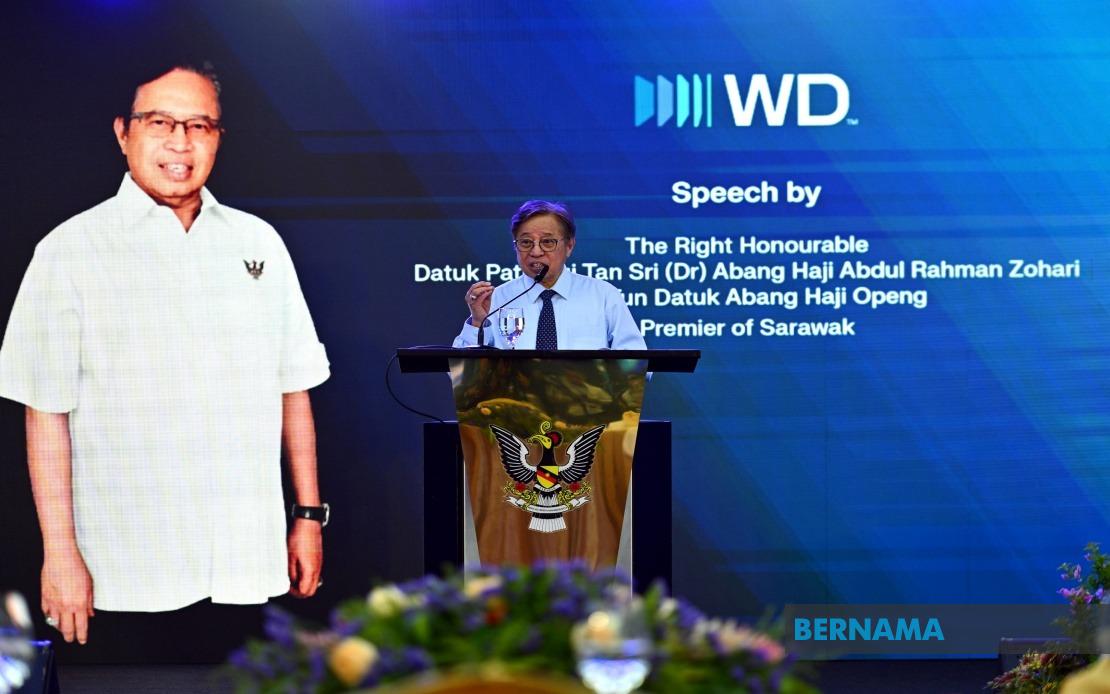
Sarawak's leadership has signalled receptiveness to a larger federal special grant, though such an arrangement hinges entirely on whether the federal government possesses sufficient fiscal room to accommodate the increase. Premier Tan Sri Abang Johari Tun Openg outlined this conditional stance after attending a technology initiative in Kuching, explaining that Sarawak's position remains pragmatic and dependent on Putrajaya's budgetary circumstances.
The premier's measured approach reflects the delicate balance required in discussions involving constitutional financial arrangements. Abang Johari articulated that while Sarawak would naturally welcome additional federal resources, the state government recognises the broader national economic context and the constraints faced by federal authorities in allocating funds. His framing—expressed as understanding rather than demanding—suggests Sarawak's negotiators are calibrating expectations against realistic fiscal projections.
Discussions regarding the special grant have remained at a conceptual stage thus far, according to the premier. The matter surfaced in general conversation during a recent engagement with Prime Minister Datuk Seri Anwar Ibrahim in Bintulu, but no detailed policy proposals or specific quantum increases have been formally tabled between the two administrations. This preliminary nature of talks indicates that any concrete arrangements remain months away from implementation.
On June 30, Prime Minister Anwar confirmed to parliament that negotiations concerning Sarawak's special grant continue in accordance with principles embedded in the Malaysia Agreement 1963, the foundational document governing Sarawak's constitutional relationship with the federation. His public acknowledgement of ongoing discussions signals that the matter retains political importance at the highest governmental levels, even as concrete progress moves slowly.
Article 112D of the Federal Constitution establishes the legal framework under which Sarawak receives special grants from the federal treasury. This provision, rooted in MA63, represents a historical compromise recognising Sarawak's distinct position within Malaysia and its particular developmental needs. Any adjustment to the quantum would require federal parliamentary approval and careful fiscal planning to ensure sustainability across multiple budget cycles.
Beyond the immediate grant discussion, Abang Johari used the occasion to highlight Sarawak's emerging technological economy. The state's three-decade partnership with Western Digital demonstrates how sustained investment in advanced manufacturing can position a region advantageously for future economic transformation. This collaboration centres on glass substrate-based data storage technology, representing cutting-edge innovation rather than commodity production.
Sarawak possesses distinctive competitive advantages that attract high-technology enterprises seeking manufacturing bases in Southeast Asia. Abundant hydroelectric and renewable energy resources provide cost-effective power for energy-intensive data centre operations, while plentiful water supplies enable the cooling systems essential for modern server facilities. These infrastructural assets position the state differently from competitors across the region and explain Western Digital's sustained commitment to Sarawak operations.
The premier's assertion that data will eclipse oil as Sarawak's most valuable future asset reflects a sophisticated understanding of long-term economic transition. This insight has profound implications for state planning. Rather than continuing dependence on fossil fuel extraction—an inherently finite and price-volatile resource—Sarawak seeks to establish itself as a data storage and processing hub serving Asia's rapidly expanding digital economy. The data storage industry, particularly glass substrate technology, requires substantial upfront capital but generates relatively stable returns through continuous demand.
Western Digital's glass substrate innovation represents a significant technological leap. This next-generation recording medium enables substantially higher data storage capacity per unit volume, a crucial advantage as artificial intelligence applications expand dramatically. The technology supports the exponential growth in data infrastructure required to power AI systems across banking, manufacturing, healthcare, and other sectors throughout Asia and globally. Sarawak's positioning as a manufacturing base for this technology places the state at the intersection of multiple growth trajectories.
Malaysia's broader economic diversification agenda intersects significantly with Sarawak's technological development. As federal policymakers grapple with reducing the nation's dependence on traditional sectors and volatile commodity prices, Sarawak's success in attracting high-value technology manufacturing serves national strategic objectives. Investments in advanced technology sectors create skilled employment, generate substantial tax revenue, and build export earnings from high-margin products rather than raw materials.
The timing of these discussions—occurring as the federal government manages inflation, exchange rate pressures, and post-pandemic fiscal consolidation—creates genuine uncertainty about the quantum of any increased grant. Federal finances remain constrained by multiple competing demands: infrastructure development across less-industrialised states, social safety nets, healthcare systems, and education provision. Any increment to Sarawak's allocation necessarily represents resources unavailable for other programmatic priorities.
Abang Johari's diplomatic framing sidesteps potential friction while keeping negotiations alive. By accepting conditionality rather than demanding unconditional increases, Sarawak's premier maintains goodwill with federal partners while preserving the state's ability to advocate for enhanced allocations once federal fiscal conditions improve. This approach recognises that effective governance of federal-state relations requires patience and strategic restraint alongside principled advocacy for regional interests.

