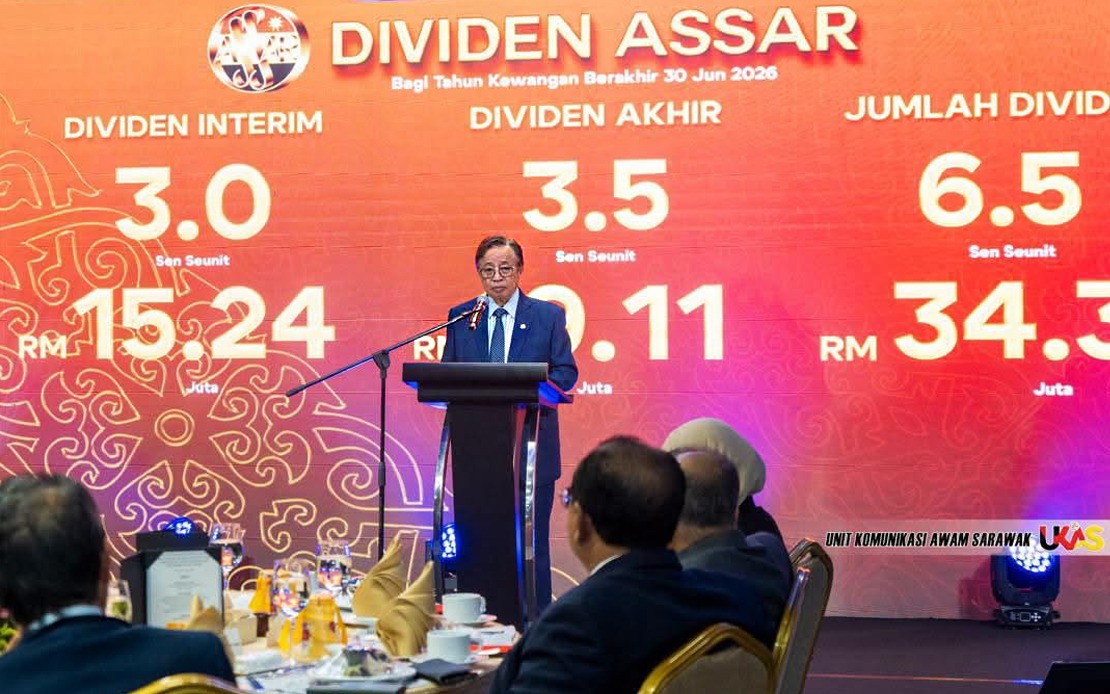
The Sarawak state government is actively exploring a significant policy shift that would democratise access to one of its flagship investment schemes by extending eligibility beyond the Bumiputera community. During the announcement of annual dividend distributions for Amanah Saham Sarawak (ASSAR) covering the financial year ending June 30, 2026, Sarawak Premier Tan Sri Abang Johari Tun Openg disclosed that the state is examining proposals to create a parallel fund structure, tentatively named ASSAR 2, that would welcome participation from non-Bumiputera Sarawakians seeking to invest in the state's growing economy.
The proposed expansion represents a departure from ASSAR's current operating framework, which has historically restricted participation to members of the Bumiputera community. Abang Johari emphasised that any modifications would require rigorous internal scrutiny, stating that the ASSAR board of directors and management team would evaluate the commercial and operational viability of such a move before proceeding. The premier indicated that organisers are drawing inspiration from comparable schemes operated by Permodalan Nasional Berhad (PNB), Malaysia's largest state-owned investment management firm, which manages multiple funds with varying eligibility criteria to serve different investor segments.
The underlying rationale for this potential initiative centres on broadening participation in Sarawak's economic development while maintaining investment discipline. By creating a dedicated vehicle for non-Bumiputera investors, the state government believes it could capture additional capital that would otherwise flow to investment vehicles outside Sarawak, thereby strengthening the state's capacity to fund development projects and business expansion. Abang Johari framed the proposal within the broader context of the state government's commitment to inclusive governance, suggesting that expanding investment opportunities across all ethnic communities aligns with contemporary thinking about equitable economic participation.
Sarawak's economic growth trajectory provides the backdrop for this policy consideration. The premier highlighted that the state economy is performing strongly, creating conditions favourable for attracting new capital from previously excluded investor categories. A widened investor base could potentially accelerate capital accumulation within state-backed investment vehicles, providing larger pools of funds for deployment across Sarawak's priority sectors including energy, infrastructure, and commercial development. This approach reflects a pragmatic acknowledgment that maximising available capital enhances the state's capacity to execute its development agenda.
The PNB model referenced by the premier demonstrates that parallel fund structures with distinct investor eligibility criteria can coexist successfully within a single institutional framework. PNB operates multiple funds targeting different demographic and professional groups, with each fund maintaining consistent governance standards while accommodating specific investor profiles. Should Sarawak adopt a comparable architecture, ASSAR 2 would function as a complementary mechanism rather than a replacement, enabling the original ASSAR to continue serving its traditional constituency while simultaneously opening pathways for non-Bumiputera citizens to build long-term savings through equity holdings in state-linked enterprises.
The timing of this announcement reflects evolving perspectives on affirmative action and inclusive economic development in Malaysia's federal system. While Bumiputera-focused investment instruments remain central to national policy, state governments increasingly recognise that excluding a substantial portion of their population from wealth-accumulation vehicles can represent untapped economic potential. Sarawak's consideration of ASSAR 2 positions the state as potentially pioneering a middle path that maintains historical commitments while acknowledging demographic realities and contemporary economic imperatives.
For Malaysian investors generally and Sarawakians specifically, such developments warrant close attention. The creation of ASSAR 2 would represent a tangible expansion of investment channels available to non-Bumiputera citizens, offering another avenue for retirement savings and wealth building aligned with state economic priorities. The scheme's performance metrics would likely influence how other state governments evaluate comparable proposals, potentially establishing a template for wider adoption across Malaysia's federal structure. Furthermore, enhanced participation in state-level investment vehicles could strengthen retail investor engagement with equity markets and foster greater understanding of capital markets dynamics among demographics historically underrepresented in direct equity ownership.
Operational considerations remain significant, particularly regarding fund management, performance benchmarking, and investor communication strategies. The ASSAR board must determine appropriate investment mandates for the proposed new vehicle, decide whether ASSAR 2 would maintain identical asset allocation strategies or pursue distinct investment approaches, and establish appropriate governance structures to ensure both funds operate with equivalent transparency and accountability standards. Additionally, marketing and distribution channels would require development to reach non-Bumiputera target audiences effectively, potentially requiring partnerships with financial advisors and investment platforms beyond traditional ASSAR distribution networks.
Regional implications extend beyond Sarawak's borders, as any successful implementation could influence investment policy discussions throughout Southeast Asia. Malaysia's federalised system creates space for policy experimentation at state level, and successful models in one jurisdiction often inspire emulation elsewhere. Should ASSAR 2 launch and demonstrate strong uptake and competitive returns, neighbouring states or federal-level policymakers might contemplate analogous structures for their respective investment schemes. This incremental opening of traditionally restricted schemes could gradually reshape Malaysia's investment landscape while maintaining foundational commitments to Bumiputera economic advancement.
The announcement reflects mature policymaking that recognises investment opportunities and affirmative action policies need not exist in zero-sum tension. Rather than framing Bumiputera privileges and non-Bumiputera inclusion as mutually exclusive propositions, the ASSAR 2 proposal attempts synthesis—maintaining the existing vehicle's original purpose while creating new capacity for previously excluded segments. This approach aligns with international best practices in social policy, where targeted interventions coexist with universal access frameworks, each addressing distinct needs within coherent overall strategies.
Moving forward, the critical question concerns execution timelines and governance design. Abang Johari's statement indicates no imminent implementation, with the proposal still in exploratory phases requiring board-level assessment. Industry observers and prospective investors should monitor ASSAR board proceedings and government announcements for progress updates. Should the proposal advance beyond preliminary review, detailed documentation of investment mandates, risk parameters, and expected performance benchmarks will become essential for investor decision-making. The eventual outcome of these deliberations will signal Sarawak's commitment to gradual economic inclusion while preserving structured support for its Bumiputera constituency.

