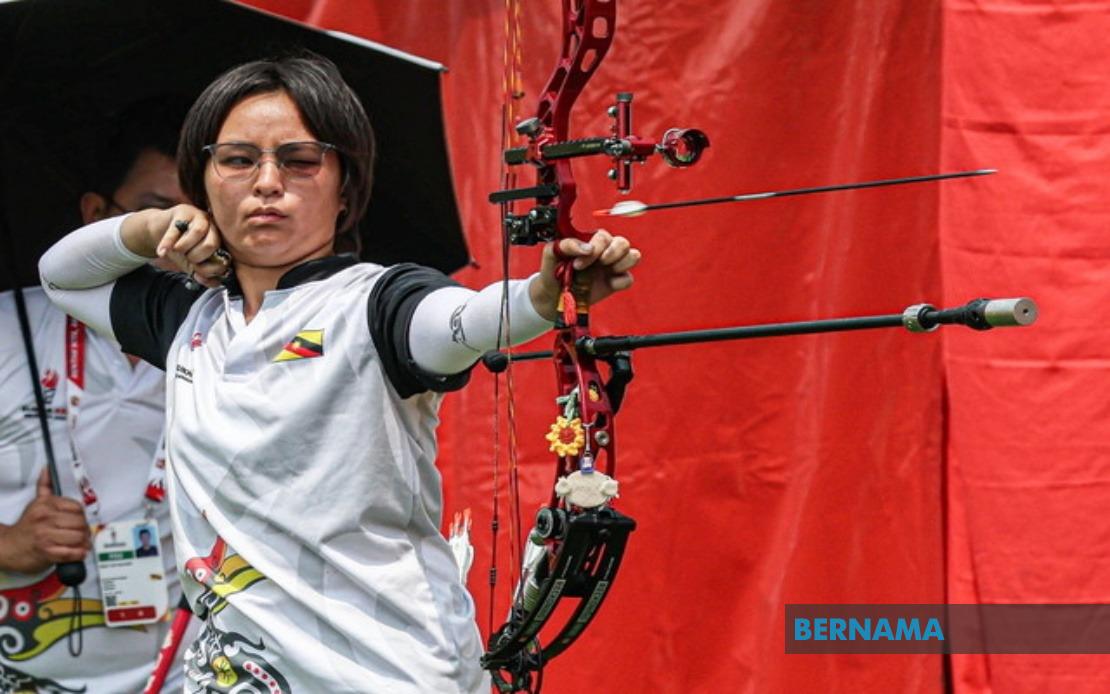
Wee Yee Qi's bold tactical decision to abandon recurve archery and embrace the compound discipline is already bearing fruit at the 2026 Malaysia Games. The 17-year-old from Miri produced a standout performance at her inaugural SUKMA competition, securing dual gold medals that underscore Sarawak's emerging strength in the sport and hint at the teenager's potential trajectory within Malaysian athletics.
Yee Qi's first success came in the mixed team category, where she partnered with Eason Lau Hui Wan to overcome Kedah's pairing of Muhammad Zaim Ahmad and Ili Nabihan Shafizan with a tightly contested 151-150 scoreline. The narrow victory demonstrated both composure under pressure and technical precision, qualities essential in elite archery competition where margins of victory often hinge on single-digit point differentials.
The Sarawak contingent's momentum continued when Yee Qi joined teammates Aira Nadirah Aizuddin and Nur Zara Aisyah Khairul Fadly in the women's team competition, clinching another gold medal after a resilient performance against Terengganu. The final scoreline of 217-213 reflected an athletic encounter that remained competitive throughout, though Sarawak's trio demonstrated particular grit by executing a comeback during the decisive final end after finding themselves in deficit through the opening three rounds. Their opponents—Airazalia Azrai, Nur Shafiena Mohd Shuhamri, and Putri Aqiera Issandra Ismayuddin—mounted a credible challenge but ultimately fell short as Sarawak's composure proved decisive.
Following her victories at the National Institute of Valuation stadium complex in Bangi, Yee Qi expressed gratitude towards her coaching staff, crediting their guidance and extensive competitive exposure as instrumental in her development. She reflected on her six-year archery journey, tracing her entry into the sport to a talent identification initiative at her school before her natural aptitude crystallised into genuine passion. This trajectory mirrors successful athlete development pathways across Southeast Asia, where grassroots identification programmes frequently unearth diamond-in-the-rough talents capable of representing their nations internationally.
The transition from recurve to compound represented a calculated pivot rather than impulsive change. Yee Qi explained that she had struggled to achieve meaningful breakthroughs within the recurve category before recognising that the compound discipline better suited her technical strengths and competitive temperament. This willingness to reassess and adapt—often psychologically challenging for young athletes invested in a particular methodology—suggests maturity beyond her years and coaches capable of objective evaluation regarding athlete development pathways.
Yee Qi's immediate future will necessarily shift focus towards her Sijil Pelajaran Malaysia examinations scheduled for November, reflecting the Malaysian education system's emphasis on academic achievement alongside sporting development. This balance between scholarly and athletic pursuits remains a defining characteristic of Malaysian talent development, contrasting with single-minded specialisation common in other sporting nations. Following completion of her secondary education, she indicated intention to channel renewed energy towards archery with aspirations of representing Malaysia at international competitions.
Beyond Yee Qi's individual achievements, Sarawak's broader performance at SUKMA 2026 archery events demonstrates the state's commitment to nurturing competitive talent across multiple disciplines. Borneo's largest state has increasingly invested in sports infrastructure and coaching personnel, positioning itself as an emerging athletic powerhouse within the federation. Such development carries implications for regional competitive balance within Malaysian sports, potentially reshaping medal distributions at future Games.
Selangor, Malaysia's industrial heartland, claimed supplementary medals through Muhammad A'rif A'fiq Suhaimi and Nur Alyaa Nazurah Fadzil Fairuz, who secured bronze in the mixed team event after defeating Sabah's pairing of Hiew Ichin and Catherine Looi Mei Qi Abdullah 154-152. The Selangor women's combination of Amira Batrisyia Mohamad Azizul Rahman, Nur Alya Sofrina Mohd Sarif, and Nur Alyaa Nazurah Fadzil Fairuz similarly garnered bronze in their respective category, edging opponents 219-212 in a closely contested match that underscored competitive depth across Malaysian archery.
The compound archery results at SUKMA 2026 reflect broader strategic evolution within Asian archery, where compound disciplines increasingly compete with traditional recurve for talent and resources. Malaysia's embrace of compound archery, demonstrated through Yee Qi's success and medal placements across categories, positions the nation competitively within regional and international contexts where both disciplines command substantial participation and investment. For Malaysian sports administrators, the emergence of performers like Yee Qi reinforces archery's potential as a medal-generating sport capable of supporting broader national athletics development objectives.

