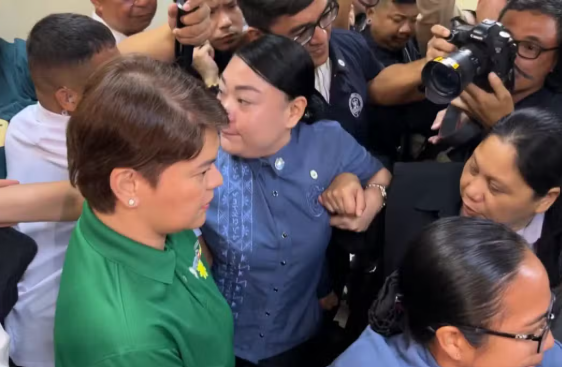
Vice President Sara Duterte has intensified her rhetoric around her ongoing impeachment proceedings, declaring on Tuesday that she will weather the political storm despite the severity of charges against her. Upon arriving at the Senate for discussions with her legal team, she characterised her trial as a "bloodbath" and vowed to emerge bruised but unbroken—a reference that echoes the Victorian poem "Invictus" by William Ernest Henley, which celebrates human resilience in the face of overwhelming adversity. The Vice President's combative framing of her legal ordeal reflects a strategy of positioning herself as a victim of political persecution rather than accepting the gravity of the allegations before her.
Duterte's latest comments represent a continuation of her inflammatory language surrounding the trial, which she first introduced in May 2025 when she explicitly stated her desire for the impeachment process to unfold as a "bloodbath." That initial pronouncement sparked considerable debate among political observers and critics, who questioned whether such language was appropriate for a sitting Vice President facing removal from office. Her continued use of martial metaphors to describe judicial proceedings has become a defining feature of her defence strategy, though it remains controversial within Philippine political circles and among legal commentators who argue that impeachment trials should be treated with appropriate solemnity.
The Vice President's conspicuous absence from most House impeachment proceedings in both 2025 and 2026 stands in marked contrast to her combative public statements. This pattern of boycotting hearings while simultaneously using inflammatory rhetoric has drawn criticism from supporters of the impeachment effort, who contend that her non-attendance undermines her credibility and suggests she is unwilling to directly address the substantive allegations arrayed against her. Political analysts have interpreted this strategy as an attempt to maintain her political narrative outside the courtroom while avoiding direct confrontation with evidence presented during formal proceedings.
The charges Duterte faces are extensive and multifaceted, encompassing four Articles of Impeachment that cover distinct areas of alleged misconduct. The first article alleges serious misappropriation of public funds, specifically accusing her of misusing P612.5 million in confidential allocations from her office alongside P112.5 million from the Department of Education. These figures represent substantial sums by Philippine standards, and the allegations strike at the heart of accountability for executive spending. Such charges carry particular weight in a nation where public fiscal management has long been a subject of intense political scrutiny and where concerns about executive discretionary spending remain deeply embedded in public consciousness.
Beyond the financial allegations, the second article targets what prosecutors characterise as unexplained wealth accumulation and deliberate misstatement of assets in her Statements of Assets, Liabilities and Net Worth across a three-year period from 2022 to 2024. These allegations suggest not merely careless accounting but potentially deliberate concealment of financial interests. The charge also includes accusations that she failed to divest from business interests as required by law, indicating an alleged pattern of regulatory non-compliance that extends over multiple years. Such accusations, if proven, would indicate systemic flouting of transparency requirements meant to prevent conflicts of interest among high government officials.
The third article introduces allegations of bribery and procurement irregularities connected to Department of Education officials, suggesting potential criminal coordination between the Vice President's office and government functionaries. This charge introduces an element of alleged corruption beyond mere financial mismanagement, implying quid pro quo arrangements that would constitute criminal activity under Philippine law. The involvement of education officials adds another dimension, as it potentially affects procurement decisions related to student welfare and institutional resources.
Perhaps most gravely, the fourth article alleges that Duterte made assassination threats against President Ferdinand Marcos Jr., First Lady Liza Araneta-Marcos, and former House Speaker Martin Romualdez. This charge transcends typical impeachment matters and enters territory that could carry implications beyond removal from office. Such allegations, if substantiated, would represent threats to national security and the safety of senior government figures, making them among the most serious charges any sitting official could face within a constitutional framework.
The procedural timeline for this trial underscores the magnitude of the undertaking. Legal observers anticipate the proceedings will consume approximately 92 days of Senate time, potentially extending into early 2027 depending on the pace of testimony and deliberations. This extended timeline reflects both the complexity of the allegations and the constitutional requirement that conviction demands a two-thirds supermajority vote among senator-judges under the 1987 Constitution. The high bar for conviction—requiring 16 affirmative votes from the 24-member Senate sitting as an impeachment court—means that acquittal requires only the defection of nine senators from any potential pro-conviction coalition, a mathematical reality that shapes political calculations throughout the trial.
For Malaysian observers and Southeast Asian analysts tracking Philippine politics, Duterte's impeachment represents a critical test of whether institutional mechanisms designed to check executive power can function effectively even when targeted against high-profile political figures. The trial also illuminates broader questions about accountability, transparency, and the willingness of legislative bodies to enforce constitutional standards against members of their own political ecosystem. The outcome will likely influence how other Southeast Asian democracies evaluate their own impeachment provisions and the robustness of their checks-and-balances systems.
Duterte's invocation of Henley's "Invictus" reveals her understanding of the narrative battle surrounding her trial. By positioning herself as an unconquerable victim of political onslaught, she seeks to transform her legal jeopardy into a morality play about resilience and defiance. However, this narrative strategy may prove insufficient to address the factual substance of the allegations, particularly those involving specific sums of money and documented assets. The coming months will determine whether rhetorical flourish can withstand forensic examination of financial records and witness testimony.
The impeachment proceedings also reflect deeper fractures within Philippine political elite networks. Duterte's defiant posture and her willingness to challenge both legislative and executive branches simultaneously suggests a political operator unwilling to accept diminished status or institutional constraints on her authority. Her supporters interpret her combativeness as evidence of principled resistance to political persecution, while critics view it as the behaviour of an official contemptuous of democratic accountability. This fundamental disagreement about whether the impeachment represents legitimate constitutional governance or politically motivated vendetta will persist throughout the trial and likely shape its political consequences regardless of its legal outcome.

