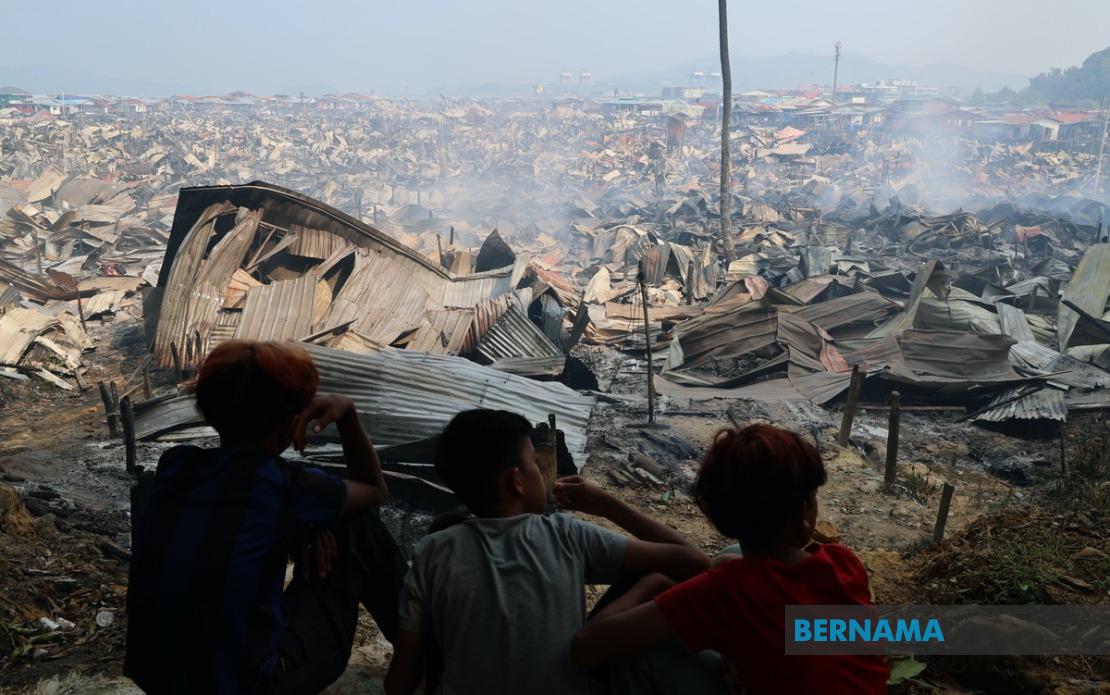
The Sabah government will distribute RM3,000 in emergency assistance to each Malaysian head of household impacted by a devastating fire in Kampung Lok Buta, Numbak, which consumed more than 200 residential structures in the early hours of the morning. The catastrophic blaze claimed the lives of three young children—Nana Abdullah aged four, her six-year-old brother Mohd Asrul, and their eight-year-old cousin Nurfarahdilah Mohd Tajihah—leaving the community reeling from both the physical destruction and profound human loss.
Chief Minister Datuk Seri Hajiji Noor announced the relief package after visiting survivors sheltering at the Likas Multipurpose Hall temporary relief centre. The RM3,000 allocation represents a coordinated effort involving three sources: the Sabah state government, the federal government, and the Yayasan Kebajikan Sabah, each contributing RM1,000 per affected household. This tri-partite approach underscores the severity of the situation and the determination of authorities across different administrative levels to respond swiftly to the crisis.
Beyond the immediate financial assistance, the state government has committed to a more comprehensive rehabilitation programme. The State Secretary's Office and Majlis Amanah Rakyat have been tasked with coordinating reconstruction efforts for affected households. However, officials have signalled that decisions regarding whether homes will be rebuilt at the original Kampung Lok Buta location or relocated elsewhere will depend on assessments of land suitability and environmental factors. This measured approach, while necessary for long-term community stability, also raises questions about displacement and whether residents will have genuine agency in choosing their new homes.
In a gesture aimed at extending relief across the community regardless of citizenship status, the state government will also provide RM1,000 to each non-Malaysian head of household affected by the fire. This inclusive stance reflects recognition that many undocumented workers and migrants live in such informal settlements and would otherwise be excluded from assistance programmes. The decision to include non-citizens, while commendable on humanitarian grounds, also highlights the complex demographic realities of informal urban settlements in Malaysian cities, where vulnerable migrant populations often bear disproportionate risk in such disasters.
Immediate relief operations have been mobilised to address basic needs. Authorities are distributing food supplies and essential household items to displaced families as they begin processing their circumstances and contemplating next steps. The provision of such necessities is crucial in the aftermath of a catastrophe that has left hundreds without shelter, possessions, or stability. For many families in Kampung Lok Buta—typically low-income households already living on narrow economic margins—the sudden loss represents not merely a temporary inconvenience but a potential threat to their economic viability and social standing.
The fire itself erupted at approximately 1:40 am, a timing that likely contributed to the high casualty rate and rapid spread through the densely packed residential structures typical of informal settlements. The loss of three children has particularly shocked the nation, underscoring broader safety concerns in unplanned communities where fire prevention infrastructure and emergency response protocols are often inadequate. The incident raises pressing questions about building codes, fire safety standards, and whether informal settlements receive sufficient attention from municipal safety authorities.
Kampung Lok Buta's experience reflects broader vulnerabilities affecting similar communities throughout Malaysia and Southeast Asia. Informal settlements, while providing affordable housing for low-income migrants and citizens alike, typically lack modern fire suppression systems, adequate emergency exits, and proper building separation. Residents in such areas often occupy wooden or temporary structures in close proximity, creating conditions where a single ignition source can rapidly escalate into a community-wide catastrophe. The destruction of over 200 homes in a single incident illustrates how quickly disaster can unfold when structural and regulatory safeguards are insufficient.
From a policy perspective, this incident should catalyse broader discussions about urban planning, informal settlement regularisation, and whether Malaysia's rapid urbanisation has outpaced the capacity of local authorities to ensure resident safety. While emergency relief and reconstruction assistance are essential immediate responses, longer-term strategies must address the root vulnerabilities that make such communities susceptible to rapid-spreading disasters. This includes deliberate engagement with residents about safety measures, upgrading informal settlements with improved infrastructure, and potentially facilitating planned relocation to safer, better-serviced housing environments.
The reconstruction phase will be instructive in observing how effectively authorities coordinate across levels of government and whether residents genuinely have input into their future living arrangements. Previous disaster recovery efforts in Malaysia have sometimes resulted in communities being relocated to distant areas, creating additional hardship as residents lose proximity to employment and social networks. The Sabah government's commitment to involving the State Secretary's Office and MARA suggests a structured approach, though transparency regarding timelines, beneficiary selection, and relocation criteria will be essential for maintaining public confidence.
The psychological trauma accompanying such events extends beyond material loss. Families who lost children, homes, and possessions simultaneously face complex grieving processes while navigating bureaucratic recovery procedures. Community leaders and social services must complement financial assistance with mental health support and counselling services tailored to survivors' needs. The experience of losing a home overnight, coupled with the loss of loved ones, creates deep psychological scars that financial compensation alone cannot heal.

