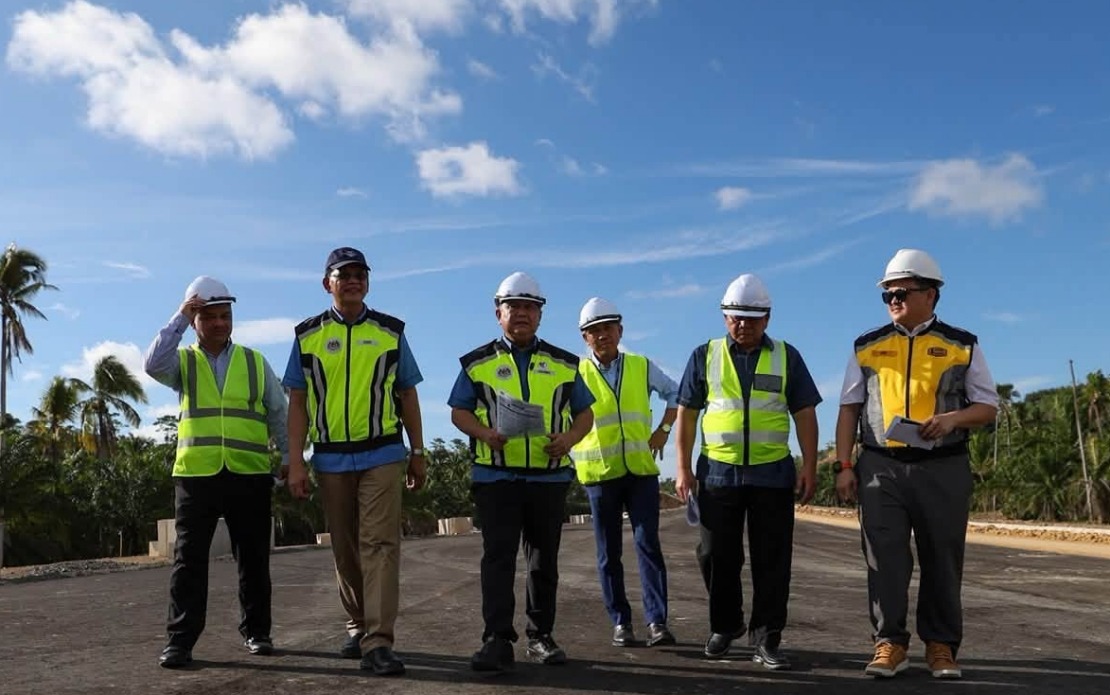
The contractor responsible for constructing Work Package 11 of the Pan Borneo Highway in Sabah has formally submitted a recovery plan intended to mitigate construction delays that have accumulated to 32 days so far. Works Minister Datuk Seri Alexander Nanta Linggi announced the submission, emphasising the government's commitment to keeping the RM167.48 million project on track for completion by September 29, 2026. The recovery strategy represents a coordinated effort among multiple government and private entities to address the various obstacles that have slowed progress on this critical infrastructure initiative.
The 7.3-kilometre alignment forming Phase 1B of the Rampayan Laut-Sarang section had reached 61.76 per cent physical completion as of late June, but this progress trails the original schedule by 4.35 per cent. The recovery plan aims to narrow this gap to just 14 days by August 2026, demonstrating confidence that the project can substantially recover lost ground through focused implementation efforts over the coming months. The Works Ministry, together with the Sabah Public Works Department, project consultants, and the contractor, will conduct close oversight of the recovery timeline to ensure execution meets the agreed milestones.
The primary impediments to maintaining the original construction schedule stem from complications surrounding utility relocation work. Multiple service providers—including Sabah Electricity Sdn Bhd, the Sabah State Water Department, and Celcom Timur Sabah Sdn Bhd—must coordinate with the main contractor to relocate their respective infrastructure away from the highway alignment. Such parallel operations invariably create bottlenecks when communication breaks down or when work sequencing proves suboptimal. Additionally, land acquisition challenges have compounded the situation, as securing necessary rights-of-way has taken longer than anticipated. The minister stressed that enhanced coordination among all stakeholders represents the most viable pathway to accelerating progress on the remaining works.
Beyond the immediate construction logistics, the Pan Borneo Highway initiative carries substantial strategic significance for Sabah's development trajectory. The Rampayan Laut-Sarang alignment will establish a safer and considerably more efficient transportation corridor through one of Sabah's less developed regions. By reducing travel distances to key destinations such as Simpang Mengayau and Kudat by approximately 30 kilometres, the improved route promises journey time savings of between 30 and 60 minutes for regular users. For rural communities and commercial operators currently reliant on longer, more circuitous routes, these efficiency gains translate into tangible economic benefits and reduced operational expenses.
The highway's completion will also unlock significant tourism potential across northern Sabah. The Northern Sabah Coastal Tourism Master Plan has long identified improved transportation connectivity as essential infrastructure underpinning regional development in this strategically important area. Better road access will enable visitors to explore the Tourism Belt more easily, potentially catalysing investment in hospitality, retail, and leisure facilities throughout the corridor. Local communities positioned along the improved route stand to benefit from increased commercial activity, employment opportunities created by new businesses serving the tourism sector, and enhanced market access for agricultural and artisanal products.
The broader economic implications extend beyond tourism to encompass general investment climate improvements. Enhanced infrastructure connectivity typically signals to potential investors that a region possesses the foundational systems necessary for successful business operations. The Pan Borneo Highway's progression through Sabah contributes to an increasingly integrated transport network that reduces logistics costs and improves supply chain reliability across the state. Manufacturing enterprises, agricultural processors, and trading companies all benefit from faster, more dependable connections to ports, markets, and distribution centres.
Minister Nanta's public commitment to delivering the project "to the highest standards of quality, safety and integrity" reflects broader government priorities regarding infrastructure development. Beyond merely completing projects on schedule, contemporary standards demand that construction meets rigorous quality benchmarks and incorporates robust safety protocols protecting workers and future users alike. The minister's emphasis on these dimensions suggests awareness that successful development requires balancing the urgency of completion against the imperative to construct durable, reliable infrastructure capable of serving Sabah's population effectively for decades.
The recovery plan's submission represents a transition from identifying problems to implementing solutions. The Works Ministry's monitoring framework seeks to prevent further slippage while systematically recapturing lost progress. Success will depend heavily on whether the identified utility relocation and land acquisition challenges can be resolved more expeditiously than circumstances have permitted thus far. Government agencies and private service providers must operate with unusual coordination and flexibility to compress timelines without compromising the quality or safety standards that the minister has publicly championed.
For Malaysian observers tracking major infrastructure development, the Pan Borneo Highway project exemplifies both the complexity and importance of large-scale transportation initiatives in less-densely populated regions. While delays have emerged—a reality in virtually all major construction projects—the formal recovery plan demonstrates institutional capacity to identify problems, propose solutions, and mobilise resources toward course correction. The 14-day reduction target by August 2026 provides a measurable checkpoint against which progress can be evaluated. Should the contractor successfully execute this recovery plan, it would demonstrate that even significant delays can be substantially overcome through coordinated effort and sustained attention from multiple stakeholders working toward a common completion objective.

