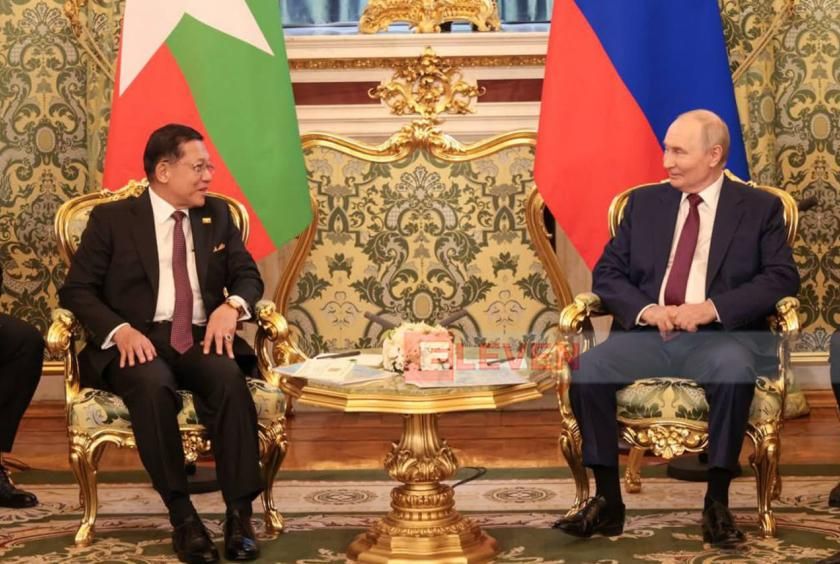
Russia has moved to broaden its strategic partnership with Myanmar by pledging comprehensive support for the nation's energy infrastructure and natural resource development. During discussions with Myanmar President U Min Aung Hlaing on August 18, Russian President Vladimir Putin outlined Moscow's commitment to exploring offshore petroleum reserves and developing alternative energy sources that could reshape Myanmar's economic landscape and regional energy dynamics.
The energy sector stands at the forefront of the expanded Russia-Myanmar relationship. Putin specifically highlighted Russia's willingness to partner on natural gas extraction, including ambitious offshore drilling programmes that could unlock significant reserves in the Andaman Sea and surrounding waters. Beyond extraction, Putin suggested that Russia could supply liquefied natural gas to Myanmar, with the possibility of Myanmar re-exporting supplies to neighbouring countries—a proposition that carries substantial implications for Southeast Asian energy markets and Myanmar's potential role as a regional hub.
The nuclear energy dimension represents perhaps the most consequential element of Russian involvement in Myanmar's development trajectory. Putin referenced a nuclear power plant agreement signed in the previous year, positioning atomic energy as a flagship project for bilateral cooperation. This development signals Myanmar's intent to diversify beyond hydropower and gas-fired generation, though it also raises questions about nuclear safety oversight, waste management frameworks, and the geopolitical dimensions of Russian technology transfer in a strategically sensitive region.
Beyond energy, Russia's ambitions in Myanmar span industrial manufacturing and transportation infrastructure. Putin outlined plans for steel and fertiliser production facilities already under construction, alongside discussions regarding a deep-sea port in southern Myanmar—a project with evident strategic implications for maritime access and regional trade patterns. These initiatives reflect Russia's broader strategy to embed itself within Myanmar's economic architecture during a period when the nation's international isolation following the 2021 military coup has created openings for alternative partnerships.
The historical foundation underpinning modern Russia-Myanmar relations traces back decades. Putin emphasised Soviet-era contributions including hospitals, universities, and broader developmental assistance provided throughout the 1950s and 1960s, establishing Moscow as a longstanding partner distinct from Western nations. This historical narrative serves as diplomatic ballast, positioning contemporary cooperation within a continuum of mutual support rather than opportunistic engagement.
People-to-people exchanges and cultural development complement the transactional dimensions of bilateral ties. Putin highlighted the visa-free travel arrangement facilitating scientific, educational, and cultural movement between nations. Approximately 400 Myanmar students currently study at Russian universities, while 17,000 former Myanmar students have graduated from Russian institutions—figures suggesting significant intellectual and professional networks spanning both societies. The establishment of Myanmar cultural centres in Russian cities and plans for a Russian Orthodox Christian church in Yangon underscore efforts to embed cultural connections within the formal state relationship.
Educational cooperation extends to language acquisition. Russian instruction at universities in Yangon and Mandalay, plus inclusion within military academy curricula, indicates systematic efforts to cultivate Russian-language proficiency among Myanmar's emerging leadership cohorts. This investment in linguistic capabilities facilitates easier technology transfer, military coordination, and broader strategic communication—dimensions that transcend simple cultural exchange.
Military-technical cooperation remains a cornerstone of the partnership, with Putin noting regular joint exercises in Myanmar waters and frequent visits by Russian naval vessels. These activities underscore Moscow's interest in maintaining naval presence and operational familiarity within Southeast Asian waters—a consideration relevant to broader regional security dynamics and great power competition in the Indian Ocean and beyond.
The diplomatic architecture supporting these initiatives expanded during the visit through 12 memorandums of understanding covering diverse sectors. These agreements presumably detail implementation mechanisms, financial arrangements, and accountability frameworks for the ambitious projects outlined. However, their specific contents remained undisclosed, preventing detailed analysis of concrete commitments versus aspirational declarations.
For Malaysia and Southeast Asia more broadly, the Russia-Myanmar energy partnership carries several implications. Should Myanmar develop significant offshore hydrocarbon production with Russian technological and financial support, regional energy markets could experience supply fluctuations. Additionally, deepened Russian involvement in Myanmar's strategic sectors—particularly ports and potentially naval facilities—introduces another external power with interests in regional geopolitics during a period of intensifying great power competition.
Myanmar's strategic position between China, India, and Southeast Asia renders it a crucial arena for competing international influences. Russia's willingness to invest across energy, infrastructure, and security domains reflects recognition of Myanmar's geopolitical significance. For Malaysian policymakers, understanding the contours of Russia-Myanmar cooperation provides essential context for regional developments, particularly regarding maritime security, energy supply chains, and the broader configuration of external power involvement in Southeast Asia.
The timing of this expanded cooperation reflects Myanmar's constrained international circumstances following the military coup. Western nations have imposed sanctions and diplomatic restrictions, creating space for alternative partnerships with Russia, China, and other non-Western powers. Russia's energy and infrastructure offerings provide Myanmar's military leadership with development pathways less encumbered by democracy and human rights conditionality—a dynamic that simultaneously deepens Myanmar's strategic dependence on Moscow and complicates regional stability calculations.

