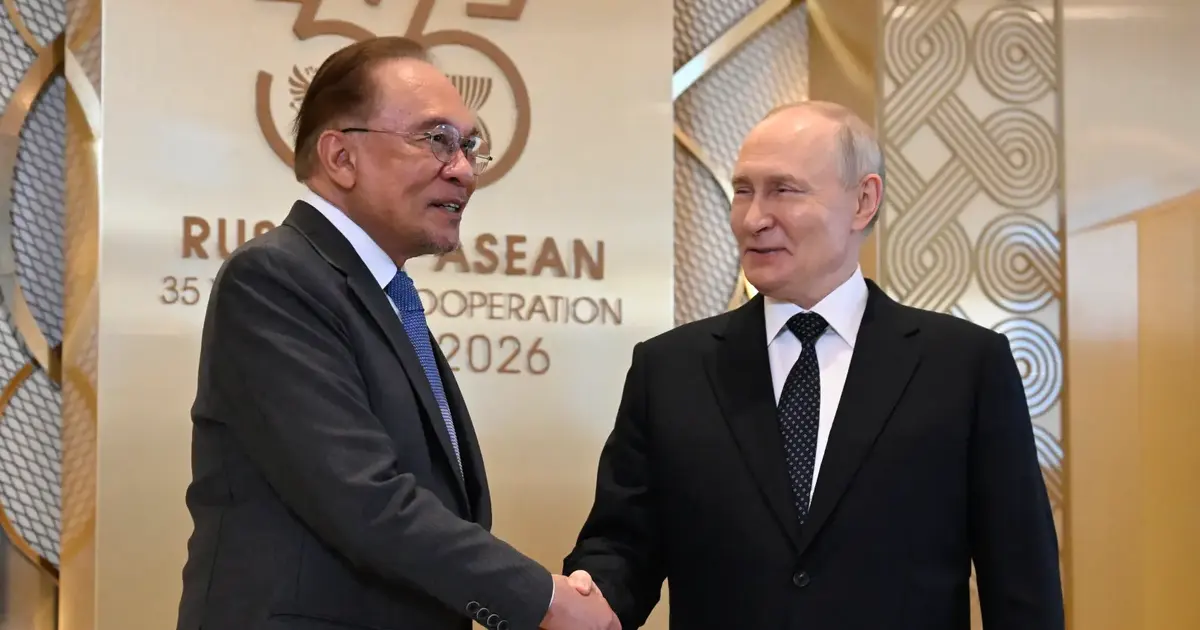
Prime Minister Anwar Ibrahim has confirmed that Russia under President Putin has pledged a stable, long-term supply of oil and gas to Malaysia extending across the next two decades, marking a significant development in the country's energy security strategy at a time when global fuel markets remain volatile and supply chains face continued uncertainty.
The assurance represents a substantial hedge against the energy price volatility that has affected Malaysian manufacturers and consumers over recent years. By locking in predictable hydrocarbon supplies from Russia, Malaysia gains insulation from sudden market shocks that have periodically disrupted economic activity across the region. The commitment underscores deepening bilateral relations between Kuala Lumpur and Moscow, particularly as Western nations have imposed sanctions and restrictions on Russian energy exports following geopolitical tensions.
For Malaysia's energy-intensive industries—from petrochemicals and refining to manufacturing and power generation—predictable access to Russian crude and natural gas offers operational certainty crucial for investment planning and competitiveness. The pharmaceutical, automotive, and electronics sectors, which collectively employ hundreds of thousands of workers, depend on stable energy pricing to maintain export competitiveness against regional competitors in Thailand, Vietnam, and Indonesia.
Anwar's diplomatic engagements extend beyond securing energy supplies. The Prime Minister has indicated that his regional visit itinerary, including Turkmenistan, forms part of a broader strategy to strengthen Malaysia's trade position in major East Asian markets. Access to Central Asian energy resources and transit routes could enhance Malaysia's role as a trade intermediary and logistics hub connecting resource-rich former Soviet republics with the manufacturing and consumption centres of China, Japan, and South Korea.
China's insatiable appetite for energy has reshaped global commodity flows over the past two decades. By positioning Malaysia as a reliable distribution and services partner for energy trading and logistics, the government can capture economic value beyond simple commodity purchases. Japanese and South Korean industrial conglomerates maintain substantial operations in Malaysia's industrial zones; securing stable energy supplies strengthens the investment proposition for these manufacturing bases.
The timing of these diplomatic overtures reflects Malaysia's pragmatic approach to energy diplomacy. Rather than adhering strictly to Western-aligned positions on energy sourcing, Kuala Lumpur pursues diversified partnerships that serve national economic interests. This strategy parallels Malaysia's historical balancing act between major powers, maintaining constructive relationships across geopolitical blocs while prioritizing domestic prosperity.
Turkmenistan's inclusion in Anwar's itinerary signals recognition of Central Asia's significance to Malaysia's broader regional strategy. Turkmenistan possesses substantial natural gas reserves and serves as a crucial transit point for resources flowing toward Asia. Building relationships with Ashgabat opens pathways for Malaysian businesses to participate in energy infrastructure development, service provision, and downstream industrial projects throughout the region.
For Malaysian businesses engaged in petroleum services, engineering, construction, and logistics, expanded engagement with Russian and Central Asian energy sectors creates commercial opportunities. Malaysian firms have historically competed successfully in Middle Eastern energy projects; similar competitive advantages could apply across Russian and Central Asian operations, particularly given Malaysia's reputation for cost-effectiveness and technical capability in tropical and challenging environments.
The 20-year supply commitment also carries implications for Malaysia's energy transition trajectory. While securing hydrocarbon supplies, policymakers must simultaneously advance renewable energy and efficiency investments to meet long-term sustainability commitments. The Russian guarantee should not substitute for renewable energy development but rather provide breathing room for Malaysia to transition to cleaner sources while maintaining industrial competitiveness and employment in energy-dependent sectors.
Regionally, Malaysia's energy diplomacy influences the broader Southeast Asian energy landscape. As ASEAN's second-largest economy, Malaysian decisions regarding energy partnerships set precedents and establish patterns of engagement that smaller neighbours observe carefully. Strengthening ties with non-Western energy suppliers while maintaining relationships with traditional partners demonstrates the diversification approach that smaller nations increasingly adopt when navigating great power competition.
The geopolitical context underlying these energy negotiations cannot be overlooked. Western restrictions on Russian energy have created opportunities for non-aligned nations to secure advantageous terms. Malaysia's willingness to engage with Moscow potentially positions it to negotiate favourable pricing and supply terms compared to Western competitors facing diplomatic complications. This strategic flexibility has historically characterized successful Malaysian statecraft.
Moving forward, execution of these commitments requires establishing institutional frameworks for regular supply management, payment mechanisms that navigate international sanctions complexities, and operational partnerships between Malaysian and Russian energy companies. The private sector must develop expertise in managing long-distance energy logistics while government agencies establish regulatory pathways for integrating Russian supplies into Malaysia's energy infrastructure.
The 20-year horizon suggests both parties anticipate sustained demand and stable bilateral relations. For Malaysia, securing energy certainty supports economic planning across multiple sectors while broadening diplomatic options in an increasingly multipolar international system. The announcement reflects pragmatic energy statecraft aimed at protecting national interests amid shifting global alignments.
%22%2F%3E%3C%2Fpattern%3E%3C%2Fdefs%3E%3Crect%20width%3D%22100%25%22%20height%3D%22100%25%22%20fill%3D%22url(%23ph14rfdg)%22%2F%3E%3Crect%20width%3D%22100%25%22%20height%3D%22100%25%22%20fill%3D%22url(%23ph14rfdp)%22%2F%3E%3Ctext%20x%3D%2250%25%22%20y%3D%2250%25%22%20text-anchor%3D%22middle%22%20dominant-baseline%3D%22central%22%20fill%3D%22rgba(255%2C255%2C255%2C0.95)%22%20font-family%3D%22Georgia%2C%20'Times%20New%20Roman'%2C%20serif%22%20font-weight%3D%22700%22%20font-size%3D%22272%22%20letter-spacing%3D%22-0.02em%22%3EAnwar%3C%2Ftext%3E%3C%2Fsvg%3E)