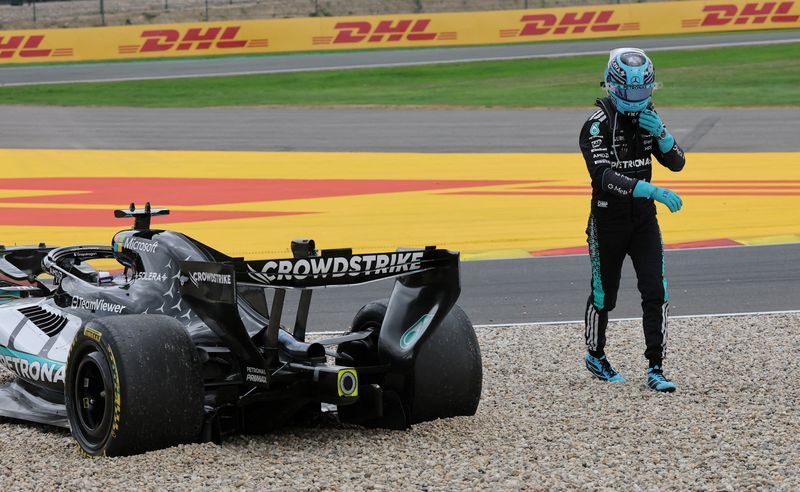
George Russell's campaign to challenge for the Formula One world championship suffered a significant setback at Spa-Francorchamps on Sunday when the Mercedes driver collided with Lewis Hamilton's Ferrari on the opening lap and spun into the gravel trap. The British driver, who started third on the grid but had tumbled down the order, attempted an aggressive pass on his former teammate in a bid to recover lost ground. The resulting contact sent Russell's car off the circuit, forcing him to abandon the Belgian Grand Prix and extending what has become a troubling streak of non-scoring results for the four-time Grand Prix winner.
Russell's frustration cut deeper than typical race-day disappointment, though he displayed a resigned demeanour when addressing the media afterwards. He acknowledged feeling emotionally detached from the latest setback, a reflection of how frequently mechanical gremlins and operational difficulties have plagued his campaign this season. Reflecting on the collision itself, Russell adopted a measured stance, accepting that whilst Hamilton bore greater responsibility for the contact, the Ferrari driver had not acted with recklessness or intent. Nevertheless, Russell's primary grievance lay not with his rival but with the fundamental performance issues that had compromised his car's capabilities from the outset.
The real culprit behind Russell's afternoon lay in a catastrophic power unit failure that manifested immediately after the opening corner. Despite executing a strong launch into the first sequence of corners, where he had positioned himself directly behind Red Bull's Max Verstappen, Russell's Mercedes suddenly suffered a critical battery degradation issue. The energy recovery system failed to recharge as designed, leaving him with only 35 percent battery capacity exiting Turn One—a deficit that proved insurmountable on the power-hungry straights of the Belgian circuit.
The problems compounded as Russell climbed towards the notorious Eau Rouge-Raidillon sequence. Without adequate electrical power to drive the turbocharger, his engine could not generate sufficient boost, leaving him defenceless against the wave of faster cars that swept past during the opening lap. By the time Russell reached the top of Eau Rouge, his battery percentage had plummeted to zero, rendering the car virtually undriveable on the following straights. Russell's characterisation of the situation as "dangerous" underscores the severity of the technical malfunction; driving a contemporary Formula One car with no electrical power creates genuine safety hazards, particularly at a high-speed circuit where battery deployment provides essential performance reserves.
This latest mechanical failure represents the third race in succession where Russell has failed to score championship points, a stark contrast to the championship leader's consistency. Kimi Antonelli, who began the Belgian weekend on pole position and holds command of the drivers' standings, extends his advantage over Russell to 25 points after nine of the 22 scheduled rounds. Antonelli has claimed six victories this season, demonstrating the sort of front-running pace that has eluded Russell recently. The championship leader's superior reliability and execution have crystallised the title fight into an increasingly lopsided affair, with Antonelli positioned to inflict lasting damage on his rivals' mathematical chances.
Mercedes had already identified troubling irregularities with Russell's car during Saturday's qualifying session, noting that aerodynamic instability on the straights was severely compromising single-lap pace. The team's engineers suspected a technical problem affecting straight-line performance, yet the severity of Sunday's battery malfunction appears to have surprised even the Mercedes camp. The discovery raises uncomfortable questions about the team's technical diagnosis and whether qualifying-session observations adequately flagged the underlying power unit issues that would subsequently manifest so dramatically during the race.
Russell's willingness to exonerate Hamilton from accusations of deliberate misconduct demonstrates professional maturity, even as frustration mounted around him. The stewards, having examined footage and telemetry, determined that Hamilton bore primary responsibility for the collision and imposed a five-second time penalty. The penalty allowed the seven-time world champion to continue and eventually salvage points, whilst Russell was left to walk back to the paddock empty-handed. This asymmetrical outcome—where the driver judged to be more culpable was penalised yet remained in contention for a top-ten finish, whilst the innocent party suffered elimination—encapsulates the cruel mathematics of opening-lap incidents in Formula One racing.
The gap between Mercedes' engineering ambitions and on-track execution has widened considerably since the season's opening rounds. Russell's ability to compete for victories hinges entirely on mechanical reliability and power unit functionality, yet this campaign has already demonstrated multiple instances where both have faltered catastrophically. For a driver of Russell's calibre and determination, repeated failures stemming from technical inadequacy rather than driving error or tactical misjudgement represent a particular source of frustration. His "numb" emotional response reflects the cumulative toll of machinery failing him when he has delivered everything within his control.
For Malaysian and Southeast Asian motorsport enthusiasts following the championship, Russell's travails underscore the brutal nature of Formula One competition at the elite level. Driver talent remains necessary but insufficient; without reliable machinery and tactical execution from the team, even accomplished competitors find themselves consigned to the sidelines. Antonelli's commanding position in the championship derives as much from Mercedes' technical prowess at delivering consistent performance as from the driver's own considerable abilities behind the wheel. Russell's current trajectory suggests that barring dramatic improvements in reliability and power unit consistency, his championship hopes may have effectively evaporated at Spa.
The implications for Mercedes' constructors' championship ambitions are equally troubling. A works team operating at the sport's highest level cannot afford to field cars hampered by fundamental power unit deficiencies, particularly when rival teams have engineered solutions to comparable technical challenges. The engineering staff face mounting pressure to identify and rectify the battery recharging and turbo boost issues that have now compromised multiple races. Without swift remediation, Mercedes risks surrendering constructors' championship points that are essential for maintaining the team's elite status and attracting world-class driver talent.

