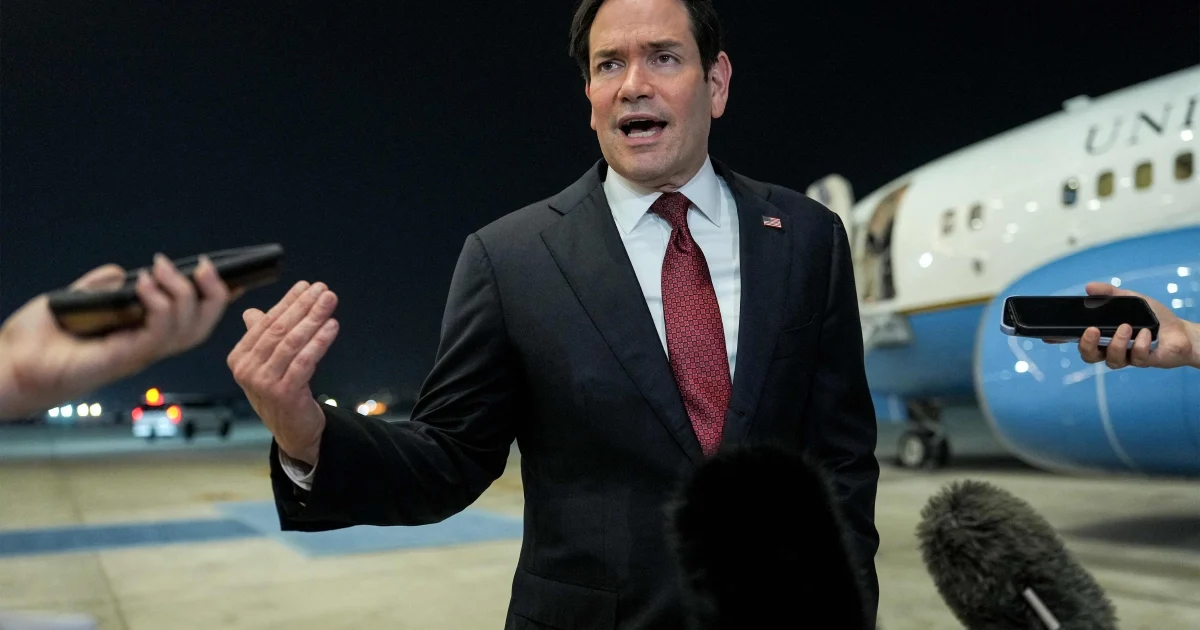
US Secretary of State Marco Rubio has flatly rejected any notion that Iran should be permitted to levy tolls or fees on commercial traffic transiting the Strait of Hormuz, marking a significant hardening of the American negotiating position on one of the world's most critical maritime chokepoints. The stance, articulated on Tuesday, underscores the divergence between Washington and Tehran on fundamental issues as early-stage talks aimed at resolving the broader Middle East conflict encounter mounting obstacles.
The Strait of Hormuz, situated between Iran and Oman, serves as the primary conduit through which roughly one-fifth of global petroleum flows reach international markets. Any disruption to shipping through this narrow passage carries profound implications not only for energy security in Asia-Pacific nations like Malaysia, Japan, South Korea, and Singapore, but also for global economic stability. The waterway's strategic importance means that disputes over access, tolling mechanisms, or freedom of navigation can reverberate across supply chains and fuel prices worldwide, making the current diplomatic disagreement a matter of regional as well as international concern.
Rubio's rejection of Iranian toll proposals reflects Washington's determination to preserve what it characterises as the freedom of navigation through international waters. The United States has historically opposed any unilateral levy system that would grant Tehran control over commercial shipping traffic or generate revenue streams from vessel transits. Iran, conversely, has sought to leverage its geographic position and national resources—including the strait itself—as bargaining chips in broader negotiations over sanctions relief and its regional security standing.
The emerging fracture in talks extends considerably beyond the Hormuz toll question. Nuclear inspections represent another significant flash point, with the two sides maintaining incompatible positions on the scope, frequency, and intrusiveness of monitoring arrangements. Iran has resisted what it perceives as excessive international scrutiny of its atomic programme, whilst Washington and its allies insist that robust, credible verification mechanisms are non-negotiable prerequisites for any accord. These competing visions reflect deeper distrust accumulated over decades of adversarial relations.
Missile capabilities constitute a third dimension of contention. The United States and its regional partners express grave concern about Iran's ballistic and cruise missile development programmes, viewing them as destabilising weapons systems that threaten shipping, military installations, and population centres throughout the Middle East. Iran maintains that its missile arsenal constitutes a legitimate national defence necessity and has proven reluctant to subordinate weapons development to external oversight or constraints. These positions appear irreconcilable without substantial diplomatic movement from one or both parties.
The accumulation of unresolved disputes signals that negotiations to terminate the wider Middle East conflict remain embryonic and fraught with difficulty. Early diplomatic engagements often expose the full magnitude of disagreement before constructive compromises become achievable. The current phase appears to be yielding numerous points of friction rather than convergence, suggesting that a comprehensive settlement remains distant. For Southeast Asian observers and policymakers, the protracted nature of these discussions carries implications for regional energy security, maritime trade patterns, and broader geopolitical alignments.
The timing of Rubio's intervention highlights American resolve to establish clear red lines before substantive negotiations advance further. By explicitly ruling out toll mechanisms on the Strait of Hormuz, the Secretary of State signals that Washington will not countenance arrangements that grant Iran leverage over global commerce or generate revenue from international shipping. This declaratory approach aims to circumscribe Iran's negotiating space and make evident to regional and international audiences that certain demands will encounter intransigent American opposition.
Iran's advocacy for toll proposals likely stems from multiple motivations. Revenue generation represents an obvious economic incentive, particularly given Iran's persistent fiscal constraints resulting from international sanctions. Additionally, any arrangement permitting Iranian tolls would constitute a form of implicit sovereignty assertion and recognition of Tehran's legitimate authority over straits passage—a symbolic concession that carries political weight within Iran itself. The domestic political dimension of Iranian negotiating positions should not be underestimated, as hardliners within Tehran scrutinise any accommodation with Washington as potentially delegitimising to the revolutionary system.
For Malaysia and other Southeast Asian maritime trading nations, the Hormuz impasse underscores vulnerabilities inherent in dependence upon chokepoints controlled or influenced by geopolitically contested actors. Malaysian energy companies, shipping firms, and traders all rely upon unimpeded transit through the strait, making the resolution of American-Iranian disagreements a matter bearing direct economic consequence. Any escalation or further deterioration in negotiations could eventually produce shipping delays, insurance premium increases, or even temporary blockades affecting commerce throughout the region.
The broader diplomatic landscape suggests that resolution of these foundational disputes may require external mediation or phased approaches that decouple certain issues from others. Specialists and regional observers increasingly advocate for confidence-building measures, interim arrangements, or partial agreements that might establish foundation for more comprehensive settlements. However, entrenched positions on tolling, inspections, and missiles indicate that such pathways would demand flexibility from parties currently displaying limited willingness to compromise.
Rubio's unambiguous rejection also serves notice to American allies in the Gulf and elsewhere that the Biden administration remains committed to preserving maritime access and constraining Iranian power projection. This rhetorical commitment may be calibrated partly for domestic consumption within the United States, where scepticism about negotiating with Iran remains pronounced across significant portions of the political spectrum. The Secretary of State's forthright language reinforces his administration's position as a steward of regional stability against what critics characterise as Iranian expansionism and destabilisation.
Looking forward, the trajectory of these negotiations will likely depend upon whether fundamental positions prove amenable to reframing or packaging. Should Iranian and American negotiators prove unable to find common ground on maritime tolls, nuclear oversight, and missile development, the talks may stall or collapse entirely. Alternatively, compartmentalisation of issues might permit progress on certain fronts whilst others remain contested. For Malaysian stakeholders and the broader Southeast Asian community, continued attention to these discussions remains warranted given their potential implications for energy security, maritime commerce, and regional stability.