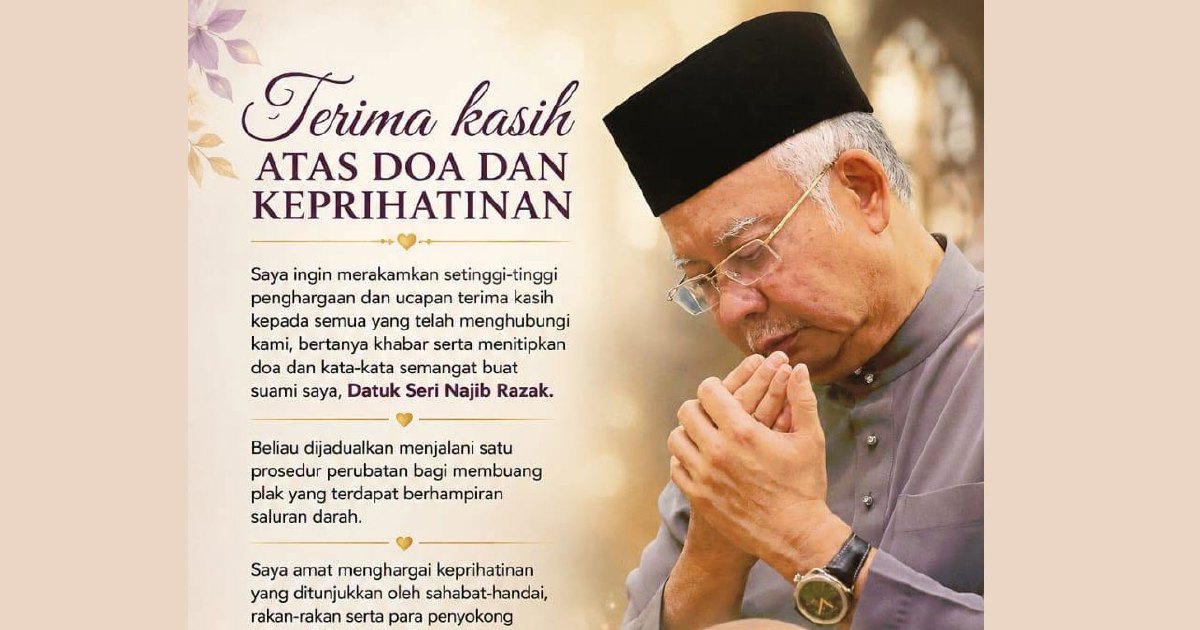
Datin Seri Rosmah Mansor has made a public appeal to the Malaysian community to offer prayers for her husband, former Prime Minister Datuk Seri Najib Razak, ahead of a scheduled medical intervention. The procedure, which Rosmah disclosed would address plaque buildup affecting blood vessel function, represents a significant moment for the family of the former leader who served as Prime Minister from 2009 to 2014.
Rosmah's appeal underscores the personal toll that the past several years have exacted on the former first family. Beyond the immediate medical concern, her request for public prayers reflects a broader desire to maintain dignity and garner support during a health crisis. The gesture also signals that despite the political controversies and legal challenges that have surrounded Najib in recent years, the family continues to seek acceptance and compassion from ordinary Malaysians.
The scheduled treatment represents a routine but necessary medical intervention designed to prevent serious cardiovascular complications. Plaque accumulation in blood vessels, a condition known as atherosclerosis, can restrict blood flow and increase the risk of heart attacks or strokes if left untreated. Modern medical techniques now allow interventional cardiologists to address such blockages through minimally invasive procedures, which typically carry low complication rates when performed by experienced specialists.
Rosmah's public acknowledgement of Najib's health situation breaks a period of relative silence from the couple regarding personal matters. In recent years, the former first lady has largely maintained a private profile, though she has occasionally made public appearances. This statement represents a deliberate effort to humanise both herself and Najib beyond their political identities, appealing to shared values of family welfare that resonate across Malaysian society regardless of political affiliation.
The timing of the disclosure is noteworthy given the broader political landscape in Malaysia. While Najib has faced numerous legal proceedings related to allegations of corruption and financial misappropriation, this health matter positions him within the universal human experience of aging and medical vulnerability. For many Malaysians, regardless of their political views toward the former Prime Minister, such health challenges can prompt reflection on mortality and the importance of family bonds.
The request for public prayer is culturally significant within the Malaysian context, where expressions of faith remain central to national identity and social cohesion. Islam, Christianity, Buddhism, Hinduism, and other faiths practiced across the country all emphasize intercessory prayer and community support during times of difficulty. Rosmah's appeal thus transcends any single religious framework, inviting Malaysians of all backgrounds to participate in collective well-wishing.
Support networks have proven crucial for individuals undergoing medical treatment, with research consistently demonstrating that emotional and spiritual encouragement contributes positively to patient outcomes and recovery. By soliciting prayers from the broader public, Rosmah is essentially seeking to expand the circle of well-wishers beyond immediate family and close associates, a strategy that can provide psychological comfort to Najib during the recovery period.
The disclosure also reflects changing attitudes within Malaysian society regarding the public discussion of health matters among prominent figures. Where previous generations might have maintained strict privacy around medical issues, contemporary practice increasingly normalizes transparent communication about healthcare needs. This shift allows public figures to maintain dignity while acknowledging human vulnerability and inviting appropriate social support.
For healthcare observers in Malaysia and the region, Najib's case highlights the prevalence of cardiovascular disease among middle-aged and older adults, particularly those in high-stress professional environments. The condition affecting him is among the leading causes of morbidity and mortality across Southeast Asia, making his public experience potentially educational for a broader audience considering their own health screening and preventive care options.
Rosmah's statement serves multiple functions simultaneously: it conveys family concern, maintains public dignity, invites communal support, and humanizes a figure whose name has become synonymous with political controversy. By framing the situation through the lens of health and family rather than politics, she creates space for Malaysians to respond with empathy while bracketing other contentious issues.
The coming days will determine the success of the procedure and Najib's recovery trajectory. Medical outcomes depend on numerous variables including the extent of arterial blockage, the specific treatment approach selected, and the patient's overall cardiovascular health and compliance with post-procedure protocols. Rosmah's appeal for prayers acknowledges the inherent uncertainty that accompanies any medical intervention, regardless of its routine nature.
This moment also offers perspective on how Malaysian society has evolved in its capacity to separate personal circumstances from political judgement. While Najib remains a polarizing figure in national discourse, his current health challenge activates different emotional registers within the population, creating temporary space for expressions of common humanity that transcend partisan divisions.

