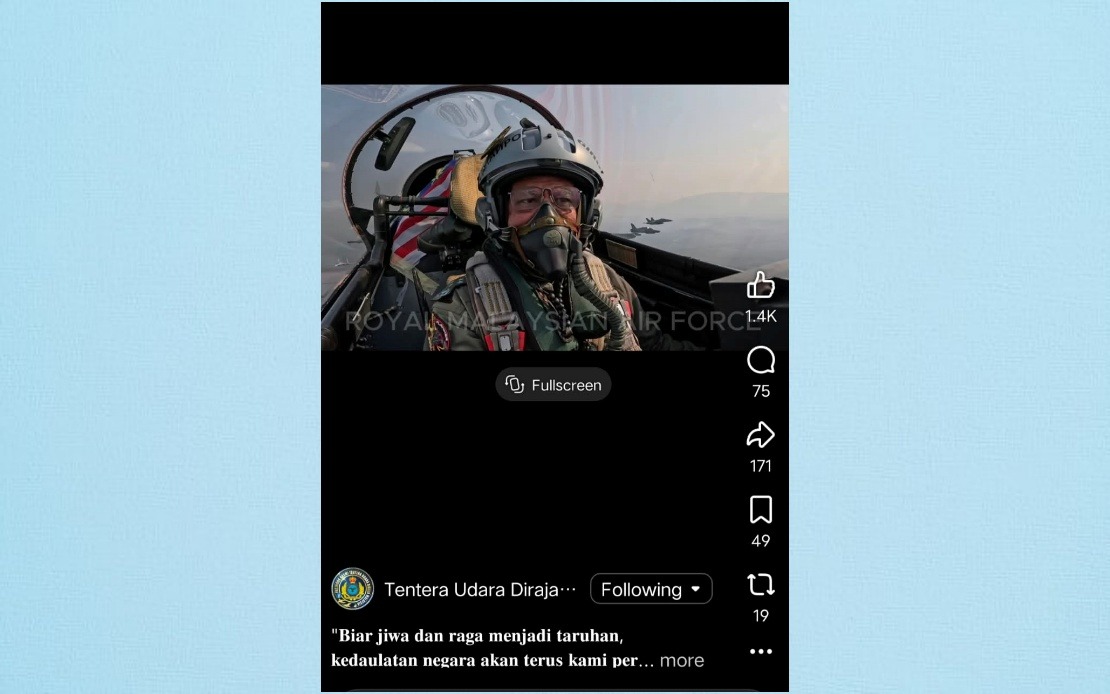
The skies above Putrajaya transformed into a theatre of military precision on August 31 as the Royal Malaysian Air Force (RMAF) executed an elaborate aerial demonstration to commemorate the nation's 69th National Day. The spectacle, which commenced at 9:30 am and lasted a full ten minutes, drew thousands of spectators to Dataran Putrajaya, where visitors craned their necks throughout the display to witness the thunderous passage of Malaysia's most advanced air assets cutting through the federal administrative centre's airspace.
General Tan Sri Muhamad Norazlan Aris, the RMAF chief, once again personally piloted a Sukhoi Su-30MKM fighter jet to lead the entire formation, continuing a tradition he established the previous year. His decision to take the controls himself rather than remaining grounded in a ceremonial capacity sends a symbolic message about the calibre and commitment of Malaysia's military leadership, demonstrating that those charged with commanding the nation's air defences are themselves operationally current and combat-capable.
The core of the aerial display comprised eleven fast jets representing the backbone of Malaysia's fighter force. Four Su-30MKM jets, which form the RMAF's primary multi-role combat aircraft platform, flew alongside four F/A-18D Super Hornets and three BAE Hawk 208 advanced trainers. These aircraft executed precisely choreographed manoeuvres organised into recognisable formations—the Kite, Diamond, Delta and Victory Combine patterns—each requiring split-second coordination among pilots flying at high speed in close proximity. Such demonstrations, while visually striking, serve a practical purpose beyond entertainment, allowing the air force to publicly validate its operational training standards and the proficiency of its pilots to execute complex tactical formations.
The presentation of fast-jet capabilities, however, represented only the opening chapter of a broader display intended to showcase the RMAF's complete operational spectrum. As the fighters completed their segment, the narrative shifted to demonstrate the air force's airlift and transport capacity, critical dimensions of military capability often overlooked in the public imagination. The C-130H Hercules, a venerable workhorse that has served the RMAF for decades, made its appearance, followed by the newer A400M Atlas, a significantly more capable multi-purpose transport platform. A CN235 rounded out the transport aircraft segment, illustrating the RMAF's ability to conduct sustained logistical operations across varied distances and to austere environments.
Commentary provided by Major Patrick Dinnesh, Major Neny Suhaida Ab Suki and Captain Muhammad Iqbal Nasrudin enriched the spectator experience by offering real-time explanation of aircraft types, manoeuvre sequences and operational significance. This educational dimension transformed the air display from mere spectacle into a form of strategic communication, allowing the general public to understand and appreciate the technical sophistication embedded in military aviation. For many Malaysian spectators, particularly younger viewers, such public demonstrations serve as powerful recruitment messaging and as a mechanism for building societal understanding of defence capabilities.
The RMAF's helicopter contingent—represented by EC725 and AW139 rotorcraft—participated in carefully coordinated formation flying with assets drawn from allied services. The presence of Malaysian Army, Royal Malaysian Navy, Fire and Rescue Department and Royal Malaysia Police aircraft within the same formation underscored the increasingly joint nature of Malaysia's security operations. In contemporary defence environments, individual service branches no longer operate in isolation; rather, seamless interoperability across the military and civilian emergency services has become fundamental to effective crisis response. Public displays that visibly demonstrate this coordination reinforce that message to both domestic and international audiences.
The reaction of the assembled crowd—thousands strong, their attention unwaveringly fixed skyward, their appreciation manifest in sustained cheering—reflected the visceral appeal of such aerial demonstrations. The combination of visual spectacle, the sensory impact of powerful jet engines at close altitude, and the evident professionalism of the executing pilots created memorable impressions that transcend typical political messaging. For government officials and military leadership, National Day air displays function as opportunities to project strength, capability and national pride without resorting to confrontational posturing.
From a regional perspective, Malaysia's decision to publicly showcase its air combat and transport capabilities holds significance within the broader Southeast Asian strategic environment. The demonstration of operational proficiency with advanced platforms such as the Su-30MKM and A400M communicates to regional observers and near-peer competitors that Malaysia maintains credible force structures backed by trained personnel capable of executing complex operations. In an era of rising maritime tensions and increasingly contested airspace across Southeast Asia, such public validation of air force readiness carries subtle but important diplomatic weight.
National Day air displays represent evolved forms of traditional military parades, substituting spectacle in the vertical dimension for ground-based processions whilst maintaining the core objective of demonstrating state power and organisational competence. For the RMAF specifically, the ability to orchestrate such a complex, multi-aircraft display without incident reflects the institutional discipline and training standards within Malaysia's air force. The logistics alone—coordinating multiple aircraft types, ensuring precision timing, managing airspace, and executing safety protocols—demand meticulous planning and execution.

