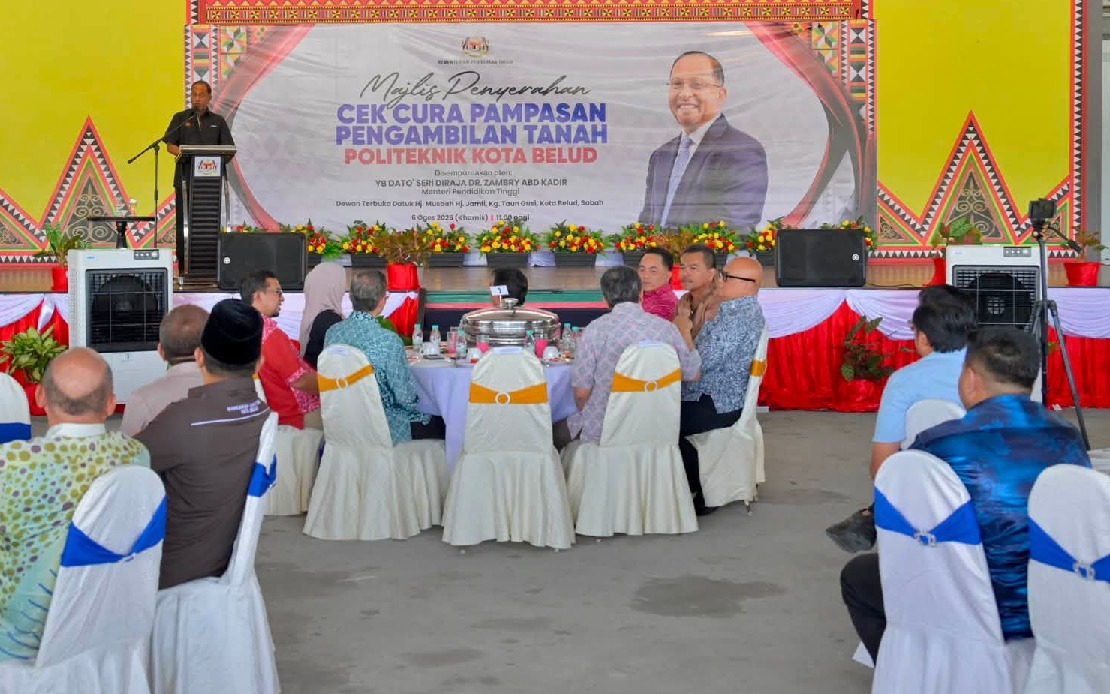
Politeknik Kota Belud, a RM250 million educational institution under development in Sabah, has taken a significant step forward after land acquisition compensation was formally presented to affected property owners. Higher Education Minister Datuk Seri Zambry Abd Kadir announced that the polytechnic is now primed to enter its construction phase, with completion targeted for 2030. The mock cheque presentation ceremony, held in Kota Belud, symbolised the transition from planning to active development, clearing a critical hurdle that had long constrained the project's advancement.
Zambry outlined an ambitious curriculum designed to position Sabah's workforce for emerging economic sectors. The polytechnic will concentrate on programmes spanning green energy, artificial intelligence, computer science, and smart technology-based agriculture—fields increasingly vital to Malaysia's trajectory toward high-income status and regional competitiveness. This focus reflects a deliberate policy shift within Malaysia's higher education strategy, recognising that rural and semi-urban regions require accessible pathways into technology-driven professions rather than traditional vocational training alone.
The development timeline stretches across the remainder of this decade, with the minister indicating that implementation will accelerate under the Third Rolling Plan within the 13th Malaysia Plan framework beginning next year. This phased approach permits comprehensive design and detailed planning work to precede actual construction, a prudent methodology for a facility of this scale and complexity. Once operational, the polytechnic aims to enrol approximately 500 students at inception, with capacity expansion planned to accommodate between 1,000 and 1,500 learners as demand and infrastructure mature.
For Sabah specifically, this investment represents a substantial educational anchor in the Kota Belud district. The state, historically disadvantaged in tertiary technical education infrastructure compared to Peninsular Malaysia, stands to benefit significantly from a high-quality polytechnic offering specialised training in growth sectors. The emphasis on green energy and sustainable agriculture aligns with Sabah's economic diversification imperative, particularly as palm oil dependency becomes increasingly contested globally and internal policy prioritises environmental stewardship.
The project's genesis traces back to 2017, when Kota Belud MP Datuk Seri Abdul Rahman Dahlan first proposed the facility. The intervening years of planning, feasibility studies, and bureaucratic coordination underscore the extended timeframes typical of major public infrastructure in Malaysia. Land acquisition—often a protracted process involving multiple stakeholders and compensation negotiations—has now concluded, removing what frequently becomes a bottleneck delaying construction commencement.
Zambry's emphasis on programmes meeting current and future workforce needs reflects evolving employer demands that standard diplomas increasingly fail to address. Malaysian industries, particularly in manufacturing, services, and emerging tech sectors, consistently report talent shortages in specialised fields. A polytechnic structured around artificial intelligence and smart agriculture could help bridge these gaps, providing employers with job-ready graduates and students with genuine employment prospects upon completion.
The timing of this announcement carries broader significance within Malaysia's education policy discourse. As the nation grapples with skills mismatches and youth unemployment despite formal qualification attainment, practical polytechnic training has gained prominence relative to traditional academic pathways. The Kota Belud facility signals commitment to regional equity in accessing such opportunities, countering perceptions that quality technical education concentrates in urban corridors like the Klang Valley or Penang.
From a regional perspective, Politeknik Kota Belud will operate within a broader Southeast Asian context of polytechnic expansion. Nations including Thailand, Vietnam, and Indonesia have substantially invested in technical education infrastructure as part of development strategies. Malaysia's comparable investment maintains competitive positioning, particularly for attracting the quality workforce multinational technology companies increasingly seek in Southeast Asia.
The compensation distribution to landowners represents not merely a financial transaction but a critical confidence signal that projects in Sabah proceed with proper due process and stakeholder respect. Rural and indigenous communities in Malaysian Borneo have experienced historical tensions over land rights and development; transparent compensation practices help establish social licence for future infrastructure initiatives in the state.
Construction commencement will generate employment opportunities both during the building phase and upon the polytechnic's opening, supporting the local economy through contractor engagement and eventual staff hiring. Ancillary services—accommodation, food, retail—will likely emerge to serve student populations, stimulating broader economic activity in Kota Belud town.
As Malaysia positions itself within the regional education marketplace, particularly attracting international students and fostering innovation hubs, polytechnics focused on high-demand disciplines become strategically important. Politeknik Kota Belud's emphasis on green energy and artificial intelligence reflects this calculation, producing graduates marketable not only domestically but potentially across ASEAN as regional energy transitions and digital transformation accelerate.
The minister's confirmation of the 2030 completion target provides stakeholders with planning certainty. Educational institutions, employers, and prospective students can now calibrate decisions knowing when the facility will become operational. For Sabah's development planning, the polytechnic becomes a concrete anchor in workforce development strategy, justifying complementary investments in transportation, housing, and industry partnerships that successful technical institutions require.

