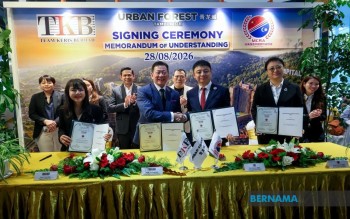
Team Keris Bhd (TKB) and its partners have unveiled an ambitious vision for transforming Tambun in Ipoh through a RM1 billion urban forest project that represents a significant departure from Perak's traditional domestic tourism positioning. The 84-acre development, scheduled for completion within three years, is being engineered as a comprehensive ecosystem that binds together accommodation, dining, shopping and experiential offerings designed to compete on an international stage. Rather than merely adding another commercial venture to the landscape, stakeholders involved describe the initiative as a catalyst for repositioning the state's entire tourism and hospitality sector toward global markets.
The collaboration brings together three distinct entities with complementary mandates. Team Keris Bhd serves as the principal developer, while RJJ Hotels Sdn Bhd contributes hospitality expertise through its alignment with Jin Jiang Hotels—a network spanning more than 50 countries with over 200 million members and 40 hotel brands. The Malaysian Chinese Restaurant Association (MCRA) rounds out the partnership by anchoring the food and beverage component, bringing both culinary authenticity and industry infrastructure. This tri-partite arrangement reflects a deliberate strategy to create a destination that functions as an integrated whole rather than disconnected attractions.
According to Loh Sze Yee, chairman of Perak's Tourism, Industry, Investment and Corridor Development Committee, the urban forest is conceived as complementary infrastructure to existing attractions in the Tambun area, notably the Lost World of Tambun and other hospitality developments. Rather than cannibalising these existing operations, planners envision the new project establishing critical mass—the threshold at which a destination becomes attractive enough to justify international visitation. This clustering effect is a well-documented phenomenon in tourism geography, wherein concentrated, diverse attractions generate network effects that elevate the entire region's competitive position. Loh articulated this vision explicitly: Perak must transition from serving primarily Malaysian domestic tourists to competing for visitors from Australia, Britain, the United States and other distant markets.
The food and beverage strategy unveils sophisticated thinking about market positioning and cultural representation. The project will allocate 40 percent of F&B operations to MCRA-affiliated establishments, ensuring Malaysian Chinese culinary traditions receive prominence and professional elevation. The remaining 60 percent will feature other Malaysian operators, creating space for Malay, Indian, East Malaysian and fusion cuisines. This deliberate composition reflects a strategic narrative: that Perak offers genuinely diverse Malaysian dining experiences rather than narrow regional offerings. Crucially, the development commits to ensuring 30 percent of all food offerings qualify as Muslim-friendly, with MCRA specifically developing halal dim sum and complementary selections. This commitment signals recognition that international Muslim-majority tourist markets—including visitors from the Middle East, Indonesia and other Islamic nations—represent significant untapped opportunity.
Datuk Lee Seng Hee, TKB's group executive chairman, articulated a broader philosophy grounding the commercial strategy. He contended that Perak merits not merely additional development, but development of superior quality delivering richer experiences and standards befitting the state. His comments reflect a quality-over-quantity ethos increasingly prevalent among regional development planners who recognise that competing against established global destinations requires differentiation through excellence rather than mere volume. The concept extends into TKB's newly established Tours & Hospitality division, which approaches visitor experience holistically—encompassing accommodation, dining, transport, discovery and experiential activities rather than treating each as discrete offerings.
RJJ Hotels chief executive Yap Lip Seng provided concrete operational detail regarding how international connectivity translates into practical accessibility for foreign tourists. His remarks addressed a persistent challenge for Perak tourism: the state's geographical position relative to Malaysia's primary international gateways. Kuala Lumpur and Penang airports receive most international arrivals, forcing potential Perak visitors to contemplate onward logistics that can deter travel. Through packaging arrangements coordinated by RJJ's global distribution network, international travellers book comprehensive Ipoh experiences—transport, accommodation, dining—as seamless packages rather than wrestling with fragmented logistics. Extended multi-night stays become the default rather than rushed brief visits, allowing guests to experience the diverse culinary and hospitality offerings the urban forest provides. This packaging approach fundamentally alters the calculus of destination competitiveness.
The global reach of RJJ's parent network provides infrastructure for promoting Ipoh within distant markets through travel agents, tour operators and platform partners with established client relationships. This advantage cannot be overstated: domestic tourism marketing reaches nearby populations efficiently, but competing for international visitors requires partnerships with distribution networks already trusted by foreign travellers. Jin Jiang Hotels' presence across 50-plus countries creates touchpoints for embedding Ipoh within international travel consciousness, positioning it not as an obscure Malaysian destination but as a curated experience within a global hospitality ecosystem.
MCRA president Gao Houyun introduced additional strategic dimensions that extend benefits beyond immediate urban forest operations. The collaboration provides training and skills upgrading for local food industry workers and operators, addressing a chronic constraint in Southeast Asian tourism—that rapid growth often outpaces local workforce capability, necessitating external recruitment. By systematically improving local human capital, Perak builds sustainable competitive advantage. Gao further outlined plans to develop localised supply chains, particularly encouraging Chinese manufacturers of sauces, spices and food ingredients to establish Perak-based production facilities. This approach transforms the urban forest from a consumption destination into an agglomeration point for food production and processing industries.
The supply chain development strategy intersects with Malaysia's halal certification framework in ways with profound implications for Perak's economic trajectory. Halal certification, developed domestically to serve Islamic dietary requirements, has evolved into a genuine competitive advantage for Malaysian food producers seeking access to Muslim-majority markets across Southeast Asia, the Middle East and beyond. Food products and restaurant concepts developed in Perak, once validated through halal certification processes, become eligible for regional expansion with credibility that competitors from non-Muslim-majority nations cannot easily match. This represents a reverse flow of value creation: rather than Perak merely consuming international offerings, the state becomes an exporter of food products and culinary concepts leveraging Malaysia's unique position as a Muslim-majority nation with sophisticated halal infrastructure.
The three-year implementation timeline imposes genuine constraints on execution, requiring coordinated mobilisation of construction, hospitality talent, food industry expertise and marketing capacity simultaneously. Regional observers will scrutinise whether the urban forest maintains quality standards amidst rapid development pressures, whether international partnerships deliver promised tourist volumes, and whether local Malaysian operators receive genuine prominence or become marginalised within a predominantly international-brand ecosystem. The project's ultimate success will depend not merely on infrastructure completion but on organic emergence of the experiential richness and authentic hospitality that international tourists increasingly prioritise over mere facility quality.
For Malaysia's broader positioning within Southeast Asian tourism competition, the Ipoh initiative signals that secondary cities and regional states increasingly recognise limitations of competing primarily on natural attractions or historical heritage. Instead, destinations are consciously engineering integrated experiences combining accommodation, food, retail and discovery. Perak's explicit embrace of this strategy—and its deliberate commitment to showcasing Malaysian culinary diversity—reflects understanding that sustainable tourism competitiveness requires deep local engagement rather than shallow international branding. If successfully executed, the urban forest could serve as a regional model for how secondary Malaysian destinations position themselves within global tourism markets.

