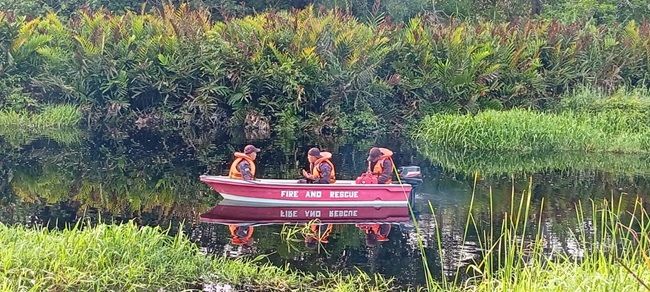
Rescue operations in Brunei intensified yesterday as authorities pressed on with their hunt for a missing man believed to have fallen victim to a crocodile attack in the waters near Kampong Baru Sungai Bera. The coordinated search, now in its third consecutive day, has yet to yield any signs of the victim despite the mobilisation of multiple government agencies and specialized equipment across the river system. The incident underscores the persistent danger posed by wildlife in Southeast Asia's waterways, particularly in regions where human settlement borders pristine natural habitats.
The Fire and Rescue Department (FRD) mounted a comprehensive operation combining traditional and modern search methods to locate the missing individual. Teams have maintained constant patrols along the river using dedicated rescue vessels, while personnel systematically combed the banks on foot to search for any trace of the victim. The FRD complemented these ground-based efforts by deploying unmanned aerial vehicles, allowing rescue coordinators to survey wider stretches of the river and its surrounding terrain from above, a technological approach increasingly common in Southeast Asian emergency response operations.
The rescue effort represents one of Brunei's larger inter-agency responses, bringing together personnel from the Royal Brunei Police Force, including specialist units focused on maritime operations. Officers from Seria Police Station have been stationed throughout the search zone, while the Royal Brunei Police Force Marine Police (POLMAR) contributed their expertise in river-based rescue operations. The Wildlife Division's involvement signals the authorities' recognition that understanding crocodile behaviour and habitat is crucial to locating the victim and preventing similar incidents. The operation is being directed by Amirul Hadi Junaidi, Senior Superintendent and Commanding Officer of the Operations Branch, ensuring coordinated decision-making across the multiple agencies involved.
The incident began when emergency services received a distress call on Wednesday, 24 June, reporting that a male victim had encountered a crocodile while fishing in the river. The FRD immediately dispatched two fire engines carrying nine personnel, led by Acting Station Officer Mohd Zulkifli Md Tahir, to the scene. Upon arrival, investigators interviewed the victim's family members, who provided crucial initial information suggesting that a crocodile attack had occurred during the fishing activity. This early intelligence shaped the subsequent response strategy and set the scope for the broader search operation.
Following the initial assessment, rescue teams established a Tactical Command Post to coordinate the multi-phase search effort. The FRD deployed firefighters and their full complement of rescue assets, recognizing that a missing person operation with a potential crocodile attack required the agency's most advanced resources. The decision to utilize drones proved particularly significant, as aerial surveillance can cover ground-based teams cannot easily access and provide real-time information about river conditions and wildlife movement patterns. This integration of technology reflects how emergency services across Southeast Asia are adopting innovative approaches to address the unique challenges posed by regional geography and fauna.
Crocodile attacks, while statistically uncommon, remain a serious concern in Brunei and surrounding regions. The Sungai Bera system, like many waterways throughout Southeast Asia, provides essential habitat for saltwater crocodiles, particularly in areas where mangrove forests meet open water. Fishing remains a common livelihood activity in communities adjacent to these rivers, creating inherent risk when individuals venture into crocodile territory. The vulnerability of locals to such attacks highlights the delicate balance between economic necessity and wildlife coexistence that many communities in the region must navigate.
The extended search operation reflects the determination of Bruneian authorities to locate the victim despite challenging circumstances. The river environment presents numerous complications for rescue teams, including strong currents, limited visibility in some areas, and the potential presence of the crocodile itself. Unlike terrestrial search operations, aquatic rescues require specialized training and equipment, and the possibility that the victim may not be recovered alive compounds the emotional and operational challenges faced by rescue personnel. The decision to maintain round-the-clock operations demonstrates the authorities' commitment to exhausting all possibilities.
For Malaysian readers, the incident offers sobering reminders about the wildlife hazards present throughout Southeast Asia's waterways. While major incidents remain rare relative to the number of people who interact with these environments daily, the consequences when attacks do occur are often catastrophic. Similar crocodile populations exist in Malaysian waters, particularly in Sarawak and Sabah, where communities have developed traditional knowledge and modern safety protocols to minimize risk. The Brunei response demonstrates best practices in emergency coordination that Malaysian agencies might reference when developing their own wildlife incident response procedures.
The broader context of this search operation reflects how Southeast Asian governments are strengthening their capacity to respond to natural disasters and wildlife emergencies. The involvement of the Wildlife Division alongside traditional emergency services indicates recognition that such incidents require both rescue expertise and ecological knowledge. As urbanization expands into previously remote areas throughout the region, such coordination between law enforcement, emergency services, and environmental agencies will become increasingly important. The Brunei operation serves as a case study in inter-agency cooperation during high-stakes situations where specialized knowledge from multiple disciplines proves essential to operational success.

