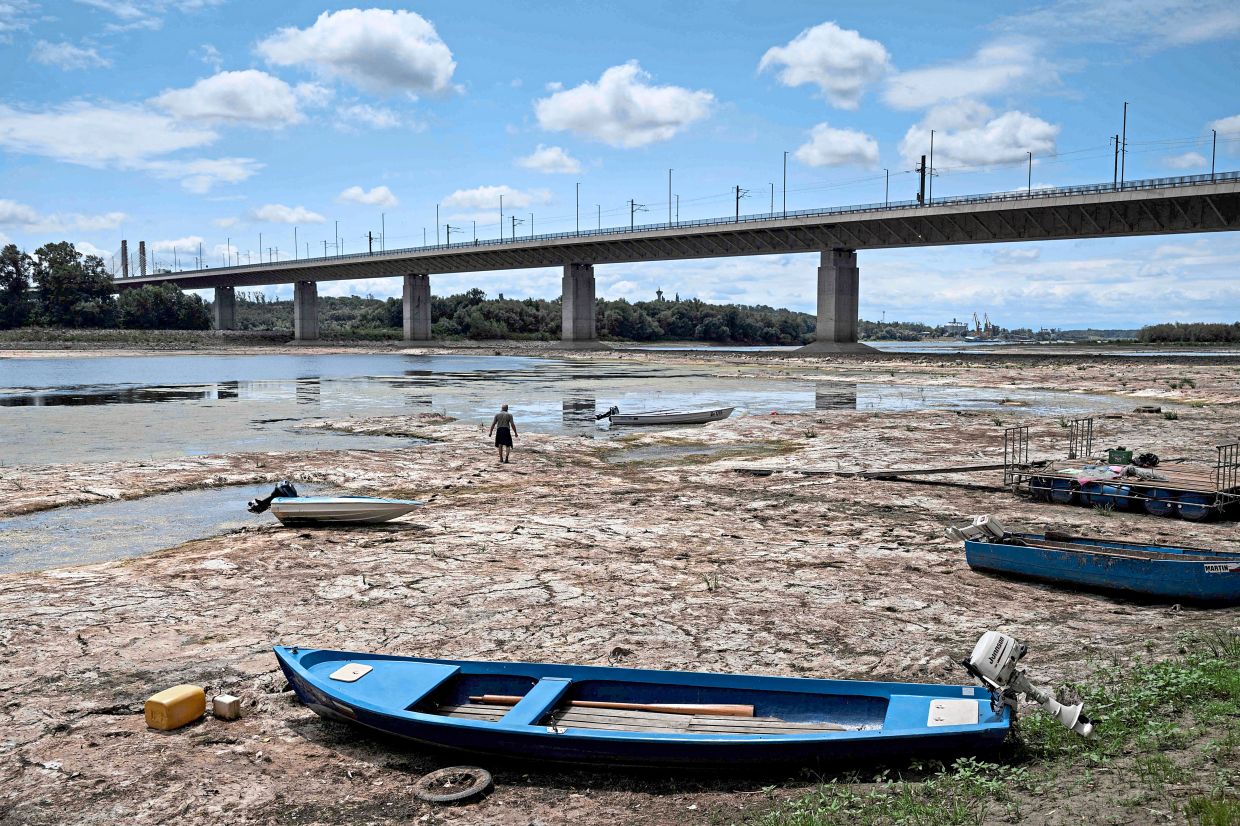
Central Europe is confronting a water crisis of historic proportions as the Danube River, one of the continent's vital waterways, has receded to unprecedented levels during an intensifying drought that shows no signs of abating. The dramatic drop—which has exposed long-buried riverbed features including World War II military ordnance, shipwrecks, and vast shoals—signals the accelerating grip of climate change on a region already grappling with successive heat waves and critically depleted precipitation. From Budapest's heart to the Danube Delta forming the border between Romania and Bulgaria, the effects ripple across an intricate web of economies, energy systems, and daily lives that depend fundamentally on Europe's second-longest river.
The scale of the water shortage becomes starkly apparent in the numbers. Hungary's National Water Authority recorded the Danube at Budapest standing at merely 23 centimetres on July 29, shattering the previous catastrophic low of 33 centimetres established during the drought of 2018. With forecasts predicting temperatures exceeding 38 degrees Celsius across the region and no meaningful rainfall anticipated, water managers expect conditions to deteriorate further. The Hungarian Meteorological Service documents the severity of precipitation deficits across the country, with 90-day rainfall totals running 80 to 130 millimetres below historical averages nearly nationwide, painting a picture of abnormality that extends far beyond a single dry season.
This environmental catastrophe has swiftly paralysed the tourism industry that relies on the Danube as a backbone of Central European hospitality. The cruise ship sector, once a reliable driver of revenue and employment in cities like Budapest and Vidin, now faces logistical nightmares as vessels that normally berth in city centres must anchor far upstream, forcing tour operators to reconfigure entire itineraries or cancel operations altogether. The situation descended into crisis when the Viking Ullur ran aground on a submerged shoal near Vidin in Bulgaria on July 28, leaving 186 passengers stranded. The stricken vessel, unable to reach port to resupply, exhausted its food and water reserves while remaining stuck as crew members waited uncertainly for water conditions to improve enough for refloating operations to commence.
Cargo shipping—the economic lifeblood of river-dependent communities and industries—has essentially ceased functioning across wide stretches of the Danube. In Serbia's Novi Sad region, hundreds of small commercial boats and dozens of cargo vessels sit marooned on exposed banks, their operators watching helplessly as shallow water makes navigation impossible. Radovan Segrt, who operates river excursion services, described watching the water recede 15 to 20 metres from the shoreline, effectively ending his summer season and leaving his business suspended until conditions normalise. The Ministry of Transport and Investment in Budapest confirmed the collapse of cargo operations, underscoring how climate vulnerability threatens the region's integrated transport networks and supply chains.
The consequences extend beyond tourism and commerce into the critical realm of energy security. The Danube's cooling waters are indispensable to nuclear power plants spanning multiple countries, and the plummeting water levels have forced unprecedented restrictions on electricity generation precisely when summer heat drives peak demand. Romania's Cernavoda nuclear facility, dependent on Danube water for reactor cooling, was forced to shut down one reactor unit for safety compliance, with authorities announcing additional shutdowns imminent as water flow dipped to approximately 1,630 cubic metres per second—roughly one-third of typical July volumes. Hungary's Paks nuclear plant, which ordinarily supplies nearly half the nation's entire electricity generation, initiated emergency power reductions on July 29 after successive downsizing over preceding days due to insufficient cooling-water availability.
The exposed riverbed has created unforeseen hazards alongside its curious archaeological revelations. Hungarian authorities closed Budapest's Margaret Bridge after a World War II-era bomb materialised at the bridge's foundation, exposed by receding waters that stripped away decades of riverine cover. The revelation illustrates how climate change can unexpectedly unearth historical dangers, creating public safety risks in urban centres. Conversely, the extreme conditions have created opportunities for metal detection enthusiasts like Zsolt Horvath, who use powerful magnets to harvest artifacts from exposed banks—military ordnance, vintage electronics, and historical fragments now accessible after prolonged submersion.
Photographer Gabor Kertesz documented the surreal landscape of Margaret Bridge's base, where bedrock and sandbars normally hidden beneath metres of water now stand exposed to daylight. His visceral response—shock at the transformation of familiar landscapes—encapsulates a broader regional reckoning with climate realities. The visible evidence of environmental upheaval has moved beyond abstract warnings into concrete, observable alterations to infrastructure, livelihoods, and public consciousness. The Danube's retreat has become a physical manifestation of climate change, too immediate and costly to dismiss or politicise away.
The drought's severity reflects cumulative moisture deficits spanning most of the year rather than a localised summer phenomenon. Successive heat waves across Central Europe have accelerated evaporation dramatically while limited precipitation fails to replenish aquifers and surface water. This extended climatic anomaly—distinct from typical seasonal fluctuations—suggests systemic shifts in regional weather patterns potentially linked to broader atmospheric changes. The simultaneous occurrence of wildfires raging across France and Spain, renewed heat waves across Western Europe, and record-low water levels across the Danube watershed indicates coordinated climate stress affecting the entire continent.
For Malaysian and Southeast Asian observers, the Danube crisis offers instructive lessons about climate vulnerability in integrated river systems serving diverse economic interests. The Mekong River—Southeast Asia's comparable vital waterway spanning multiple nations—faces analogous pressures from upstream dam construction, climate variability, and competing water demands. The Danube's current crisis demonstrates how interconnected modern economies become when critical infrastructure depends on finite water resources; when those resources vanish, no single nation can solve the problem unilaterally. The simultaneous shutdown of multiple nuclear reactors illustrates how climate change threatens energy security across entire regions, a concern equally relevant to nuclear-dependent nations throughout Asia.
The crisis also underscores how environmental degradation disproportionately affects economically vulnerable populations and sectors. Small boat operators, seasonal tourism workers, and communities dependent on river transport lack the institutional resources to absorb the shocks that corporations and governments might weather. The immediate suffering—stranded tourists, idle workers, depleted business revenues—accumulates into broader economic damage extending months beyond the actual drought period. Recovery from such disruptions requires investment and planning that many regions struggle to mobilise, potentially widening economic disparities within affected countries.
Looking forward, the Danube's predicament raises uncomfortable questions about infrastructure resilience and long-term water security across Europe. Power plants designed for a specific cooling-water regime now struggle with climate conditions outside historical parameters. Ships scheduled around water-level averages that no longer obtain face structural risks. Tourism operators dependent on predictable seasonal patterns confront unpredictable disruptions. Adaptation will require substantial capital investment, regulatory changes, and potentially difficult negotiations between nations sharing the river's benefits and burdens. The European Union's involvement offers some institutional framework for cooperative management, yet even coordinated regional bodies struggle when climate change fundamentally alters the system's operating conditions.
The convergence of crisis—simultaneous heat waves, wildfires, and extreme drought—across the continent suggests that incremental responses and business-as-usual approaches have become inadequate. The Danube at 23 centimetres represents not merely a water shortage but a challenge to assumptions underlying modern infrastructure and economic organisation. As Europe confronts these realities, policymakers, business leaders, and citizens throughout the developing world watch with urgent interest, recognising in the Danube's decline a preview of potential futures if current climate trajectories persist.

