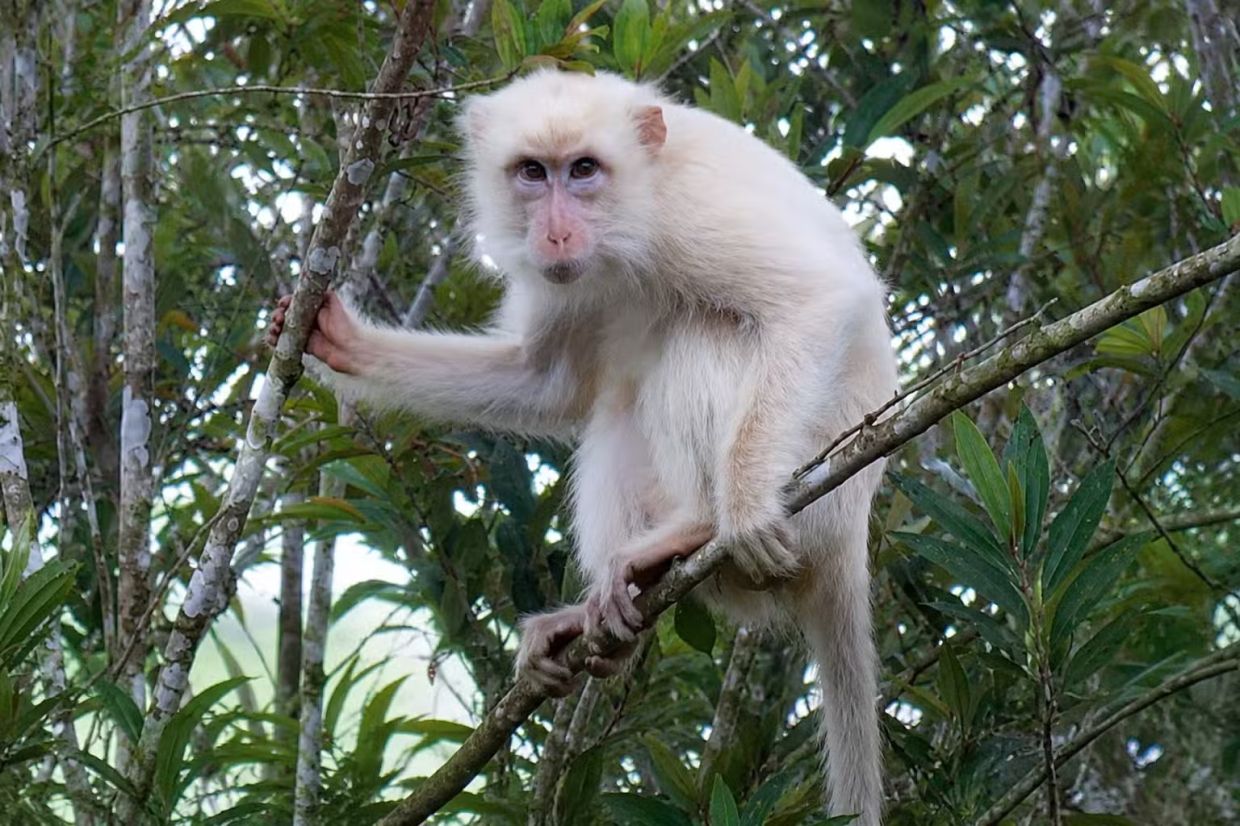
A striking white macaque that has inhabited a forested area in Sultan Kudarat for nearly a decade has suddenly become the subject of intensive conservation efforts, driven by the twin forces of social media exposure and wildlife protection concerns. For years, the distinctive animal moved quietly through the forests around Senator Ninoy Aquino town, a familiar but unremarkable feature of the local landscape to residents who encountered it regularly. The situation shifted dramatically once images and video clips began circulating across social media platforms, transforming a local curiosity into a nationally recognized wildlife phenomenon that has now triggered formal government intervention and habitat protection protocols.
The macaque in question belongs to the Philippine long-tailed macaque species, known scientifically as Macaca fascicularis philippensis, but displays a striking white coloration that distinguishes it fundamentally from its darker-furred relatives. Initial assessments by local observers suggested the animal suffered from albinism, a complete absence of pigmentation that occasionally occurs in wild populations. However, a comprehensive field validation conducted by a Department of Environment and Natural Resources (DENR) Region XII monitoring team produced more nuanced findings that complicate the original diagnosis. The team noted that the macaque possessed brown to dark brown eyes rather than the pink or red eyes characteristic of albino animals, suggesting instead that the creature may be afflicted with leucism, a condition involving reduced pigmentation that differs fundamentally from albinism, or potentially another distinct pigmentation anomaly altogether.
Wildlife experts emphasize that definitive scientific verification remains necessary before specialists can conclusively determine the precise nature of the macaque's condition. This technical uncertainty has not deterred protective action, however, as authorities recognize the acute vulnerability that the animal's distinctive appearance creates regardless of the underlying cause. According to Armando, a local resident cited in official documentation, the white macaque has been a regular presence in the Senator Ninoy Aquino area since at least 2016, roaming familiar territories and maintaining a relatively stable presence in the region's forest ecosystem. The animal's obscurity changed abruptly once digital media amplified its visibility, transforming it from an overlooked resident into a target of potential exploitation.
The risks that accompany sudden public awareness of rare wildlife are well-documented across Southeast Asia, where poaching networks and trafficking syndicates rapidly mobilize to capture animals that attract media and social media attention. DENR officials have articulated clear concerns that the white macaque faces heightened danger from disturbance, hunting, deliberate capture for collection, and potential integration into illegal wildlife trading networks. The pigmentation anomaly, while unusual, makes the animal particularly desirable to unscrupulous collectors and trafficking operations seeking distinctive specimens for private menageries or overseas markets. Environmental authorities view the social media phenomenon less as celebratory documentation and more as a publicized advertisement for poaching activity, requiring swift intervention to protect the subject of viral attention.
During the field validation process, DENR XII monitoring teams conducted broader assessments of the macaque's ecological context and habitat suitability. Researchers confirmed that the forest environment continues to sustain the resident macaque population through adequate secondary forest vegetation and reliable natural food sources, suggesting that the broader ecosystem remains functional and capable of supporting wildlife populations. This positive finding regarding habitat quality provides an encouraging foundation for long-term conservation strategy, indicating that protection measures can build upon an existing ecosystem already capable of nurturing the species. The macaque's presence within a relatively healthy forest system contrasts with many conservation scenarios across the Philippines, where habitat degradation and deforestation severely constrain species survival prospects.
In response to documented conservation concerns, the municipal government of Senator Ninoy Aquino implemented a temporary closure of the forest area where the white macaque is frequently observed. This protective measure aims simultaneously to minimize direct disturbance to the animal, prevent illegal wildlife collection activities, and reduce human-wildlife interaction that could endanger both the macaque and local residents. The geographic restriction represents an acknowledgment that passive awareness of the macaque's existence, amplified through social media channels, creates sufficient poaching incentive to warrant active access control. Barangay Bugso, the administrative division encompassing the affected area, has initiated the development of a formal ordinance designed to institutionalize protective measures for the white macaque, its immediate habitat, and the broader forest ecosystem that sustains it.
Beyond restrictive measures, local authorities have embraced a proactive conservation agenda integrating habitat restoration and ecotourism development. Barangay Bugso has planned tree-planting and habitat-restoration activities intended to strengthen overall biodiversity conservation while simultaneously promoting responsible and regulated ecotourism opportunities. This approach seeks to transform the white macaque from a liability of excessive attention into an asset that generates sustainable community benefits through carefully managed nature tourism. Rather than attempting to suppress all human interest in the distinctive animal, conservation planners recognize that channeling that interest through regulated, low-impact observational activities could generate economic incentives for sustained habitat protection while satisfying public curiosity without exposing the animal to poaching risk.
The legal framework protecting the white macaque derives from Republic Act No. 9147, the Wildlife Resources Conservation and Protection Act, which provides comprehensive prohibitions on hunting, capturing, collecting, possessing, transporting, trading or disturbing any protected wildlife without explicit government authorization. The legal provisions apply universally across all Philippine wildlife, but the white macaque's distinctive appearance and social media prominence create particular enforcement challenges, as the animal's distinctive characteristics make unauthorized capture potentially lucrative and the widespread public knowledge of its location complicates access restriction. DENR has explicitly appealed to content creators, journalists, photographers and social media users to avoid disclosing precise locations of wildlife sightings or posting geotagged content that could facilitate poaching activity, recognizing that public responsibility represents an essential complement to official enforcement mechanisms.
The DENR XII organization has undertaken to submit comprehensive documentation on the white macaque to the Biodiversity Management Bureau, a specialized government agency responsible for technical evaluation of significant wildlife discoveries and unusual biological phenomena. This institutional escalation ensures that the macaque's case receives expert-level attention from the highest levels of Philippines environmental administration, potentially generating broader research interest and scientific resources. Simultaneously, DENR XII committed to ongoing habitat monitoring, strengthened coordination with local government stakeholders and community organizations, and intensified public information campaigns emphasizing wildlife protection principles. The multi-layered approach reflects recognition that protecting the white macaque requires sustained institutional attention extending far beyond the initial protective response to the social media phenomenon.
The white macaque's journey from unremarkable forest resident to protected species exemplifies broader conservation challenges facing Southeast Asia in an era of instantaneous digital communication. The animal's vulnerability increased not because its ecological status fundamentally changed, but because technological platforms amplified awareness among actors with exploitative intent. Conservation success in this context depends not merely on habitat protection or legal prohibition, but on cultivating public consciousness regarding the consequences of uncontrolled wildlife visibility. The Philippine case demonstrates that even rare and distinctive animals can achieve temporary protection through rapid governmental response, though long-term survival ultimately depends on sustained community commitment to habitat preservation and responsible ecotourism management that converts public fascination into conservation incentive rather than exploitation opportunity.

