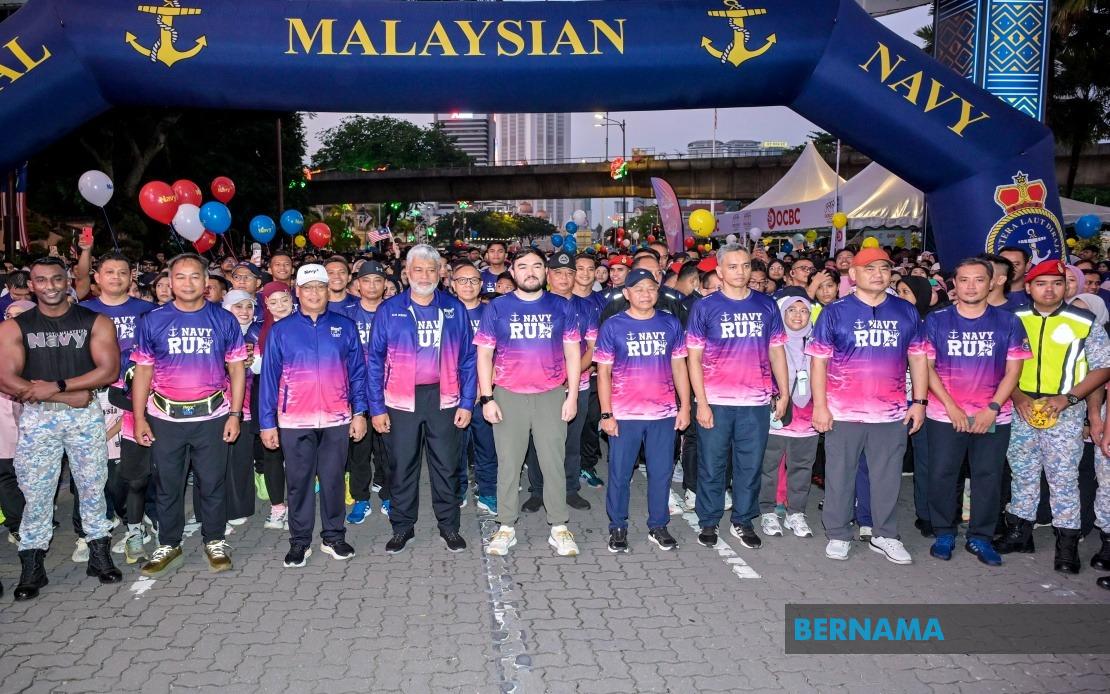
The Royal Malaysian Navy consolidated its community engagement efforts on 2 August when Tengku Amir Shah Sultan Sharafuddin Idris Shah, the Raja Muda of Selangor, inaugurated the Navy Run 2026 at Dataran DBKL in central Kuala Lumpur. The seven-kilometre running event shattered previous attendance records, drawing 15,000 participants and signalling growing public enthusiasm for initiatives that bridge the gap between Malaysia's armed forces and civilian society. The Raja Muda's personal involvement extended beyond the ceremonial flag-off, as he actively participated in the race and completed the full distance alongside ordinary Malaysians, demonstrating the inclusive nature of the gathering.
Now in its fourth iteration since inception in 2023, the Navy Run has evolved from a modest fitness event into a flagship platform for military public relations in Malaysia. The rapid scaling from the initial years to this year's record turnout reflects a deliberate strategy by the Royal Malaysian Navy to humanise its operations and foster closer bonds with the general population. This progression mirrors international best practices where armed forces increasingly recognise the value of civilian interaction in building institutional credibility and national defence consciousness.
The event's leadership extended across multiple tiers of Malaysian governance and military hierarchy. Admiral Tan Sri Dr Zulhelmy Ithnain, the RMN chief, and Kuala Lumpur mayor Datuk Fadlun Mak Ujud provided official oversight, while Lumut Naval Shipyard Sdn Bhd chief executive officer Azhar Jumaat represented the defence industrial sector. This convergence of royalty, defence establishment, municipal authorities, and defence contractors underscored the government's integrated approach to promoting national institutions while stimulating economic participation through related industries.
The physical limitations of a single venue did not constrain the event's geographic reach. The Navy Run 2026 was simultaneously broadcast and conducted at RMN bases stationed in Lumut, Kuantan, and Kota Kinabalu, extending participation to naval personnel distributed across peninsular Malaysia and East Malaysia. This distributed model enhanced operational significance by enabling sailors and officers at remote installations to engage in collective patriotic activities without geographical barriers, addressing the isolation challenges that regional naval bases often encounter.
Beyond the competitive running element, the Navy Run functioned as a multi-sensory engagement platform. Complementary activities including aerobics sessions, performances by the RMN Central Band, and precision silent drill demonstrations provided entertainment value whilst subtly exposing civilians to military professionalism and discipline. An exhibition showcasing RMN career opportunities directly addressed recruitment challenges in attracting quality personnel to naval service, whilst a lucky draw element injected mass appeal that transcended traditional fitness enthusiast demographics.
The Royal Malaysian Navy's accompanying statement articulated the ideological framework underlying the event. Navy officials positioned the run as a manifestation of unity between Malaysia's maritime defence force and the broader population, emphasising that civilian familiarity with naval operations generates institutional trust and patriotic sentiment. This messaging acknowledges a psychological reality: public support for defence spending and military recruitment becomes sustainable when ordinary citizens understand the navy's strategic relevance and perceive its personnel as accessible rather than distant or insular.
For Malaysian observers, this event carries particular resonance given the nation's extensive maritime boundaries and growing strategic importance in Southeast Asian waters. As geopolitical tensions in the South China Sea persist and regional powers enhance naval capabilities, public understanding of Malaysia's own maritime defence infrastructure becomes strategically valuable. The Navy Run serves as a civilian soft-power mechanism that subtly reinforces national consciousness regarding maritime sovereignty and defence preparedness without resorting to alarmism or militaristic rhetoric.
The 15,000-participant figure also signals broader societal shifts in health consciousness and community engagement within Malaysia. The event's capacity to mobilise this scale of participation within a major urban centre demonstrates successful community programming that transcends typical government initiatives. The combination of official patronage through royal participation and grassroots appeal through accessible fitness activities creates legitimacy that purely top-down government campaigns struggle to achieve.
From a defence establishment perspective, the Navy Run represents intelligent institutional positioning in an era when military organisations globally face questions about relevance and public understanding. By reframing military service as part of shared national life rather than a separate domain, the RMN employs experiential marketing that generates familiarity and counters potential alienation between civilian and military spheres. The inclusion of Lumut Naval Shipyard in official participation also signals integration between uniformed services and defence industrial capacity, reinforcing messages about self-reliance in maritime capability development.
The event's expansion trajectory suggests the Navy Run has transcended novelty status and established itself as an institutionalised annual fixture within Malaysia's civic calendar. The scheduled continuation into 2026 and beyond indicates organisational commitment to sustaining this engagement mechanism. For other Malaysian government agencies and institutions, the Navy Run provides a template for community-building initiatives that combine elite endorsement with participatory openness, demonstrating that official institutions can remain relevant and valued within contemporary society when leadership engages directly with ordinary citizens.
Looking forward, the Navy Run's success raises questions about replicability across other defence and security agencies. Could similar models benefit the Royal Malaysian Air Force, the Malaysian Army, or even civilian security institutions? The evident enthusiasm displayed by 15,000 Malaysians suggests substantial untapped appetite for structured engagement between citizens and their national institutions. As Malaysia navigates complex regional security challenges, initiatives that deepen public connection to defence institutions deserve consideration as elements of comprehensive national resilience building.

