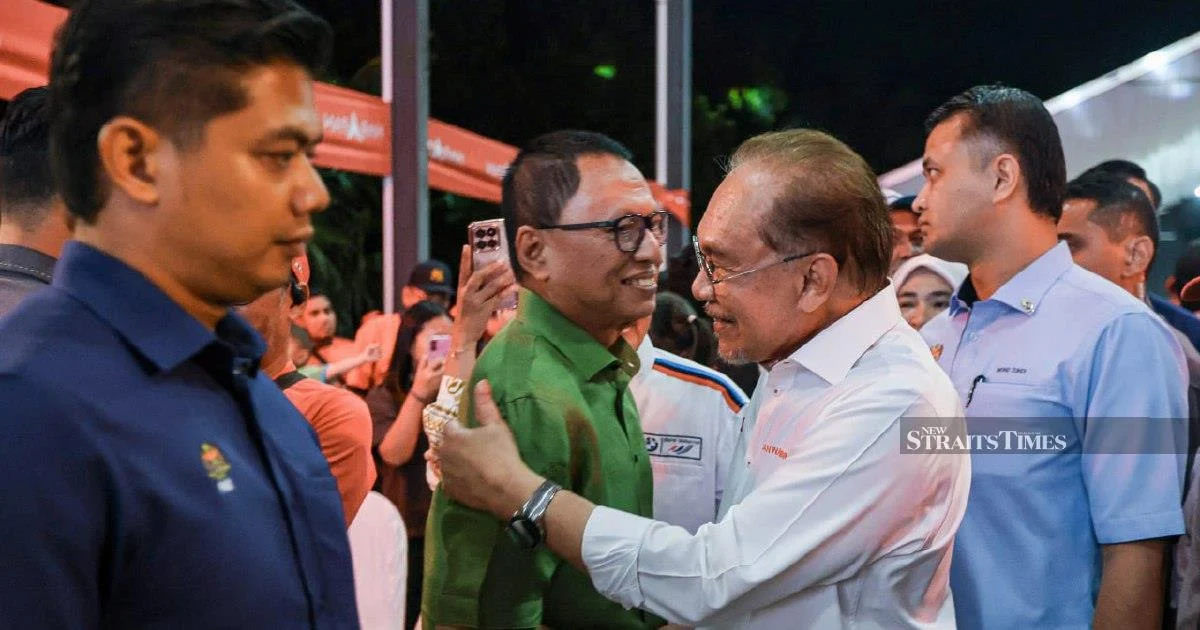
Bersama leader Datuk Seri Rafizi Ramli has delivered a pointed jab at Datuk Dr Mohd Puad Zarkashi following a conspicuous public display of solidarity with Prime Minister Anwar Ibrahim in Johor Baru on Saturday, hinting with characteristic wit that the veteran politician may be repositioning himself within the governing coalition.
The comment reflects the ongoing realignment in Malaysia's political landscape, where public gestures between leaders often carry significance far beyond their surface appearance. Rafizi's quip suggests that Puad's embrace with the premier could be interpreted as more than a mere courtesy, instead pointing to potential shifts in patronage networks and political positioning within Pakatan Harapan and its allies.
Puad Zarkashi has long been a prominent figure in Umno, Malaysia's oldest political party, where he has held various significant positions throughout his career. His decision to publicly embrace the prime minister at a gathering in Johor Baru has not gone unnoticed by political observers and rival party leaders alike, who are quick to interpret such visible displays of camaraderie as indicators of changing political fortunes and alliance structures.
Rafizi, as head of Bersama, a component party within the government coalition, occupies a strategic position in Malaysia's current political architecture. His playful yet pointed commentary underscores the delicate balance maintained between coalition partners and the careful watching of senior leaders' public interactions for signs of political manoeuvring. In Malaysian politics, a seemingly spontaneous embrace can trigger waves of speculation about broader coalition dynamics and individual political trajectories.
The timing of Rafizi's remark comes amid broader discussions about the stability and composition of the current government. Coalition governments in Malaysia have historically been fragile arrangements requiring constant negotiation between parties with sometimes competing interests. Each party leader's public profile and relationship with the prime minister carries weight in such configurations, affecting everything from cabinet positions to policy priorities.
Puad's background as a senior Umno member makes his warm interaction with Anwar particularly noteworthy, given the historical tensions between Umno and Anwar's own political journey. The two men have had a complicated history spanning decades, with periods of cooperation interspersed with confrontation. Any apparent softening in relations between them carries implications for how Umno positions itself within the broader coalition framework and whether individual senior figures from the party are moving closer to the government's inner circle.
For Malaysian political observers, such public moments serve as crucial data points in understanding the invisible currents running through the government coalition. Coalition politics often operate on multiple levels simultaneously, with formal institutional structures existing alongside informal networks of influence and patronage. A politician's proximity to the prime minister, demonstrated through such public interactions, can influence their access to resources, their ability to shape policy, and their standing within their own party.
Rafizi's characteristic humour masks a serious observation about the fluidity of political positioning in contemporary Malaysia. The Bersama leader's comment invites readers to consider whether high-profile figures from older established parties like Umno are genuinely repositioning themselves or simply demonstrating the flexible approach to coalition governance that has become necessary for political survival in Malaysia's current environment. Such flexibility has become a survival mechanism in a political landscape where coalition arrangements can shift with surprising speed.
The interaction between Rafizi and Puad also highlights how leaders use public statements and social commentary to signal their awareness of political currents and their ability to read the political landscape. By commenting on Puad's gesture, Rafizi subtly reminds observers of Bersama's role in the coalition while also establishing a narrative about political realignment that serves his party's interests.
For Southeast Asian political analysts watching Malaysian developments, this exchange represents the kind of coded communication that frequently occurs within coalition governments in the region. What appears on the surface as good-natured banter often reflects deeper calculations about power distribution, resource allocation, and the long-term viability of coalition arrangements. Malaysia's experience with coalition governance offers lessons relevant to other multi-party systems in Southeast Asia navigating similar complexities.
The broader context reveals how Malaysian politicians leverage public moments and media commentary to shape perceptions of political movement and influence. By making his observation about Puad, Rafizi contributes to a narrative that keeps coalition dynamics visible and subject to ongoing public and political discussion. This constant negotiation of perceptions and positions represents a core feature of how Malaysia's coalition government maintains its complex balance.
Moving forward, such interactions between senior figures will continue to merit close observation from political analysts and coalition partners alike. The stability of Malaysia's current governing arrangement depends partly on the ongoing calibration of relationships between party leaders and their public positioning relative to the prime minister. Rafizi's wry observation serves as a reminder that in Malaysian politics, nothing is truly casual, and every public gesture carries potential significance for the broader political system.

