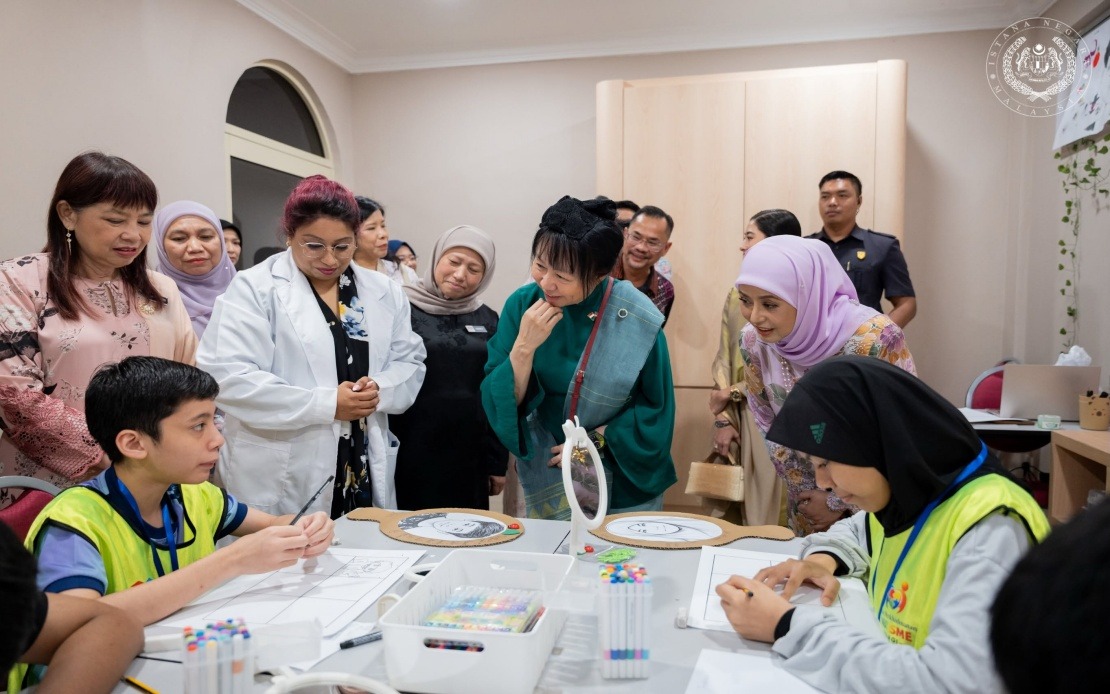
Malaysia's Queen Raja Zarith Sofiah joined Singapore First Lady Jane Ittogi Shanmugaratnam for a visit to the Bangi Autism Service Centre in the Klang Valley on July 14, marking a bilateral engagement that underscores both nations' commitment to advancing social welfare and disability support services. The official tour occurred as part of Singapore President Tharman Shanmugaratnam's state visit to Malaysia, reflecting the complementary nature of diplomatic engagements across the causeway that extend beyond formal bilateral meetings and into the realm of social development.
The Queen was joined by Tunku Tun Aminah Sultan Ibrahim in welcoming Jane Ittogi, setting the tone for a cordial exchange centred on shared experiences in managing autism services. The visiting First Lady's presence underscored Singapore's interest in understanding Malaysian approaches to autism care, particularly through a public-private partnership model that has gained prominence across the region. Prime Minister's wife Datuk Seri Dr Wan Azizah Wan Ismail attended alongside several government officials, including Women, Family and Community Development Minister Datuk Seri Nancy Shukri and her deputy Lim Hui Ying, signalling high-level governmental interest in the sector.
The delegation's tour covered multiple facilities within the Bangi centre, including the Activities of Daily Living Room, where individuals with autism acquire practical skills essential for independent living, and the Occupational Therapy Room where therapeutic interventions are delivered. The gymnasium and supporting infrastructure demonstrated the centre's comprehensive, multi-disciplinary approach to autism management, moving beyond traditional clinical models toward a holistic framework that addresses daily functioning alongside therapeutic needs. This integrated approach reflects contemporary best practices in disability support, where the emphasis has shifted toward maximising independence and community integration rather than institutional care.
Minister Nancy Shukri disclosed that Malaysia's Social Welfare Department has registered 93,199 individuals with autism as of June, a figure that provides crucial insight into the scale of the condition within the local population. She projected that this number would continue climbing in coming years, driven by enhanced public awareness campaigns and improved access to diagnostic services across the country. The trend of rising autism registrations mirrors similar patterns across developed and developing nations, where better screening infrastructure and reduced social stigma have led to increased case identification. Malaysia's healthcare system has progressively expanded autism screening capabilities in recent years, though disparities remain between urban centres like Kuala Lumpur and Selangor versus more remote states.
The Bangi facility itself represents an evolving model of disability service delivery in Malaysia, operating through strategic collaboration between government agencies and the non-profit sector. The National Autism Society of Malaysia and the Damansara Damai Community-Based Rehabilitation Centre jointly manage the centre, combining NASOM's specialised expertise with community-based rehabilitation approaches. This partnership structure addresses resource constraints that often limit public sector capacity while leveraging NGO agility and innovation. Such collaborative arrangements have become increasingly common in Malaysian social services, particularly as government budgets face pressure and civil society organisations demonstrate effectiveness in targeted interventions.
The visit's timing during a presidential state visit carries symbolic weight beyond the immediate engagement with autism services. It signals that Malaysia and Singapore view social welfare as integral to bilateral relations, not merely peripheral to trade and security discussions. For Malaysian policymakers, Jane Ittogi's interest in local autism services reflected Singapore's active monitoring of social development practices across the region, as the city-state frequently benchmarks its own policies against neighbouring countries' approaches. For Singapore's leadership, the tour provided exposure to Malaysia's community-based rehabilitation strategies, which may inform refinements to how Singapore manages its own growing autism population.
The implications for Malaysian autism advocacy are substantial. Official recognition through high-level visits enhances the sector's political priority and may influence budgetary allocations toward autism services in coming fiscal cycles. Parents and advocacy organisations have long pressed for expanded funding and resources, and governmental showcasing of autism facilities to international dignitaries suggests receptiveness to elevating the issue's profile. The event also provides an opportunity for the National Autism Society and community rehabilitation centres to demonstrate their contributions and justify continued or enhanced government support.
Regionally, the tour reflects broader Southeast Asian trends in acknowledging neurodevelopmental conditions and integrating autism support into mainstream healthcare and welfare frameworks. Indonesia, Thailand, and the Philippines face similar challenges in expanding diagnosis and care infrastructure, and Malaysia's approach—combining public provision with NGO partnerships—offers a replicable model that other nations are studying. As awareness spreads across the region, countries increasingly recognise that autism prevalence in their populations likely resembles Malaysia's rates, prompting similar policy responses and investment decisions.
Looking forward, the visit positions Malaysia to deepen its expertise in autism service delivery while learning from Singapore's systematic approaches to population health management. The exchange of best practices, explicitly mentioned by officials as an outcome of the tour, may yield collaborative research initiatives, staff training programmes, or policy harmonisation on diagnostic standards. Such bilateral cooperation strengthens the regional foundation for addressing neurodevelopmental conditions across national borders, facilitating knowledge transfer that ultimately benefits affected families throughout Southeast Asia.

