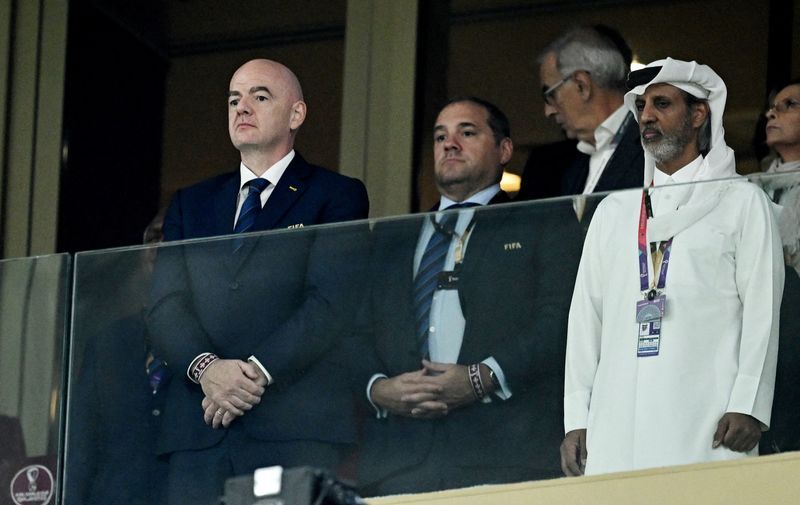
Qatar's Football Association has escalated tensions within Asian football's governing structure by publicly challenging the Asian Football Confederation's authority to issue a joint statement with UEFA and CONCACAF that criticised FIFA President Gianni Infantino's conduct. The dispute, conducted through an extraordinary exchange of formal letters, exposes deeper rifts over procedural governance and leadership accountability within the AFC—an organisation typically reluctant to air such disagreements publicly.
The controversy stems from a proposal by Infantino to introduce private investment into the FIFA World Cup, an initiative developed without consulting regional confederations before being presented directly to FIFA's 211 member associations. This top-down approach triggered significant opposition from Europe and the Americas, with UEFA and CONCACAF releasing a joint statement questioning the FIFA President's leadership and decision-making processes. The AFC subsequently added its voice to this criticism, but Qatar's response suggests this endorsement came without the transparent deliberation expected of such consequential institutional positions.
Qatar Football Association President Hamad bin Khalifa Al-Thani, writing in his third letter to AFC leadership, argues that the confederation's defence of its actions inadvertently confirmed that no meaningful consultation occurred. Al-Thani contends that whether the AFC executive committee, individual member associations, or the broader membership was consulted prior to the statement's release remains unanswered—a procedural failure he characterises as fundamentally delegitimising the AFC's position. The persistence of this complaint through successive correspondence indicates genuine frustration rather than a passing disagreement.
The substance of Al-Thani's objection hinges on institutional authority and member representation. As an AFC member holding a FIFA Council seat, Qatar's leader argues that Sheikh Salman bin Ebrahim Al-Khalifa, the Bahraini AFC President, exceeded his mandate by issuing the statement without securing prior approval from the 47 member associations he purports to represent. In response, Sheikh Salman defended his prerogative to act decisively on matters affecting Asian football's interests, citing his constitutional authority as confederation president and previous instances where he issued statements on behalf of the AFC without exhaustive member consultation.
The irony embedded in this dispute is striking. Infantino faced criticism for unilaterally developing the investment proposal without confederal input, yet the AFC's response to that very criticism was itself challenged as having bypassed similar consultative processes. This parallel structure raises uncomfortable questions about whether regional football bodies operate with sufficient democratic accountability or whether executive decision-making inevitably outpaces membership deliberation even when transparency is ostensibly valued.
Qatar's position carries particular weight given its unusual status within Asian football politics. The nation hosted the 2022 FIFA World Cup under significant international pressure and scrutiny, experiences that afforded it visibility and influence disproportionate to its football development levels. Six AFC members, including Qatar, declared early support for Infantino during the investment proposal crisis, positioning themselves against the European and North American confederations. This alignment with the FIFA President's interests may explain the Qatari body's willingness to challenge the AFC's statement as procedurally invalid—a technical objection that conveniently undermines opposition to Infantino's leadership.
Sheikh Salman countered by referencing past AFC statements on matters of significance, particularly the confederation's public backing for Qatar's 2022 World Cup hosting. He argued that such precedents justified his authority to issue the recent joint letter. Yet Al-Thani's response contains a crucial distinction: previous statements in support of Qatar's World Cup reflected the AFC's institutional interests as an organisation, whereas the Infantino letter represented a position on FIFA governance that individual members might reasonably view differently. This differentiation suggests that not all matters merit the same level of executive unilateralism.
The public nature of this exchange is itself noteworthy. The AFC, like most continental football bodies, typically conducts sensitive governance matters behind closed doors, with disagreements resolved through private negotiation rather than open letters accessible to media scrutiny. That Qatari officials have chosen to press their case through correspondence subsequently shared with international news organisations signals either exceptional frustration with internal resolution mechanisms or a strategic calculation that public pressure might be more effective than confidential advocacy.
For Malaysian and Southeast Asian football stakeholders, this dispute carries implications beyond inter-confederation relations. The AFC encompasses 47 members from vastly different economic, political, and footballing contexts. Smaller nations and those lacking permanent FIFA Council representation depend on the confederation's governance structures to amplify their voices. If the AFC executive operates without meaningful member consultation on significant matters, smaller associations face marginalisation in continental and global football decision-making. Malaysia, as a mid-tier AFC member with limited direct FIFA influence, has material interest in whether the confederation functions as a genuine collective body or as an institution where executive leadership exercises substantial autonomy.
The underlying governance question remains unresolved. The AFC's formal response to Qatar's third letter has not yet been released, leaving open whether the confederation will commit to enhanced consultation procedures or defend the necessity of executive discretion in time-sensitive matters. Different confederations have adopted varying approaches to member consultation, from elaborate committee structures that slow decision-making to streamlined executive models that prioritise efficiency. The AFC must balance these competing values, particularly as global football politics grow more contentious and consequential governance decisions require broader legitimacy.
Infantino's reelection campaign, scheduled for next year, forms the backdrop to this entire sequence. By challenging the AFC's authority to criticise him, Qatar and its supporters effectively question whether the statement represents genuine Asian football consensus or merely executive positioning. Should Infantino succeed in framing AFC opposition as procedurally illegitimate, he weakens one of the few institutional voices capable of constraining FIFA's executive power. Conversely, if the AFC strengthens its consultative mechanisms, it may emerge with greater legitimacy precisely when football's governance structures face unprecedented scrutiny and reform pressure from multiple regions simultaneously.

