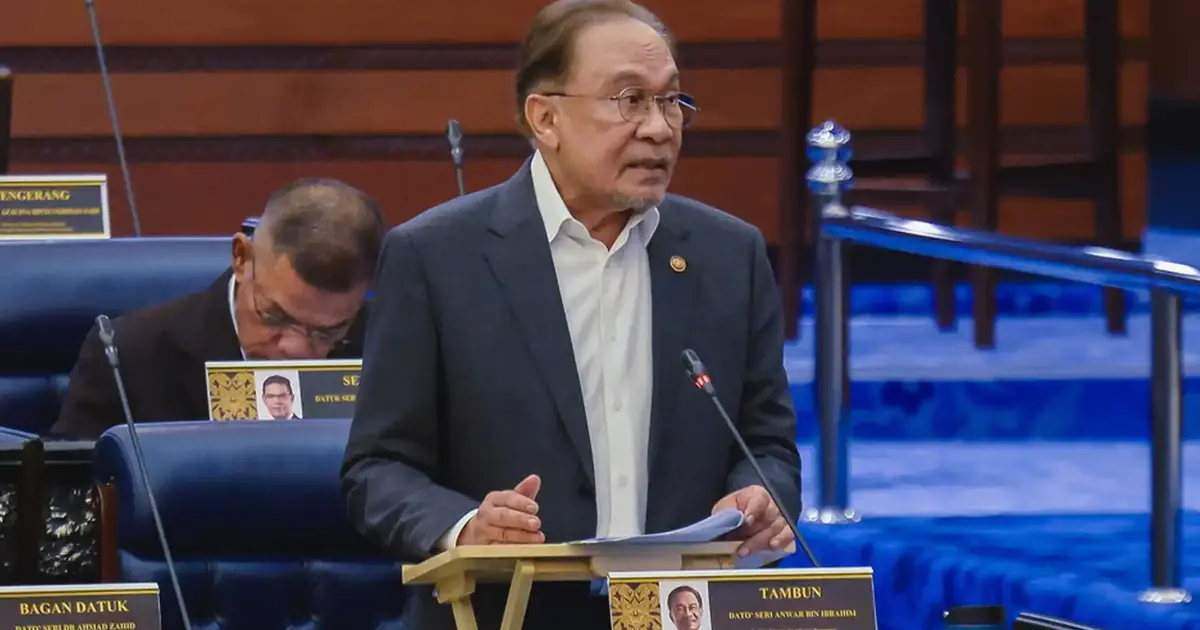
Prime Minister Anwar Ibrahim has delivered a direct message to Malaysia's state governments: do not anticipate financial rescue from Putrajaya when your development projects exceed their original budgets. In a significant statement on federal-state fiscal relations, Anwar stressed that any state government seeking additional funds from the federal purse—whether through increased allocations or fresh loans—would need to engage in formal renegotiation rather than expect automatic approval.
The prime minister's position reflects growing scrutiny over how development costs are managed across Malaysia's multi-tier governance structure. State administrations have increasingly turned to the federal government for supplementary funding when initial project estimates prove insufficient, a pattern that has strained federal finances and raised questions about project planning and accountability at the state level. Anwar's firm stance signals a shift toward stricter fiscal discipline, placing responsibility squarely on state governments to manage their budgets more carefully and to justify any funding requests with transparent cost analyses.
This approach carries particular significance for Malaysia's federal system, where states retain considerable autonomy over development projects yet remain dependent on federal support for major infrastructure initiatives. The tension between state autonomy and fiscal responsibility has long complicated intergovernmental relations, especially when politically divergent administrations govern different regions. By insisting on renegotiation rather than blanket approvals, Anwar is attempting to establish clearer boundaries around federal liability and to encourage states to absorb cost overrun risks themselves.
The implications for Malaysian development planning are substantial. State governments will need to conduct more rigorous feasibility studies and cost projections before launching major projects, knowing that Putrajaya will not serve as an unlimited safety net. This should theoretically lead to more disciplined project management, though it may also deter some states from pursuing necessary infrastructure if they lack confidence in their own revenue-raising capacity. The approach mirrors broader global trends toward fiscal federalism, where lower-tier governments assume greater responsibility for their financial decisions.
For Malaysian readers and taxpayers, Anwar's statement underscores a core challenge facing the country's public finances. Federal resources are finite, and demand from states for infrastructure funding consistently outpaces available supply. By refusing to absorb state cost overruns, the federal government protects itself against moral hazard—the risk that states will become careless with budgeting if they know Putrajaya will cover shortfalls. This establishes incentives for prudent planning from the outset.
However, the policy also raises practical concerns about development equity across Malaysia's varied states. Wealthier states with stronger revenue bases can absorb cost increases internally; poorer states may struggle to complete essential projects if hit with unexpected expenses. The differential impact across regions could widen existing disparities unless federal support is carefully calibrated to account for these differences. Anwar's framework does not address whether exceptions might be made for economically disadvantaged states facing genuine hardship.
The timing of this declaration matters too. Malaysia has been managing a substantial fiscal deficit in recent years, with government debt reaching concerning levels relative to GDP. Federal finances remain under pressure from various spending commitments, from defence and civil service salaries to debt servicing costs. In this context, preventing additional unbudgeted expenses from state projects becomes part of broader fiscal consolidation efforts. Anwar's statement aligns with his administration's wider push for financial discipline across government.
State governments will interpret this directive through their own political lenses. Opposition-controlled states may view it as a test of their fiscal independence, an opportunity to demonstrate they can fund development without federal patronage. Government-aligned states may see it as a challenge to negotiate harder upfront to secure adequate initial funding. The practical effect depends heavily on how Putrajaya implements this policy when specific requests arrive—whether it maintains strict consistency or allows flexibility for compelling cases.
The renegotiation requirement itself introduces procedural complexity. States will need to present revised cost estimates, revised timelines, and justifications for increases. This process could slow project completion or create disputes over which cost increases warrant federal support. Clear guidelines about what constitutes legitimate claims for additional funding versus preventable overruns would help, though developing such guidelines remains contentious given varied circumstances across different projects and regions.
International experience offers mixed lessons. Some federations have successfully implemented strict cost-control regimes; others have found that rigid rules inadvertently damage critical infrastructure development. Malaysia's approach will likely need refinement as actual cases test the policy's boundaries. The question of whether 'cost increase' refers only to unforeseen circumstances or also includes design changes initiated by states themselves will become important in practice.
Anwar's declaration also reflects confidence in his government's political capital to enforce such a policy. Previous administrations faced difficulty maintaining fiscal discipline when states from the ruling coalition requested additional support, creating precedent for flexible interpretation. If the current government can sustain its position consistently across both allied and opposition-run states, it may successfully reshape expectations about federal-state fiscal relations. If it weakens selectively, credibility will suffer.
Ultimately, the prime minister's message attempts to rebalance an asymmetric relationship where state demand for federal resources perpetually exceeds supply. By requiring renegotiation and rejecting automatic coverage of cost overruns, Anwar is trying to introduce market discipline into federally-funded development. Whether this approach enhances project quality and fiscal responsibility, or simply defers needed infrastructure while redistributing risk, will become clearer as Malaysia's states respond to this new fiscal reality.

