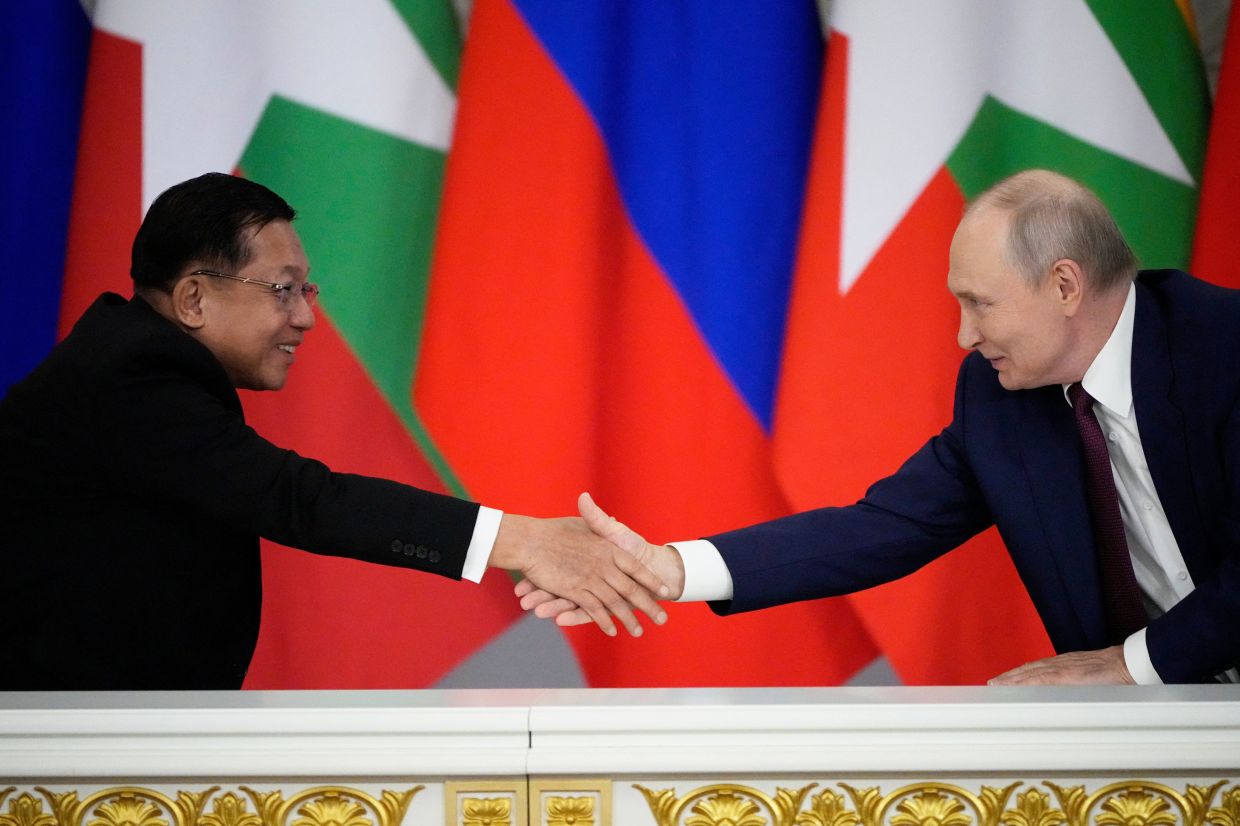
Russian President Vladimir Putin used bilateral talks with Myanmar's leader Min Aung Hlaing in Moscow to underscore the strategic importance of deepening ties between the two countries. The meeting on Tuesday marked the Myanmar leader's first visit to Russia since formally assuming the presidency in April, and represented at least the fourth encounter between the pair since Russia's invasion of Ukraine fundamentally reshaped global geopolitics. Putin characterised relations between Moscow and Naypyidaw as having become "especially trusting" in recent years, signalling the Kremlin's determination to cement its position as a key partner to Myanmar's military rulers at a time when much of the Western world has isolated them following the 2021 coup.
The economic dimension of the partnership featured prominently in Putin's remarks and in the composition of his delegation, which included high-ranking officials overseeing foreign policy, finance, energy and defence. Russia is actively pursuing major infrastructure investments in Myanmar, with Putin explicitly referencing plans to construct a power plant and oil refinery in the country's southern regions. Beyond these flagship projects, Moscow has signalled its ambition to participate in geological surveys and hydrocarbon exploration activities, positioning itself as a long-term economic partner willing to develop Myanmar's energy sector during a period when Western investment has become politically sensitive and largely unavailable.
The nuclear dimension of the bilateral relationship reflects perhaps the deepest level of technological cooperation between the two nations. Myanmar is collaborating with Russia's state nuclear corporation Rosatom to develop a small-scale nuclear power plant, a project that Moscow frames as an initial foray into deploying atomic technology across civilian sectors including healthcare, agriculture and industrial applications. This cooperation signals Russia's willingness to transfer advanced technological capabilities to Myanmar, a move that would have been unthinkable under previous democratic administrations but has become feasible under the current military government's governance structure.
Military and defence cooperation forms the bedrock of the Russia-Myanmar relationship, with Putin explicitly acknowledging what he termed "close military and military-technical cooperation" between the two countries. According to a United Nations report from May 2023, Russia has supplied more than US$400 million in advanced weaponry to Myanmar's armed forces since the 2021 coup, making Moscow one of the handful of major arms suppliers willing to do business with Naypyidaw despite international criticism and sanctions regimes. This arms relationship has grown steadily more important to Myanmar's military establishment as Western suppliers have withdrawn and neighbouring countries have maintained cautious distance from the regime.
Putin's characterisation of relations as bearing "good prospects" for cooperation on liquefied natural gas exports points to future energy trade possibilities that could prove economically significant for both parties. For Russia, such arrangements would provide alternative markets for LNG production at a time when European demand has collapsed following Western sanctions and the continent has redirected its energy sourcing away from Moscow. For Myanmar, Russian investment and technology transfer in the energy sector could generate substantial government revenues while reducing the country's dependence on Chinese capital, a consideration that resonates across Myanmar's political and military leadership.
The timing of this visit underscores Min Aung Hlaing's broader diplomatic strategy following the controversial August 2023 election that international observers including the United Nations described as fundamentally flawed. Rather than accepting international isolation, the Myanmar leader has embarked on an ambitious tour of regional and traditional allies, recently visiting China, India, Laos and Thailand in pursuit of legitimacy and economic engagement. The Moscow trip forms part of this larger effort to demonstrate that Myanmar's military government possesses viable partnerships and can govern without Western recognition, a narrative that resonates domestically even as it masks international concern about democratic backsliding and human rights abuses.
The composition of Myanmar's delegation to Moscow, which included multiple cabinet ministers and the head of the Myanmar Space Agency, underscores the comprehensive nature of the bilateral relationship. Min Aung Hlaing held separate meetings with Russian Prime Minister Mikhail Mishustin and Vyacheslav Volodin, the speaker of the lower house, ensuring engagement across Russia's political and economic establishment. The schedule also included participation in a Myanmar-Russia Business Forum, signalling the Kremlin's intention to facilitate private sector connections and commercial partnerships that could institutionalise economic ties beyond governmental relations.
Russia's willingness to maintain and deepen engagement with Myanmar's military rulers distinguishes Moscow from the Western alliance and positions the Kremlin as a dependable partner for regimes facing international isolation. This approach reflects both pragmatic geopolitical calculation and ideological sympathy between Moscow and military-led governments that share scepticism toward international institutions and Western-dominated governance frameworks. For Myanmar's leadership, Russian partnership provides strategic breathing room and tangible economic benefits that cushion the impact of Western sanctions and frozen development assistance.
For Southeast Asia more broadly, deepening Russia-Myanmar ties represent a significant shift in regional geopolitics. Myanmar's strategic location along China's southwestern frontier makes it a critical country for both Beijing and Moscow, and their ability to coordinate support for the military government constrains regional flexibility and limits prospects for democratic restoration in the near term. The Russian commitment to major infrastructure projects suggests Moscow views Myanmar as a long-term strategic interest rather than a temporary tactical engagement, with implications for how regional powers calibrate their own policies toward Naypyidaw.
Putin's emphasis on working "actively" with Myanmar on the international stage hints at potential cooperation on United Nations votes and multilateral forums where Myanmar's military government has faced criticism. As a non-permanent Security Council member in past terms and a regular participant in UN General Assembly votes, Myanmar's support could prove valuable to Russia as it faces international pressure and isolation. This dimension of the partnership, though less publicly discussed than energy or defence cooperation, may ultimately prove as consequential as the more tangible economic arrangements being negotiated.
The first visit by Russian Security Council Secretary Sergei Shoigu to Myanmar in February, immediately following the disputed August election, established the template for this pattern of high-level engagement. That visit, which made Shoigu the first foreign official to arrive after the contested polls, signalled Russia's determination to legitimise the military government's electoral process and demonstrate that isolation from the West need not translate into diplomatic weakness. Putin's meeting with Min Aung Hlaing continues this established trajectory of steadfast support.

