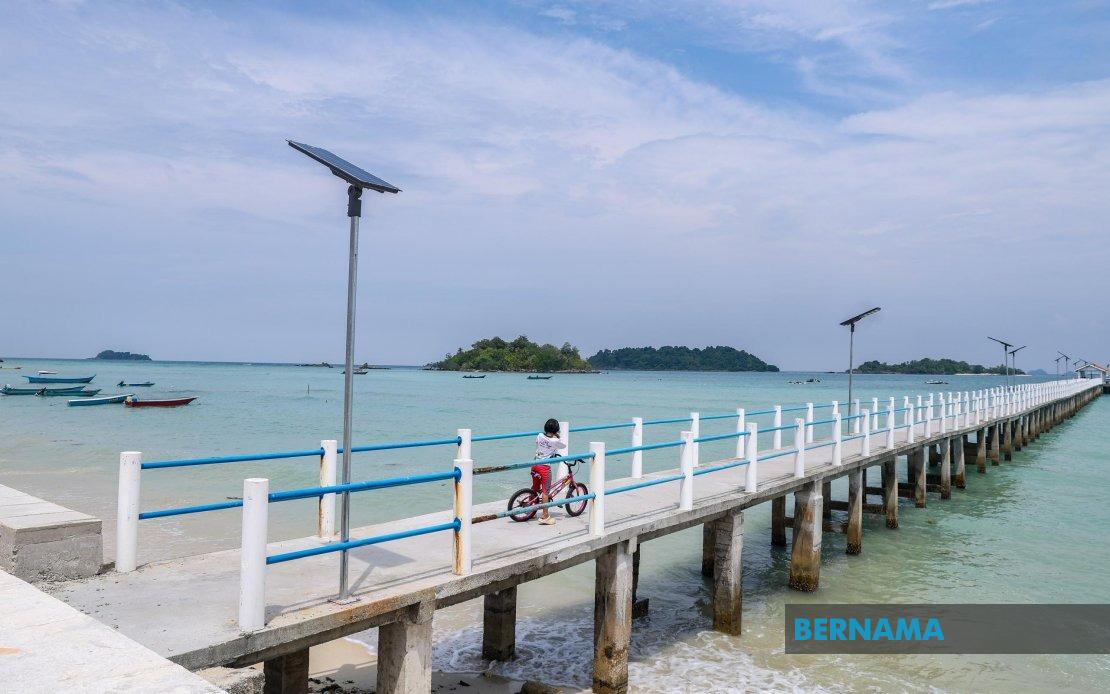
Ahead of Saturday's Johor state election, residents of two small villages on Pulau Tinggi are demanding urgent intervention from their incoming state representative to tackle infrastructure decay and housing deprivation that have plagued their isolated community for years. The island's approximately 150 inhabitants, concentrated in Kampung Pasir Panjang and Kampung Tanjung Balang, have long endured substandard living conditions and deteriorating public facilities, issues that remain conspicuously absent from mainstream campaign discourse despite affecting one of Johor's most vulnerable populations.
The Kampung Pasir Panjang jetty stands as the physical embodiment of the island's broader neglect. Since around 2017, the facility—which serves as the lifeline for both the island's tourism industry and its fishing community—has fallen into significant disrepair. Despite the visible deterioration, local residents continue to depend on the aging structure, with village authorities continually reminding them to exercise caution. Rossana Hussin, the 57-year-old Kampung Pulau Tinggi chief who assumed office in 2024, confirms that formal upgrade applications were lodged with the Mersing District Office back in March and received encouraging preliminary responses. Yet months have passed without concrete action, leaving the community in limbo as they await bureaucratic machinery to deliver tangible results.
The housing situation compounds the island's development challenges. Kampung Tanjung Balang is predominantly home to B40-category fishermen—Malaysia's lowest-income household bracket—many of whom inhabit structures requiring substantial repairs or remain unfinished. For these families already stretched thin by the volatile economics of artisanal fishing, home maintenance becomes an impossible luxury. Rossana emphasizes that targeted housing repair assistance would materially improve living standards and provide psychological relief to families who have resigned themselves to substandard conditions. The issue transcends mere comfort; adequate housing directly influences health outcomes, children's educational performance, and overall family stability in a community where economic opportunities are severely constrained.
The timing of these concerns carries particular significance. The 16th Johor state election will determine which 56 lawmakers represent the state's 2.7 million eligible voters, with the Tenggaroh seat responsible for Pulau Tinggi and surrounding areas. Village leaders are strategically raising these issues now, hoping that the electoral moment might galvanize political attention and commitments from candidates seeking to secure votes. The implicit message is clear: Pulau Tinggi's residents, though geographically marginal and numerically insignificant in statewide terms, warrant inclusion in the incoming government's development agenda.
Beyond immediate infrastructure needs, deeper structural challenges threaten the island's viability as a functioning community. Mariam Mamat, an 85-year-old resident, articulates a concern that extends beyond potholes and housing repairs—the systematic depopulation of Pulau Tinggi itself. She recalls when the island supported a considerably larger population, but successive waves of outmigration have depleted the community as younger residents pursue employment opportunities on the mainland and others relocate to Federal Land Development Authority (Felda) schemes. This demographic drain reflects a familiar pattern across Malaysia's peripheral rural areas, where limited economic prospects and inadequate services drive persistent youth migration toward urban centers and more developed regions.
Tourism represents the one potential economic engine the island possesses, yet it remains severely underdeveloped. Pulau Tinggi's natural beauty and cultural character could theoretically attract visitors seeking authentic experiences beyond Mersing's mainstream offerings. However, without a functioning jetty to reliably transport tourists, without adequate accommodation infrastructure, and without coordinated marketing efforts, the tourism sector languishes at a fraction of its potential. Revitalizing this industry would simultaneously generate employment for young people who remain on the island, create pathways for economic diversification beyond fishing, and provide rationale for residents to stay rather than seek opportunities elsewhere. The case for tourism development thus becomes intertwined with broader questions of community survival and intergenerational equity.
The obstacles to rapid resolution are real. Bureaucratic procedures demand formal applications, feasibility studies, budgetary allocations, and tender processes—all of which consume time that island residents experience as stagnation. The jetty upgrade and housing assistance program likely competed with countless other local priorities across Johor's 56 constituencies for limited state resources. However, the very modesty of these requests—a functional jetty, housing repairs for low-income families, support for a struggling economic sector—suggests that political will rather than fiscal impossibility represents the genuine constraint. Previous state governments may have simply deprioritized Pulau Tinggi, treating it as too remote and too small to warrant urgent attention.
The incoming Tenggaroh representative, whoever wins Saturday's election, will inherit an implicit social contract. The residents have articulated their needs clearly and communicated them through appropriate channels. They have allowed the application process to unfold without disruptive agitation. Now they expect results—not necessarily within days, but within a reasonable timeframe that demonstrates their concerns register as legitimate priorities rather than background noise. This expectation reflects a fundamental democratic principle: elected representatives should dedicate meaningful attention to their most marginalized constituents, not merely to swing voters in competitive urban precincts.
The broader implications extend across Malaysian electoral politics and development philosophy. Pulau Tinggi exemplifies how rural and peripheral communities often experience democratic participation as performative—elections arrive with campaign promises, but between elections, development languishes and infrastructure decays. Addressing this pattern requires conscious commitment to inclusive development that reaches beyond population centers and politically influential constituencies. The Johor state election provides an opportunity to reset expectations, establishing that no community, however small and remote, will be systematically neglected. Whether the incoming government meets this standard will reveal whether electoral rhetoric translates into genuine policy reorientation or remains mere campaign theater.

