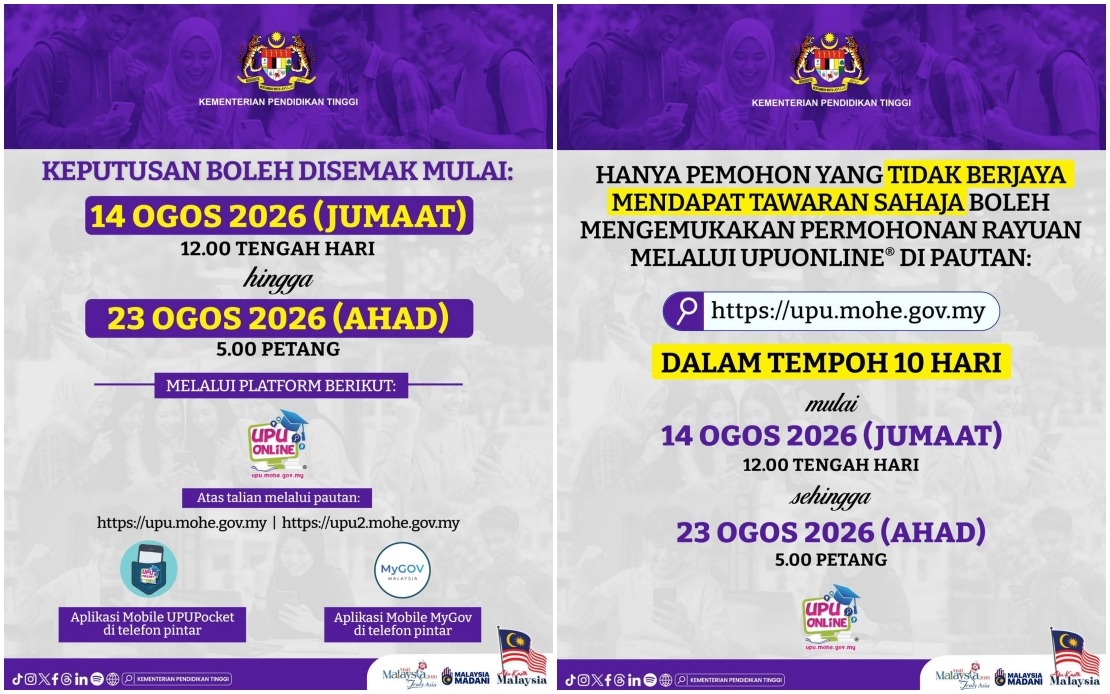
The Ministry of Higher Education will unveil admission results for the 2026/2027 academic year on August 14, marking a pivotal moment for tens of thousands of STPM and equivalent qualification holders awaiting placement at Malaysia's public universities. The announcement comes as the country's higher education system continues its transition toward digital-first student management, with the ministry having consolidated application and results tracking into centralised online portals accessible nationwide.
Prospective students can access their outcomes starting at noon on August 14 through three primary channels. The official UPUOnline platform (https://upu.mohe.gov.my and https://upu2.mohe.gov.my) will display results alongside the UPUPocket mobile application and the government's MyGov digital ecosystem. This multi-platform approach reflects efforts to ensure equitable access across different demographic groups, though it places responsibility on applicants to navigate multiple systems within the results window, which closes at 5 pm on August 23.
The confirmation phase begins immediately after results release, running from August 15 through August 23 as candidates respond to offers through individual university portals. The Ministry of Higher Education has emphasised that this nine-day window is critical, as failure to confirm acceptance by the deadline may result in forfeiture of offers. Official acceptance letters from universities will commence distribution on August 15 for those who confirm their willingness to enrol, establishing the administrative foundation for the incoming cohort.
For applicants unsuccessful in the initial round, the ministry provides a secondary pathway through appeals submitted between August 14 and 23. However, this mechanism operates under significant constraints. Appeals can only be entertained for programmes and universities with remaining vacancies after existing acceptances are registered, meaning availability is unpredictable and limited. This creates considerable uncertainty for borderline candidates, who may face weeks of waiting before learning whether alternative placements materialise.
The final allocation of places represents a closed determination, as the Ministry of Higher Education has stipulated that no programme or university changes are permissible following the August 14 announcement. This policy eliminates flexibility for students reconsidering their choices after receiving results, effectively locking placement decisions regardless of changed circumstances or preferences. Such rigidity has implications for student welfare and satisfaction, as those dissatisfied with their allocated institutions have minimal recourse beyond the unpredictable appeal process.
For Malaysian education stakeholders, this admission cycle underscores ongoing structural challenges in tertiary access. The concentration of places within a limited window and the restriction on switching between programmes creates bottlenecks that particularly disadvantage first-generation university students and those from disadvantaged backgrounds who may lack sophisticated navigation of multiple digital platforms. The digital-first approach, while modernising processes, potentially excludes applicants with inconsistent internet connectivity or limited technological familiarity.
The timing of results release—mid-August for a September intake—compresses the preparation period for accepted students. Accommodation arrangements, course materials procurement, and administrative enrolment procedures must occur within weeks, presenting logistical challenges for candidates, families, and institutions alike. International applicants and those requiring relocation face especially compressed timelines.
From a regional perspective, Malaysia's managed admissions system contrasts with less structured approaches elsewhere in Southeast Asia. The UPUOnline framework represents a consolidation of state capacity and institutional coordination that developing education systems in neighbouring countries continue to aspire toward, though implementation remains contingent on sustained digital infrastructure investment and public-sector technological competence.
Universities themselves operate under pressure to accommodate demand with finite resources. The appeal selection policy—contingent on vacancy availability—reflects the reality that many institutions operate at near-maximum capacity. This structural constraint means admission outcomes for substantial portions of applicants hinge not on merit alone but on aggregate enrolment patterns across the entire university system, introducing element of chance beyond individual control.
The August 14 results announcement initiates a series of cascading institutional processes. Universities must rapidly process confirmations, issue documentation, coordinate accommodation, and prepare induction programming for first-year cohorts. Administrative bodies within the Ministry of Higher Education must simultaneously manage appeals and monitor system performance, creating intensive operational demands during the traditional August holiday period.
Looking forward, the admission cycle's structure raises questions about future flexibility in higher education access. As Malaysia's tertiary system expands, consideration may be warranted regarding whether rigid admission windows and programme-locking policies serve contemporary learner needs. Increasing numbers of mature-age students, part-time learners, and those pursuing non-linear educational pathways may require more adaptable admission architectures.

