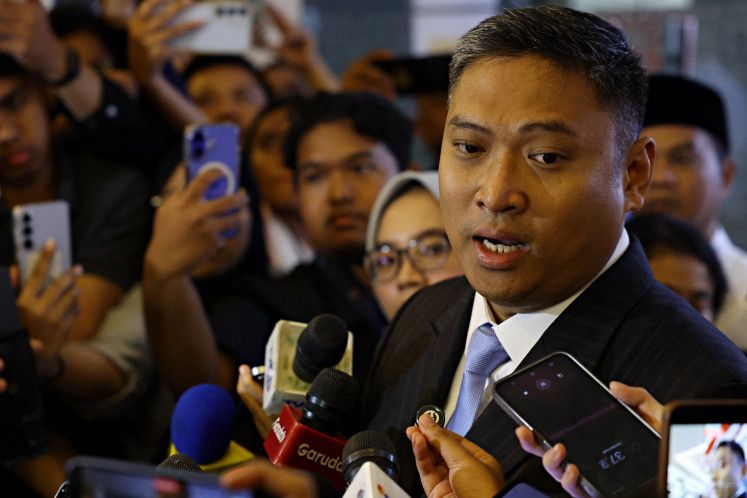
President Prabowo Subianto's ambitious free nutritious meals initiative has encountered yet another leadership crisis, with the National Nutrition Agency (BGN) losing its second chief in as many months. The departure of Nanik Sudaryati Deyang, who announced her resignation via Facebook on Wednesday citing pressing health concerns, underscores deepening institutional weakness in what remains one of the administration's most visible policy commitments to Indonesian voters.
Nanik's decision to step down came just weeks into her tenure, following her predecessor Dadan Hindayana's arrest on corruption charges in June. Dadan and two deputies faced investigation over alleged procurement and financial irregularities within the multitrillion-rupiah programme, prompting Prabowo to dismiss him and install Nanik as a reformer. However, her rapid departure suggests the role has become untenable, with the BGN head bearing extraordinary institutional pressure that has become physically debilitating.
The outgoing chief provided a rare window into the psychological toll of overseeing the agency's sprawling operations. Nanik disclosed that doctors had identified a coronary blockage, a condition she attributed partly to the acute stress of managing such enormous public resources. In emotional terms, she described the responsibility as equivalent to "standing on the edge of a steep cliff" where miscalculation could prove catastrophic. Her admission that she obsessively questioned policies and refused to sign documents independently reveals a leadership culture consumed by fear of accountability rather than focused on delivering services to beneficiaries.
Within hours of accepting her resignation, Prabowo appointed Sudaryono, the Deputy Agriculture Minister and a long-standing party loyalist from Gerindra, as the new BGN chief. Sudaryono's background as a political operative and former presidential aide rather than a technocrat or programme management specialist reinforces analyst concerns that the initiative has become hostage to political rather than administrative imperatives. His inauguration at the State Palace in Jakarta signalled that Prabowo remains personally invested in salvaging the programme's reputation, yet the reliance on party-aligned figures raises questions about whether reform will prioritise institutional independence or political rehabilitation.
Acknowledging past governance failures, Sudaryono promised increased transparency and digitalisation of manual processes to prevent wrongdoing. His pledge that "nothing should happen behind closed doors anymore" addresses legitimate public concern about financial irregularities, though his political affiliation casts doubt on whether external oversight mechanisms will meaningfully constrain executive discretion. State Secretary Prasetyo Hadi underscored that Sudaryono's selection reflected his involvement in the programme's design phase, suggesting that institutional knowledge rather than reform credentials drove the appointment.
The free meals initiative has endured eighteen months of operational turbulence since its rollout in early 2025. Beyond the recent corruption investigation, the programme has generated persistent complaints about food quality and multiple mass poisoning incidents across the archipelago. These failures triggered a moratorium on new kitchen facilities imposed by Nanik, whose review of nearly 28,000 existing operations prompted fierce pushback from thousands of prospective operators who had invested heavily in infrastructure. The move inadvertently exposed how the programme's rapid expansion had outpaced capacity for quality assurance and worker training.
Facing mounting criticism and implementation chaos, the government has substantially scaled back ambitions. The BGN announced Tuesday that the 2026 provisional budget has been reduced from Rp335 trillion to Rp229 trillion, a 32 per cent reduction that reflects acknowledgment of the programme's inability to absorb allocated resources effectively. The beneficiary target for next year has similarly declined from 82.9 million people to 62.7 million, encompassing schoolchildren, toddlers and pregnant women but covering a markedly smaller population than originally envisioned.
Deputy BGN chief Agustina Arumsari framed the retrenchment as a strategic reorientation toward quality rather than scale, announcing that the agency would eschew fixed beneficiary targets in 2026 to focus on service improvement. However, this represents a fundamental retreat from Prabowo's campaign messaging, which positioned universal free meals as a cornerstone anti-poverty initiative. The decision to prioritise qualitative over quantitative metrics suggests recognition that expanding the programme faster than institutional capacity could accommodate had become counterproductive, yet it also signals that Prabowo's political vision has collided with administrative reality.
Political analyst Wasisto Raharjo Jati attributed the succession of crises to fundamental deficiencies in the programme's conceptualisation and planning architecture. Despite its elevation as a presidential priority, Wasisto observed that the initiative reflected "political ambition" more than "technocratic preparation," a diagnostic that points to the administration's tendency to announce flagship policies before establishing operational frameworks. The conviction that resources and political will alone suffice to implement complex mass programmes has proven illusory, with the BGN lacking the institutional depth, technological infrastructure and human capital necessary to manage a budget of such magnitude.
For regional observers, the free meals controversy illuminates persistent governance challenges across Southeast Asia, where newly elected leaders frequently announce ambitious social spending initiatives that subsequently encounter implementation bottlenecks. Indonesia's experience suggests that scaling welfare programmes rapidly without prior pilot testing and capacity assessment creates vulnerabilities to corruption, service failures and eventually policy reversal. The appointment of Sudaryono, while politically pragmatic, does not signal confidence that systemic institutional reforms will occur during the remainder of Prabowo's administration.
The programme's trajectory will likely influence public perceptions of the Prabowo presidency during its critical first year. While the retrenchment may reduce immediate governance risks by narrowing the scale of operations, it also delivers a symbolic blow to campaign commitments that resonated with voters seeking concrete economic relief. Whether Sudaryono can rehabilitate the BGN's reputation and establish sustainable operations remains uncertain, but his political profile suggests that the administration prioritises damage control and narrative management over deep institutional overhaul.
Looking forward, the BGN episode highlights the tension between presidential vision and bureaucratic capacity that defines governance in emerging democracies. Prabowo's team faces a choice between further scaling back the programme to match current institutional capabilities or investing substantially in systems, training and accountability mechanisms that would enable meaningful expansion. Current trajectory suggests the former path will prove more politically expedient, converting a flagship initiative into a more modest targeted programme that quietly underperforms against original promises.

