President Prabowo Subianto is stepping back from his originally conceived approach to two signature welfare programmes, ordering cabinet-level reviews that hint at a fundamental recalibration of how Indonesia's government delivers nutritional support and rural economic assistance to its most vulnerable populations. The reassessment comes as the free meals initiative and Red and White cooperative scheme have attracted sustained criticism, public demonstrations, and investigations into implementation failures—forcing the administration to confront the political cost of rolling out programmes at such massive scale without adequate safeguards.
The turning point emerged from a four-hour closed-door session at the Palace on Wednesday, July 15, where Prabowo met with cabinet officials overseeing both initiatives. The National Nutrition Agency, tasked with administering the free meals scheme, received explicit instructions to conduct what officials described as a thorough and deliberate examination of current practices. According to Agustina Arumsari, the agency's deputy chief, Prabowo emphasised that all policy adjustments must proceed methodically rather than hastily, reflecting a notably different tone from the aggressive rollout stance that had characterised the programmes' launch.
At the heart of the meals programme review lies a troubling operational reality that has largely escaped public attention: the government's difficulty in balancing universal access against fairness perceptions within mixed-income school environments. The current design provides free meals to approximately 83 million beneficiaries, encompassing schoolchildren across all income levels and pregnant women, funded through a budget allocation of at least Rp 268 trillion (US$19.5 billion) for 2026 alone. Yet Prabowo's direction suggests the government now recognises that blanket provision creates awkward social dynamics when wealthier students receive identical benefits to economically disadvantaged peers sitting in the same classroom.
The presidential instruction reflects sophisticated understanding of the psychological dimensions of welfare delivery—a concern rarely voiced in public policy discussions but deeply relevant to programme sustainability. Officials are now mandated to evaluate how means-testing modifications would function across diverse school populations, essentially attempting to engineer a system that targets assistance to genuinely needy families without creating visible stigma or classroom-level inequality. This represents an implicit acknowledgment that the original design, while comprehensive in coverage, may have overlooked the human and social dimensions of assistance programmes.
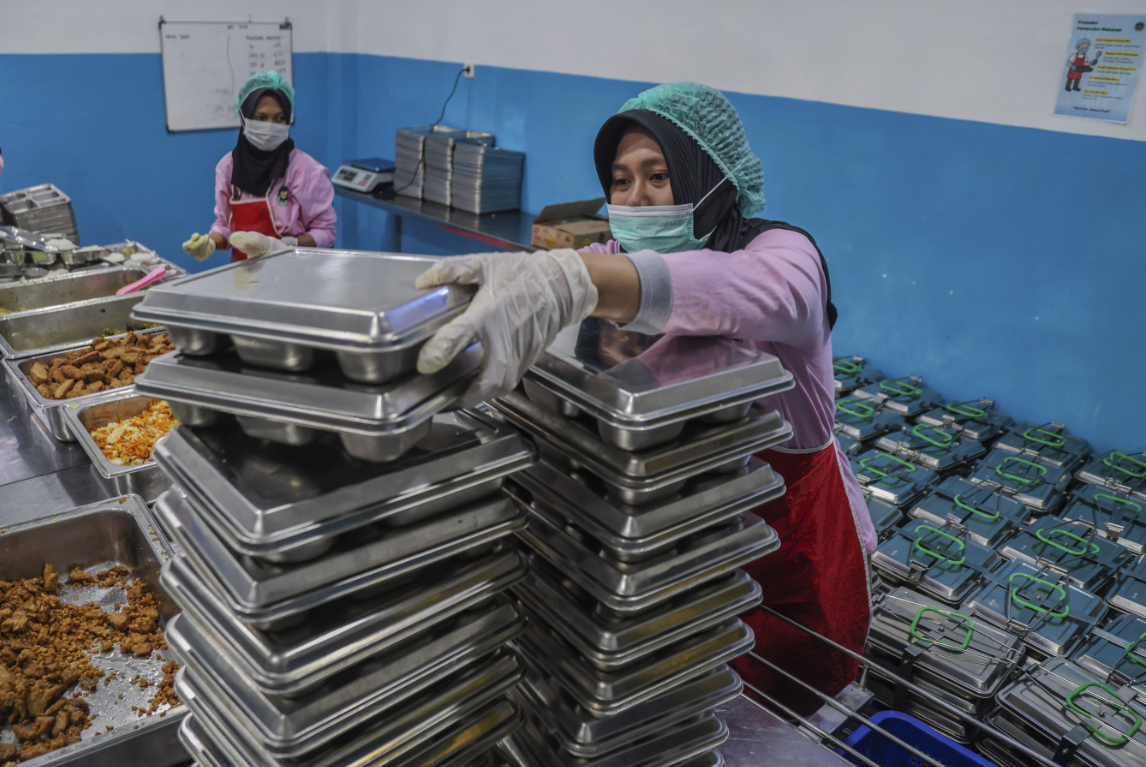
Beyond eligibility recalibration, the government is exploring fundamentally different delivery mechanisms that could reshape how the programme functions in practice. Rather than relying exclusively on centralised free meal kitchens as currently structured, officials are examining whether school canteens could serve as the primary distribution channel. Such a shift would represent more than administrative reengineering; it would transfer operational responsibility partially to school-level actors, potentially reducing bureaucratic complexity while creating new coordination challenges and quality assurance concerns. The exploration of alternative delivery models suggests policymakers recognise that the current centralised approach may be inefficient, costly, or difficult to sustain at the scale required.
The meals programme has become emblematic of broader governance challenges facing the Prabowo administration, facing a convergence of crises that threaten its credibility. Street protests erupted last month demanding suspension of the initiative, while food poisoning incidents generated headlines that undermined public confidence in food safety protocols. More damaging still, a corruption investigation has ensnared senior officials from both the National Police and Indonesian Military, exposing potential mismanagement within institutions theoretically capable of ensuring programme integrity. These accumulated pressures have forced Prabowo to signal that the government will recalibrate rather than stubbornly defend the original design.
Parallel to the meals programme review, Coordinating Food Minister Zulhas Hasan announced modifications to the Red and White cooperative initiative, which has also encountered significant implementation difficulties. The government has decided to expand the cooperatives' role beyond their original scope, positioning them as primary channels for distributing various government assistance programmes and subsidised goods alongside their core agricultural functions. This expansion reflects an attempt to justify continued investment in the cooperative structure despite mounting criticism, essentially pivoting the justification for the programme toward broader welfare distribution rather than solely agricultural support.
The cooperatives will assume responsibility for purchasing agricultural products at government-set floor prices when market conditions threaten farmer incomes, a function theoretically stabilising rural commodity markets. However, this expansion masks deeper problems that sparked initial controversies. The programme attracted fierce criticism after mandatory military-style training for cooperative managers resulted in at least four deaths, a tragedy that exposed the militaristic implementation approach adopted by officials overseeing the rollout. Rather than abandoning the cooperative model entirely, the government appears to be attempting damage control through functional expansion.
For Malaysian observers, the Indonesian experience offers instructive lessons about the challenges of delivering large-scale welfare programmes without adequate institutional capacity or public consultation. President Prabowo's decision to order reviews rather than defend original designs demonstrates how political pressure and operational crises can force policy recalibration in Southeast Asia's largest economy. The focus on psychological and social dimensions of programme delivery, particularly the concern about classroom-level stigma, reflects sophisticated understanding of welfare administration that often escapes attention in policy discussions across the region.
The one-month deadline imposed on the nutritional programme review suggests Prabowo intends to project decisive action while actually buying time to manage public perception of ongoing problems. This timeline reflects not genuine policy transformation but rather political necessity—the need to appear responsive without admitting fundamental design flaws. For Southeast Asia more broadly, Indonesia's experience underscores the importance of pilot testing large-scale welfare initiatives before rolling them out nationally, a lesson particularly relevant as other regional governments contemplate similarly ambitious social programmes.
The outcomes of these reviews will reveal whether Prabowo's administration can genuinely restructure these programmes to address identified deficiencies or whether the modifications represent superficial adjustments designed primarily to reduce immediate political pressure. The cooperative initiative's expansion into broader welfare distribution, rather than concentrated agricultural focus, suggests the government may be doubling down on problematic implementation rather than fundamentally rethinking the underlying approach. Both programmes remain under intense scrutiny, and the credibility of the administration depends substantially on demonstrating that the promised reviews produce meaningful improvements rather than merely reshuffling operational details.

