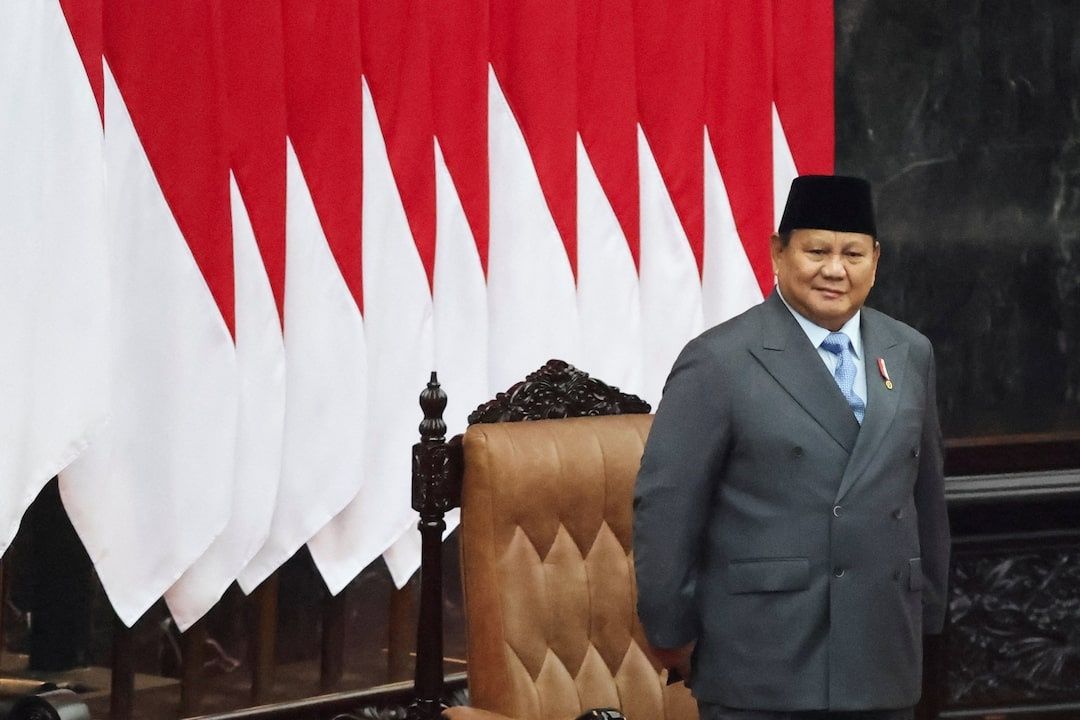
Indonesian President Prabowo Subianto faces one of his most consequential political moments on Friday as he unveils the 2027 budget blueprint, a presentation that has taken on outsized significance given the deterioration in his standing with both domestic voters and the international investment community. The former military commander, who swept to office in October 2024 on a wave of optimism about tackling corruption and accelerating growth, now finds himself navigating a markedly different political landscape characterised by currency weakness, stock market sluggishness, and mounting public disenchantment.
When Prabowo took the presidency following his decisive election victory, his mandate rested on three pillars: establishing an incorruptible government, elevating economic growth from the existing 5% trajectory to an ambitious 8%, and implementing a sweeping free meals programme that would benefit millions of school children across the archipelago. These commitments resonated powerfully with voters seeking transformative change after years of conventional politics. Yet within less than a year, the trajectory has shifted noticeably, with the president grappling with economic headwinds that have tested both his administration's credibility and the patience of international observers.
The economic picture has darkened considerably since Prabowo's inauguration. Indonesia's currency has depreciated meaningfully against the US dollar, while the Jakarta stock exchange has underperformed expectations in ways that signal investor anxiety rather than confidence. More troublingly for the government's fiscal narrative, concerns have emerged regarding expenditure discipline, with observers noting that spending has not been as carefully constrained as reassuring statements from officials might suggest. Simultaneously, questions about the independence of Bank Indonesia, the central bank, have surfaced—a sensitive issue for foreign investors accustomed to strong institutional safeguards against political interference.
The fate of Prabowo's signature free meals initiative exemplifies the difficulties his administration has encountered. What was positioned as a cornerstone programme meant to demonstrate the government's commitment to citizen welfare has been compromised by budget constraints and management controversies. Reports of misallocation and administrative failings have undermined the programme's credibility, creating an early perception that the administration struggles with execution despite its policy ambitions.
Friday's presentation will be split into two parts, reflecting the ceremonial and substantive dimensions of the occasion. In the morning, Prabowo will address parliament in conjunction with Indonesia's Independence Day commemoration, framing his remarks within the nation's broader political narrative. The afternoon session devoted to the detailed 2027 budget proposal will carry the technical weight that international financial markets scrutinise intensely. Analysts describe this budget as a critical credibility benchmark—a moment when the administration must demonstrate its capacity for coherent economic stewardship rather than sweeping announcements followed by confusion or reversal.
Banks and investment houses have explicitly flagged what they perceive as the core challenge facing this budget presentation. Irman Faiz of Bank Danamon notes that the 2027 budget represents one of the most significant investor credibility checkpoints in recent memory, particularly given that Prabowo's tenure has already delivered multiple policy surprises that markets have had to absorb and reassess. The economist emphasises a crucial shift in market psychology: investor tolerance for policy uncertainty has noticeably diminished. This means that announcements lacking sufficient clarity or appearing to contradict previous statements carry amplified negative consequences.
The fiscal mathematics underscore the pressures facing the government. Indonesia's fiscal deficit currently stands at approximately 2.8% of GDP, and trajectory analysis suggests it will again approach the 3% constitutional ceiling in 2025. This ceiling constraint means Prabowo cannot indefinitely pursue expansionary spending without triggering constitutional complications or losing credibility with fiscal conservatives among both domestic and international observers. The budget presentation must therefore balance political commitments against mathematical reality in ways that appear credible rather than evasive.
A particular flashpoint concerns Prabowo's May announcement of plans to centralise all critical natural resource exports through a newly created state entity, Danantara Sumberdaya Indonesia. International commodity traders and investment analysts viewed this proposal with alarm, interpreting it as potential state capture of mineral and agricultural export logistics. In subsequent months, various government officials have suggested that Danantara Sumberdaya Indonesia would function primarily in a supervisory capacity rather than exercising direct control, as the original announcement implied. However, the precise operational scope and authority of this entity remain ambiguous—precisely the kind of unclear policy messaging that erodes investor confidence. Friday's budget address presents an opportunity to eliminate this ambiguity through explicit clarification of the entity's actual powers and constraints.
Palm oil traders and agricultural commodity specialists are particularly attentive to any additional details about Danantara Sumberdaya Indonesia, since Indonesia's dominance in global palm oil supply means that miscalculated government intervention could trigger significant international market disruptions. The potential for export logistics to be constrained or manipulated creates pricing uncertainty that commodity markets instinctively punish. Clear definition of this entity's role—whether supervisory versus operational—will substantially influence investor positioning in Indonesian agricultural commodity futures.
The political dimension cannot be separated from the economic analysis. Recent polling data reveals a dramatic erosion in Prabowo's approval ratings, which fell thirty percentage points over eight months to reach 51% in the most recent survey. This decline reflects not merely abstract economic statistics but rather the lived experience of ordinary Indonesians confronting deteriorating economic conditions and frustration with the enforcement of law and order priorities. The confluence of economic disappointment and perceived law enforcement failures has created a political environment where the president cannot simply invoke his election mandate as justification for controversial policies.
Arya Fernandes of the Center for Strategic and International Studies has underscored the difficulty of the task ahead. Prabowo must address not merely the technical budget figures but also the fundamental doubts that have emerged regarding economic stewardship and the viability of his priority programmes. The combination of declining approval ratings, investor scepticism, fiscal constraints, and unresolved policy ambiguities means that Friday's presentation must simultaneously accomplish multiple objectives: reassure voters that their president retains control of events, convince investors that policy surprises have concluded, demonstrate fiscal discipline within constitutional limits, and clarify previously murky policy intentions. Accomplishing all four objectives simultaneously represents a formidable challenge in the current political environment.

