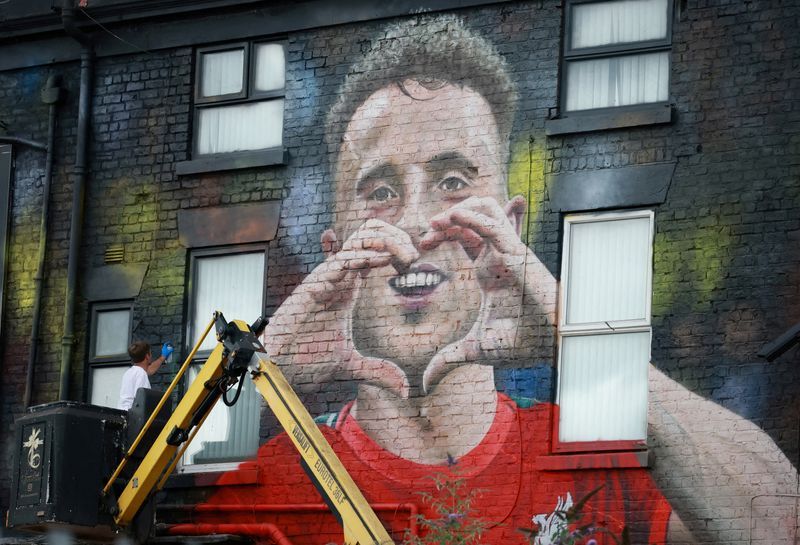
Portugal's journey through the World Cup has been shadowed by remembrance since the moment the squad touched down in North America. On Thursday, when the team faces Croatia in the tournament's round of 32, they will carry with them the weight of a tragic anniversary that stretches across continents. While the match kicks off in Toronto on July 2, the midnight hour will mark the passage into July 3 in Portugal—exactly one year since Diogo Jota, the country's celebrated Liverpool forward, died alongside his brother André Silva in a catastrophic car accident in northwestern Spain. The Lamborghini they were travelling in careened off the road and caught fire, robbing Portuguese football of one of its most gifted and devoted players at just 28 years old.
The emotional resonance of this moment has not been left to chance. Throughout the past month, as Portugal has moved through its World Cup preparations and early fixtures, the team has deliberately ensured that Jota remains woven into every aspect of the campaign. Manager Roberto Martinez, who has spoken movingly of Jota as "our light", took the symbolic step of naming the late forward as an honorary member of the squad—a gesture that acknowledges both his integral place within the team structure and the impossibility of truly replacing him. This decision transformed what might have been private grief into a collective statement about Jota's enduring presence within Portuguese football.
The tributes have manifested in tangible, visible ways throughout the tournament. Midfielder Rúben Neves, who shared a particularly close bond with Jota, has chosen to wear the number 21 jersey that belonged to his departed friend. Prime Minister Luís Montenegro gifted the players wristbands inscribed with Jota's name, turning personal accessories into symbols of national remembrance. During Portugal's opening World Cup match against DR Congo in Houston, Jota's parents, Isabel and Joaquim Silva, watched an emotional tribute unfold in the stadium stands, their tears reflecting the broader sorrow that continues to grip the nation and the football community.
For the players themselves, Thursday's fixture carries implications that transcend the ordinary calculus of World Cup football. Defender Vitinha articulated this sentiment when speaking to media on Wednesday, describing how the squad is driven by multiple layers of motivation—families, country, and now Diogo Jota himself. The anniversary transforms what would ordinarily be a routine knockout match into something far more profound. The timing works in poignant counterpoint to the geography of the tournament; as the opening whistle sounds in Toronto, Portugal will simultaneously cross into a new day at home, one marked by the passage of another year without their fallen teammate.
Jota's legacy extends beyond the Portuguese national setup. Andy Robertson, the Scotland captain and Jota's Liverpool teammate, immediately thought of his departed friend when Scotland secured their World Cup qualification in November. The relationship between Robertson and Jota clearly ran deep, transcending the transactional nature of club football. Jota's widow, Rute Cardoso, wrote directly to Robertson as the tournament commenced, her message capturing the way grief and sporting endeavour have become intertwined. She wrote of Jota's presence accompanying Robertson onto the pitch, residing in his thoughts and steps and heart, and thanked him for transforming the pain of loss into strength and beauty. Such correspondence reveals how individual deaths ripple outward through football's interconnected world.
In statistical terms, Jota's contribution to Portugal's international ambitions was substantial. He accumulated 14 goals across 49 appearances for his country, establishing himself as a reliable scorer at the highest level. Significantly, he had been absent from the 2018 World Cup squad due to a calf injury—a circumstance that lends poignancy to his absence now, which is permanent and unbridgeable. Had he lived, Jota would almost certainly have featured prominently in the Portuguese squad for this North American tournament, adding another chapter to his narrative as one of the generation that has kept Portugal among football's elite nations.
The passage of twelve months has provided some distance from the raw shock of his death, yet the wound shows few signs of healing. Within the Portuguese dressing room, players speak not as though they have accepted Jota's absence but rather as though they have learned to channel their grief into competitive motivation. Vitinha's comments about playing for families, for the country, and for Jota himself suggest that the anniversary has crystallised a sense of shared purpose. What might have been an opportunity for the squad to move beyond tragedy has instead become a moment of deliberate, collective remembrance—a choice that speaks to how deeply Jota was integrated into the team's identity and culture.
For the Portuguese-Canadian community gathered in Toronto's Little Portugal neighbourhood, the timing carries its own significance. Miguel De Silva, owner of the Amigos da Dundas Sports Bar, recognised that Jota's memory will provide an additional emotional catalyst for the players. He framed the anniversary not as a burden but as an additional source of strength—another reason to emerge victorious from a match that has taken on dimensions far beyond the ordinary scope of tournament football. This perspective, shared among supporters across multiple continents, suggests that Jota's death, while devastating, has paradoxically strengthened the bonds within Portuguese football.
As Portugal prepares to step onto the pitch in Toronto, the squad carries with them not merely the tactical preparation and physical conditioning that characterise modern football, but also a deeply human burden and motivation. The anniversary of Jota's death will unfold across time zones, with Canadian midnight marking the beginning of a day in Portugal that has become synonymous with loss and remembrance. For Roberto Martinez's team, Thursday's match against Croatia represents an opportunity to channel grief into achievement, to honour a teammate whose presence continues to shape the collective identity of Portuguese football.

