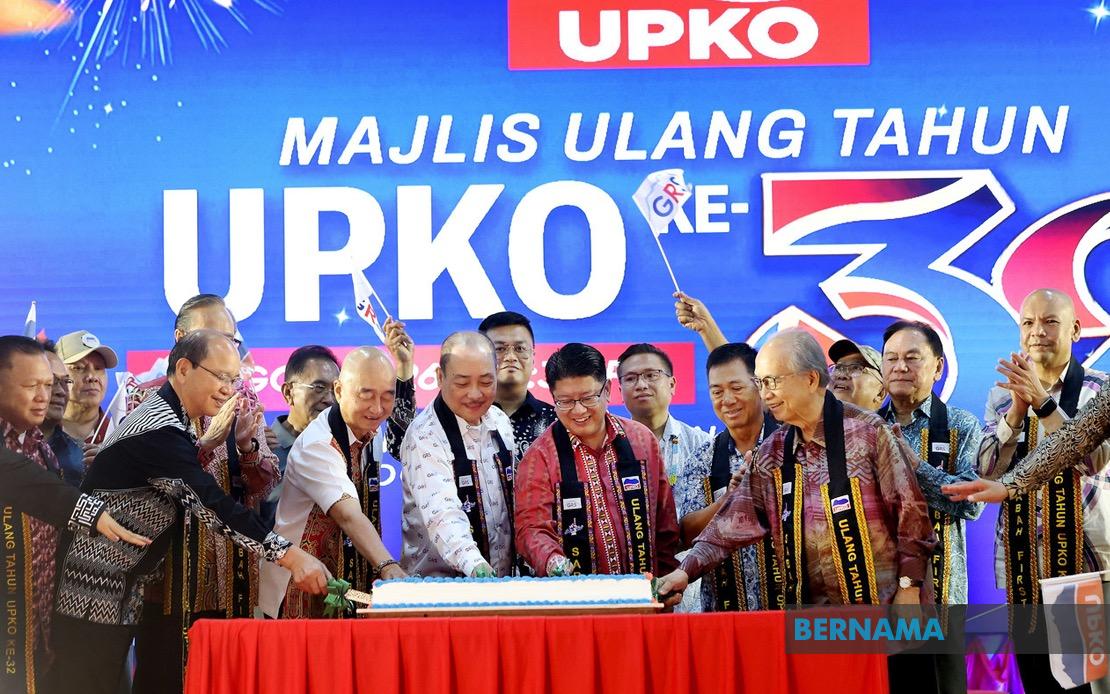
Sabah Chief Minister Datuk Seri Hajiji Noor has underscored the indispensable role of political stability in enabling the state government to direct resources and attention toward development initiatives, economic growth, and infrastructure expansion. Speaking at the 32nd United Progressive Kinabalu Organisation (UPKO) anniversary celebration and the opening of the party's 17th Triennial Delegates Conference in Kota Kinabalu, Hajiji articulated how a unified political environment allows administrations to operate without the distraction of internal disputes or coalition tensions that can derail governance priorities.
The Gabungan Rakyat Sabah (GRS) chairman acknowledged that while the coalition's component parties bring distinct political traditions and organisational identities to the alliance, their commitment to a shared developmental vision for Sabah transcends these differences. He framed GRS as a collective shelter under which diverse political interests converge, united by a commitment to serve the people and advance the state's interests. This framing reflects the pragmatic approach to coalition politics increasingly common in Malaysian state governance, where parties with ideological or historical distinctions work together within umbrella organisations to achieve electoral viability and administrative stability.
Hajiji invoked a series of slogans—Sabah First, Sabah United, Sabah Forward, and Sabah Prosper—emphasizing that these common objectives supersede individual party agendas. By repeatedly calling on UPKO leaders and members to maintain cohesion around these principles, he signalled the administration's intention to leverage the expanded coalition as a stabilising force. The Chief Minister's remarks come at a moment when maintaining coalition discipline remains essential for GRS to sustain its governing majority and pursue its policy agenda without the threat of defections or internal fractures that have plagued Malaysian coalitions in recent years.
UPKO's formal entry into GRS in June marked a significant consolidation of the ruling alliance in Sabah. The party's accession expanded GRS from five to six component parties, now encompassing Parti Gagasan Rakyat Sabah, Parti Bersatu Sabah, the Liberal Democratic Party, Parti Harapan Rakyat Sabah, and Parti Cinta Sabah alongside UPKO. For a state like Sabah with its distinct political culture and multi-ethnic composition, such coalitions serve a critical function in aggregating diverse community interests and preventing winner-take-all politics that could marginalise minority voices. UPKO's inclusion broadens GRS's appeal across regional constituencies and potentially strengthens its representation of indigenous communities and rural interests.
UPKO president Datuk Ewon Benedick, who holds the positions of Sabah Deputy Chief Minister III and Minister of Industrial Development, Entrepreneurship and Transportation, represents the party's integration into the state's executive structure. His role underscores how UPKO's coalition membership directly translates into ministerial portfolio allocation and influence over key economic and development portfolios. For Malaysian observers tracking state-level politics, such arrangements reveal how coalition stability often depends on equitable distribution of cabinet positions and responsibility for high-profile portfolios that confer both resources and visibility.
The emphasis on political stability reflects broader challenges facing Malaysian state administrations. Sabah, like other states, has experienced episodes of political volatility linked to defections, party-hopping, and coalition instability. When political capital is consumed by managing internal threats to governing coalitions, resources that might otherwise support education, healthcare, infrastructure, and economic diversification get diverted into political consolidation efforts. Hajiji's implicit argument—that stability frees government to focus on delivery—resonates with public expectations that elected administrations should prioritise service delivery over political manoeuvring.
From a regional perspective, Sabah's coalition dynamics carry significance for understanding governance patterns across Southeast Asia. The state's multi-party coalitions reflect demographic pluralism and the practical necessity of building consensus across communities. Unlike more centralised political systems, Malaysia's federal structure and state autonomy mean that state-level coalitions operate with considerable independence. GRS's expansion demonstrates how regional parties can leverage their geographic and community bases to negotiate advantageous positions within broader alliances, gaining influence disproportionate to their size relative to federal-level partners.
The investment in coalition rhetoric and symbolism—the emphasis on shared roofs and skies, the repeated invocation of common slogans—serves multiple audiences. For party members and grassroots activists, it reinforces their participation in a larger cause beyond narrow partisan interests. For the general public, it communicates an administration's commitment to unity and forward momentum. For investors and business interests monitoring Sabah's governance environment, political stability signals a reduced risk of policy disruption or administrative paralysis. The Chief Minister's messaging thus operates on multiple registers simultaneously, a necessity in coalition governance where sustaining internal cohesion requires constant reinforcement of shared objectives.
Looking forward, the true test of GRS's stability will emerge in the distribution of electoral nominations and resources in future elections, as well as in the coalition's capacity to deliver on its developmental promises. Political stability rooted purely in coalition rhetoric tends to be fragile; durability requires demonstrable improvements in citizens' lives and equitable treatment of coalition partners. For Sabah's voters, the government's ability to translate stability into tangible progress in employment, infrastructure quality, and economic opportunity will ultimately determine whether the coalition narrative resonates beyond political circles.
The state's development trajectory will depend significantly on whether GRS's expanded coalition can maintain discipline while executing complex projects requiring sustained investment and coordination. Infrastructure expansion, economic diversification, and human capital development all demand medium to long-term commitment and consistency, the very commodities that political instability threatens. By framing stability as a prerequisite for development rather than an end in itself, Hajiji articulates a view increasingly shared across Malaysian political leadership—that effective governance requires not just winning elections but maintaining the internal cohesion necessary to govern.

