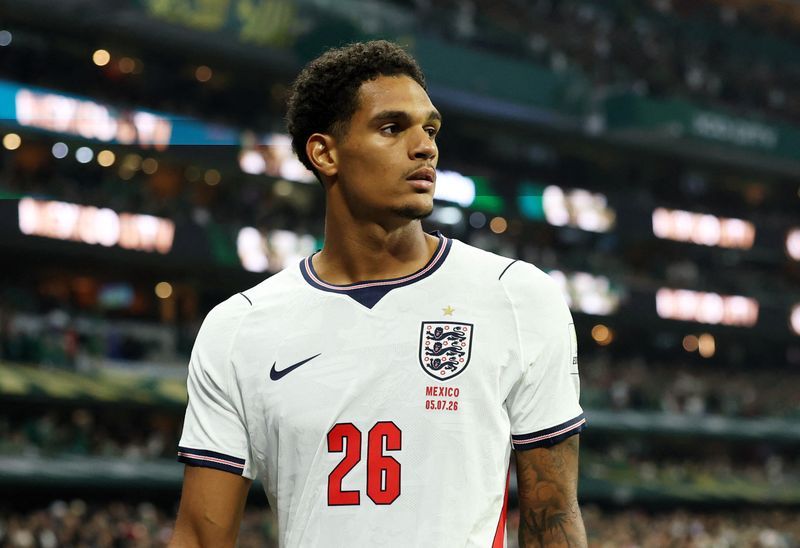
The furore surrounding Folarin Balogun's disciplinary reprieve has spilled decisively into the political arena, with United Kingdom lawmakers now deploying parliamentary pressure to secure identical treatment for another player caught in the tournament's most contentious dispute. Labour MPs Noah Law and Melanie Onn have issued separate public letters to FIFA President Gianni Infantino requesting that defender Jarell Quansah's automatic one-match suspension be deferred until after the World Cup concludes, directly invoking the controversial precedent set by the American striker's case as justification for intervention.
Quansah, like Balogun before him, received a red card during competitive play—in his instance, during England's dramatic 3-2 victory over Mexico at the Azteca Stadium on Sunday. Standard FIFA regulations ordinarily mandate an immediate suspension following dismissal, yet the differential treatment now afforded to Balogun has exposed what British politicians characterise as an alarming inconsistency in how the sport's governing body applies its own rules. The situation has transformed what might ordinarily remain a technical disciplinary matter into a matter of parliamentary concern, reflecting the broader anxiety among England's political establishment that FIFA's processes may have been compromised.
The controversy traces its origins to an extraordinary revelation by United States President Donald Trump, who publicly disclosed that he had personally contacted Infantino regarding Balogun's suspension. Though Infantino subsequently asserted that FIFA's independent judicial structures would determine the outcome without external interference, the very fact of presidential involvement has catalysed suspicion across European football authorities and political circles. The American striker's eventual reprieve—granted under the provisions of Article 27—now stands as a reference point that opponents of the decision argue demonstrates either capitulation to political leverage or a shocking double standard in how discipline is administered.
Law's public statement carried particular weight, acknowledging the legitimacy of Quansah's original red card while simultaneously contending that deferring his suspension until after the tournament's conclusion would constitute the equitable course of action. His framing of the issue—accepting the disciplinary decision whilst questioning its timing—attempts to navigate the difficult terrain between respecting on-field refereeing decisions and advocating for procedural fairness. Onn reinforced this position by emphasising the logical incoherence of permitting one player to sidestep suspension under materially similar circumstances whilst denying identical relief to another, suggesting that FIFA faces an unavoidable choice between applying its precedent uniformly or acknowledging that Balogun's reprieve represented a singular exception.
Caroline Dinenage, who chairs the House of Commons Culture, Media and Sport Committee, has escalated the political dimension further by issuing an official call for FIFA to provide urgent and comprehensive explanation for its Balogun decision. Dinenage's intervention carries institutional weight, suggesting that parliamentary scrutiny of FIFA's conduct may intensify if the organisation fails to provide satisfactory transparency. Her statement articulates the broader concern animating these interventions: that the integrity of international sport itself depends upon demonstrable consistency and the absence of political influence in disciplinary determinations. She pointedly noted that England's impressive victory against Mexico risks becoming overshadowed by legitimate questions about whether FIFA's processes remain credible.
The English Football Association is understood to be actively evaluating potential appeal mechanisms, though Reuters sources indicated that the organisation has received no clarity regarding whether FIFA would consider Quansah's case under the same Article 27 framework that facilitated Balogun's reprieve. This opacity regarding FIFA's actual position compounds the political frustration, as the organisation has maintained studied silence despite multiple requests for comment. The refusal to engage publicly with questions about whether similar treatment might extend to other players has itself become a source of controversy, suggesting either that FIFA lacks a coherent position or that it prefers to avoid setting explicit precedents.
For Malaysian and Southeast Asian observers, this controversy illuminates the fragility of international sports governance when political actors become directly involved in disciplinary processes. The case demonstrates how presidential intervention in a single player's suspension can cascade into broader institutional challenges to an organisation's legitimacy. The precedent established here may reverberate through Asian football governance, where questions about political influence in disciplinary matters have periodically surfaced. If FIFA is perceived as susceptible to high-level political pressure from major footballing nations, the implications for how smaller confederations and nations experience disciplinary processes could prove significant.
The timing amplifies the stakes considerably. England faces Norway in the quarter-finals scheduled for Saturday in Miami, meaning that any resolution regarding Quansah's availability must materialise within an extraordinarily compressed timeframe. The prospect of England fielding a depleted squad due to suspension whilst another nation's player remains available under identical circumstances would constitute precisely the kind of competitive inequality that undermines tournament integrity. This practical dimension—the actual sporting consequences of inconsistent rule application—gives the political pressure considerably more force than abstract concerns about procedural fairness might otherwise generate.
FIFA's stated position that its judicial bodies operated independently in the Balogun matter, whilst technically accurate regarding institutional responsibility, has failed to address the substantive question of whether external political communication influenced the reasoning or outcome of those bodies' deliberations. The organisation appears caught between defending its institutional independence and addressing legitimate public concerns that its disciplinary processes are no longer perceived as genuinely free from political consideration. Whether FIFA responds to parliamentary pressure by extending Article 27 relief to Quansah, clarifying its decision-making process, or maintaining its current posture of silence will signal something significant about the organisation's vulnerability to political pressure and its capacity to maintain consistent disciplinary standards across different cases and nations.

