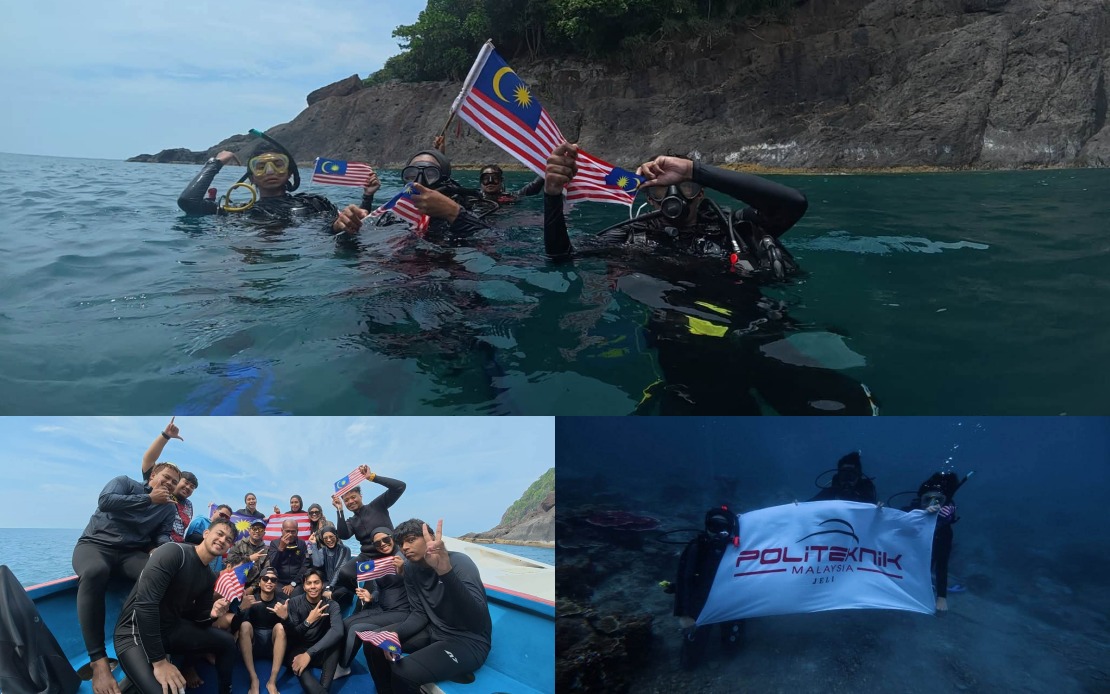
In a distinctive observance of the 69th National Day celebration, Politeknik Jeli Kelantan made headlines by planting Malaysia's national flag on the seafloor 18 metres below the surface off Pulau Tenggol in Terengganu waters. The unconventional gesture represented far more than a symbolic patriotic exercise; it served as a capstone to a comprehensive scuba diving and water safety certification programme that strengthened the technical competencies of the institution's aquaculture students.
The initiative emerged from an intensive training block conducted between August 27 and 30 at Dive Buddy Dungun, organised collaboratively by PJK's Aquaculture Technology Unit and its Department of Agrotechnology and Bio-Industry. Rather than treating scuba certification as an isolated skill acquisition, the institution integrated it within a broader framework of water safety consciousness. Mohd Adam Nashriq Bani Yamin, an Aquaculture lecturer at PJK, explained that the underwater flag placement symbolised how the institution weaves practical maritime competencies into its curriculum while maintaining strong national consciousness among trainees.
The diving operation itself involved four participants: two lecturers and two fifth-semester Diploma in Aquaculture Technology students. The trainees underwent Professional Association of Diving Instructors (PADI) certification, with instruction provided by Dive Buddy Malaysia's Dr Nabila Talib. Upon successful completion, participants earned PADI Open Water Diver qualifications, credentials that substantially enhance employment prospects within Malaysia's growing aquaculture and marine biotechnology sectors. Beyond the Jalur Gemilang, the underwater ceremony also featured the PJK institutional flag, reinforcing the dual message of institutional pride and technical proficiency.
For polytechnic institutions training the next generation of marine professionals, such experiential learning proves invaluable. Aquaculture and marine biotechnology careers frequently demand that graduates work within aquatic environments or conduct underwater inspections and maintenance tasks. The scuba certification acquired through this programme equips students with genuine occupational readiness that extends beyond classroom theory. Dr Nashriq emphasised that this hands-on exposure bridges a critical gap between academic knowledge and industry expectations, preparing graduates to manage real-world challenges they will encounter in offshore farming operations or marine conservation projects.
The water safety component of the training programme deserves particular attention within Malaysia's maritime education landscape. Given the inherent hazards associated with underwater work—decompression sickness, nitrogen narcosis, equipment failure, and disorientation—formal safety training serves as a safeguard against occupational injuries. By embedding emergency preparedness and accident response procedures within the curriculum, Politeknik Jeli ensures that its aquaculture graduates possess not merely technical diving skills but also the judgment and protocols necessary to operate safely in challenging marine environments.
This initiative reflects broader trends within technical education in Southeast Asia, where institutions increasingly recognise that industry 4.0 competencies extend beyond digital literacy. Employers in aquaculture, marine biotechnology, and environmental management explicitly seek personnel capable of conducting underwater surveys, managing submerged infrastructure, and executing marine ecosystem monitoring. The convergence of certification programmes with academic curricula addresses this demand directly, producing graduates whose credentials are immediately recognised and valued within the employment market.
The timing of this National Day gesture also carries symbolic weight. As Malaysia emphasises the importance of blue economy development and sustainable ocean management, investing in maritime skills becomes a national imperative. Politeknik Jeli's approach—coupling patriotic observance with practical workforce development—exemplifies how educational institutions can simultaneously honour national traditions and advance sectoral capacity building. The Jalur Gemilang displayed 18 metres below serves as a physical manifestation of this commitment.
Moreover, the programme's focus on marine farming management and ecosystem conservation applications extends its relevance beyond commercial aquaculture. Doctoral research, environmental monitoring, and conservation initiatives increasingly depend on qualified personnel capable of executing underwater tasks safely and competently. By producing graduates with PADI certification and proven water competency, Politeknik Jeli strengthens Malaysia's capacity for marine resource stewardship and biodiversity protection—priorities that grow more urgent as global ocean health faces escalating pressures.
The broader implications for Malaysian polytechnic education merit consideration. As institutions nationwide evaluate curriculum enhancement strategies, Politeknik Jeli's model demonstrates how experiential learning programmes can be meaningfully embedded within regular academic schedules. The August 27-30 timeframe integrated seamlessly into the academic calendar, suggesting that such initiatives need not require extensive institutional restructuring. Other polytechnics training students in maritime, coastal, or aquatic specialisations may readily replicate similar certification programmes, leveraging existing relationships with diving operators and training providers.
For Terengganu's marine economy and the broader Kelantan-Terengganu region, such initiatives contribute incrementally to workforce capacity in growth sectors. The state has increasingly positioned itself as a centre for aquaculture innovation and marine biotechnology development. Politeknik Jeli's commitment to producing not only theoretically educated but practically certified graduates reinforces regional competitiveness within increasingly sophisticated global aquaculture markets. Employers evaluating potential hires can now identify Politeknik Jeli graduates as possessing internationally recognised PADI credentials alongside academic qualifications—a distinction that strengthens their market positioning.
The National Day celebration itself, when viewed through this lens, transcends ceremonial meaning. Rather than confining patriotic expression to flag-hoisting and official ceremonies, Politeknik Jeli integrated national consciousness into substantive capacity building. Students will remember their National Day 2024 not merely as a public holiday but as the occasion when they earned internationally recognised diving certification while contributing to a patriotic underwater tableau. This embedding of values within practical achievement creates more memorable and meaningful observances than conventional flag ceremonies alone.
Looking forward, the success of this initial underwater flag programme may inspire similar initiatives at other maritime-focused institutions across Malaysia and the region. The model also suggests possibilities for interdisciplinary collaboration—could engineering students conduct underwater structure assessments, or environmental studies students conduct reef health surveys, similarly marked by patriotic ceremony? As tertiary institutions increasingly recognise that experiential learning drives both academic excellence and graduate employability, programmes like Politeknik Jeli's aquaculture diving certification offer a template for integrated education that serves institutional, individual, and national interests simultaneously.

