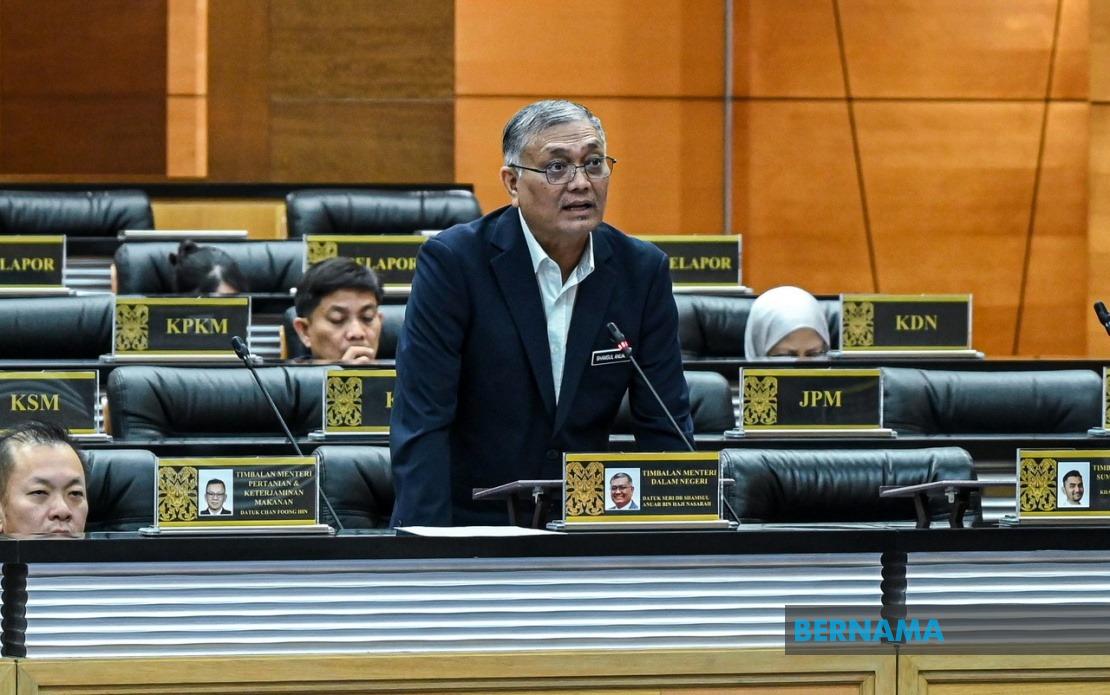
Deputy Home Minister Datuk Seri Dr Shamsul Anuar Nasarah has made an unequivocal statement to Parliament that the Royal Malaysian Police (PDRM) operate without favouritism when handling sensitive investigations, emphasizing that no individual receives preferential treatment based on their standing or political connections. His remarks come amid ongoing public scrutiny of several high-profile cases that have generated considerable public interest and speculation about the independence of the investigative process.
The Deputy Home Minister's comments were prompted by a parliamentary question from Datuk Wan Saifulruddin Wan Jan regarding the progression of multiple prominent investigations. Among these is the case involving an explicit video recording that became widely circulated in 2019 and carried links to a former member of the Cabinet. Shamsul Anuar disclosed that police efforts remain focused on recovering the original source material alongside identifying all devices and infrastructure implicated in the creation and distribution of the footage. The continued investigation underscores the complexity of digital forensics and the challenge of tracing materials through multiple technological pathways once they have entered the public domain.
The inquiry into the 2019 video recording operates under several legislative frameworks designed to address different aspects of the alleged offence. Investigators are proceeding under Section 292, Section 377B and Section 504 of the Penal Code, statutes that address matters of obscenity, unnatural offences, and defamation respectively. Additionally, authorities are invoking Section 233 of the Communications and Multimedia Act 1998, which provides jurisdiction over misuse of network facilities and electronic communications. This multi-layered legal approach reflects the prosecution's strategy to comprehensively address the various dimensions of the case and ensure that all relevant breaches are properly accounted for in the investigative framework.
Shamsul Anuar's explicit assurance that the PDRM conducts its work "professionally, transparently and fairly without considering the position or political affiliation of any party" is particularly significant in the Malaysian context, where questions about institutional impartiality have periodically emerged during politically sensitive cases. The statement appears designed to counter any perception that high office or political alignment might influence the trajectory or vigour of police investigations. By articulating this principle publicly in Parliament, the Deputy Home Minister seeks to reinforce public confidence in law enforcement's commitment to the rule of law and equal treatment under the criminal justice system.
Parallel to the video recording investigation, authorities are also advancing a separate inquiry concerning the son-in-law of former Prime Minister Tan Sri Muhyiddin Yassin. Shamsul Anuar indicated that this matter falls within the purview of the Malaysian Anti-Corruption Commission (MACC) rather than the police, and that the MACC has already issued an arrest warrant in connection with the individual. The Deputy Home Minister notably declined to provide additional commentary on this particular case, citing the conventional protocol that government representatives refrain from discussing matters under active investigation by specialized agencies. This demarcation of responsibility between institutions demonstrates the compartmentalization of investigative authority across different bodies according to the nature of the alleged offence.
The involvement of the MACC indicates that corruption concerns form the substantive basis of the inquiry into the former Prime Minister's son-in-law. Malaysia's anti-corruption framework has assumed an increasingly prominent role in national governance, particularly following shifts in political leadership that have brought renewed focus to issues of financial propriety and abuse of official position. The existence of a formal arrest warrant signals that investigators have compiled sufficient preliminary evidence to satisfy the procedural requirements for such an action, though the issuance of a warrant does not constitute a finding of guilt or culpability.
Beyond domestic criminal investigations, Shamsul Anuar also addressed matters of international legal cooperation, specifically extradition procedures. He outlined that Malaysia currently maintains extradition treaties with eleven nations and has additionally subscribed to the ASEAN Extradition Treaty, which facilitates the transfer of suspects and convicted individuals between member states of the Association of Southeast Asian Nations. The extradition framework operates under the Extradition Act 1992, a statute that establishes the legal mechanisms and conditions under which individuals can be surrendered to foreign jurisdictions for prosecution or punishment.
The Deputy Home Minister emphasized Malaysia's openness to negotiating additional extradition arrangements with countries with which formal treaties do not yet exist. This openness reflects a broader commitment to international cooperation in law enforcement and recognition that cross-border criminal conduct increasingly requires coordinated responses between national authorities. For Malaysia, whose geographic position and economic integration with regional neighbours position it as a hub for both legitimate commerce and potentially illicit activities, robust extradition relationships serve important security and justice objectives.
The Parliamentary session during which these statements were delivered underscores the ongoing demand for government accountability and transparency concerning prominent criminal investigations. Malaysian legislators continue to pose questions about case progression and investigative methodology, reflecting both legitimate oversight functions and constituent concerns about whether the justice system operates equitably across all social strata. The Deputy Home Minister's comprehensive responses, though measured in their specificity regarding active cases, appear calculated to affirm institutional integrity while respecting the confidentiality necessary to preserve investigative integrity and the legal rights of those under suspicion.
For Malaysian citizens and regional observers, these assurances carry particular significance in a context where perceptions of selective justice or political manipulation of law enforcement have periodically undermined public confidence in institutions. The emphasis on professional conduct, transparency, and fair treatment regardless of status represents a reaffirmation of principles that underpin functional democracies and rule-of-law governance. Whether the actual outcomes of these investigations align with such stated principles will ultimately determine whether public trust in the integrity of the Malaysian justice system is reinforced or eroded.

