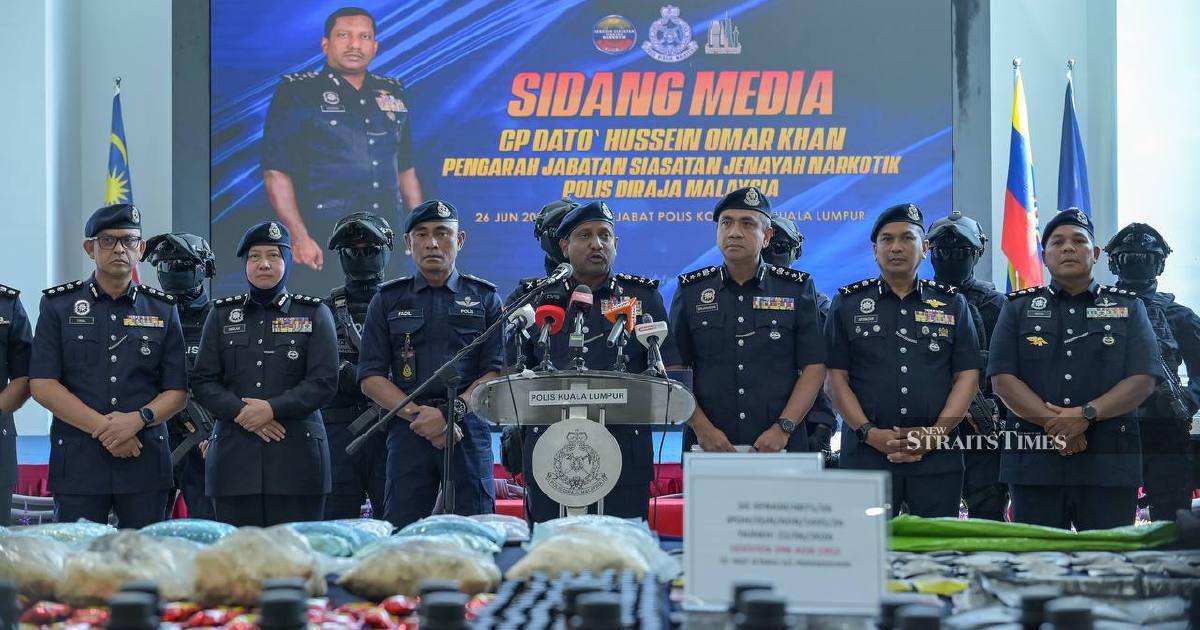
Malaysian law enforcement has dealt a significant blow to organised drug trafficking networks operating in the Klang Valley, successfully intercepting a substantial consignment of illegal narcotics valued at RM135.63 million. The breakthrough came through coordinated raids executed on June 20 across multiple locations in the Cheras district of Kuala Lumpur, where police arrested seven individuals suspected of orchestrating the distribution operation.
The scale of the seizure underscores the persistent challenge facing Malaysian authorities in combating the illegal drug trade, which continues to funnel vast quantities of narcotics through Southeast Asian supply chains destined for local consumption and onward trafficking. The RM135.63 million valuation represents one of the more substantial drug hauls reported in recent months, reflecting both the volume of contraband intercepted and the sophistication of smuggling networks attempting to establish beachheads in Malaysian cities.
The Cheras operation appears to have targeted what law enforcement officials describe as a coordinated attempt to flood the domestic market with controlled substances. Such efforts reflect a troubling trend wherein regional trafficking syndicates view Malaysia's position along major drug corridors as strategically valuable for establishing distribution hubs. The nation's extensive port facilities, land borders, and established urban infrastructure make it an attractive logistics node for international narcotics operations seeking to penetrate Southeast Asian markets.
The seven arrests made during the June 20 operation represent key personnel within the suspected trafficking network, though authorities have yet to publicly detail the organisational hierarchy or operational scope of the dismantled group. The simultaneous nature of the raids suggests police had conducted sustained surveillance and intelligence gathering prior to the enforcement action, indicating a methodical approach to disrupting networks rather than opportunistic interdiction at border crossings.
Conveying the variety of substances involved in large seizures has become increasingly important as traffickers diversify their product offerings in response to enforcement pressure. The composition of the RM135.63 million haul would provide insights into regional drug market preferences and the operational focus of trafficking organisations currently active in Malaysia. Syndicates operating across Southeast Asia typically adjust their cargo according to demand signals from distribution networks in key urban centres.
The successful execution of this operation highlights the importance of inter-agency coordination and intelligence sharing within Malaysian law enforcement structures. Such major seizures rarely result from isolated enforcement actions but typically represent the culmination of investigative efforts spanning weeks or months. The coordination required to conduct simultaneous raids across multiple Cheras locations demonstrates the operational capability Malaysian police have developed in targeting organised crime networks.
From a regional perspective, the Cheras seizure reflects broader patterns in Southeast Asian drug trafficking that increasingly concern authorities across the bloc. The region serves as both a transit zone and consumption market, with production facilities in the Golden Triangle and illicit laboratories in clandestine locations supplying multiple downstream markets. Malaysia's geographic position exposes it to trafficking pressures from multiple directions simultaneously.
The incident also carries implications for Malaysia's standing in international drug enforcement cooperation frameworks. Nations that demonstrate consistent capacity to intercept major trafficking operations tend to receive enhanced information-sharing privileges from international partners and better access to intelligence regarding precursor chemicals and trafficking methodologies. Successful enforcement actions like the Cheras raids strengthen Malaysia's negotiating position within ASEAN counternarcotics cooperation mechanisms.
Police operations against trafficking networks necessarily focus on dismantling supply chain infrastructure, apprehending key operational personnel, and preventing product from reaching street-level distribution networks. The arrest of seven suspects suggests this operation targeted multiple functional roles within the trafficking operation, though the specific charges and individual roles remain to be detailed through prosecutorial proceedings.
Looking forward, the Cheras operation likely represents one component within a broader enforcement strategy targeting trafficking syndicates believed to maintain operations across the Klang Valley. Malaysian authorities have increasingly recognised that sustainable suppression of drug availability requires sustained pressure against organised networks rather than episodic enforcement actions. The June 20 raids fit this pattern of systematic disruption of criminal infrastructure.
The successful interception of RM135.63 million worth of narcotics serves as a temporary disruption to trafficking operations, though experienced narcotics enforcement officials recognise that seizures alone cannot permanently eliminate drug supply pressures. Networks disrupted through arrest and asset seizure frequently reconstitute themselves or are rapidly replaced by competing organisations seeking to capture market share. Sustainable reduction in drug availability ultimately requires addressing both supply and demand factors within Malaysian society.
As investigations into the Cheras operation proceed through Malaysia's criminal justice system, additional details regarding the trafficking network's international connections, financial arrangements, and distribution methods will likely emerge. Such intelligence gathering capacity simultaneously informs ongoing enforcement efforts and contributes to evolving understanding of transnational organised crime operating throughout Southeast Asia.

