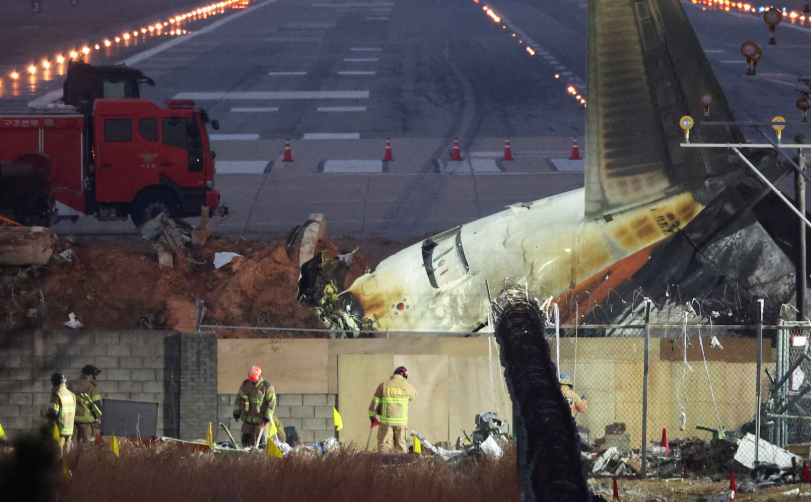
South Korean authorities have intensified their criminal investigation into the Jeju Air disaster by conducting simultaneous raids on multiple government agencies and the country's primary airport operator. Police teams descended on Korea Airports Corp (KAC), the transport ministry, and the Busan Regional Office of Aviation on Tuesday, August 11, to gather additional evidence pertaining to the December 29, 2024 crash at Muan International Airport that claimed 179 lives. The operation marks a significant escalation in the prosecution phase of an investigation that has already identified 74 suspects and raised questions about systemic failures in both operational and regulatory oversight.
The raids represent the investigative team's third incursion into the transport ministry since the disaster occurred, signalling that prosecutors believe crucial documentary evidence or communications related to the crash remain within the ministry's holdings. Korea Airports Corp, which operates the majority of South Korea's major domestic airports with the notable exception of Incheon International Airport, was targeted because of its direct responsibility for Muan International Airport's operations and maintenance. The simultaneous nature of the three-location operation suggests authorities are pursuing a coordinated strategy to prevent the destruction or concealment of evidence while interrogations continue elsewhere.
The specific focus of the raids centres on gathering material to substantiate charges of professional negligence resulting in death or injury, which are among the most serious criminal allegations that can be filed in connection with aviation disasters. This charge category holds particular significance in Korean law because it applies to individuals or organisations whose dereliction of duty directly contributed to fatal outcomes. With 74 suspects already identified and facing various charges, prosecutors are building a comprehensive narrative of how the crash occurred and which parties bear responsibility for the sequence of events that led to the tragedy.
Beyond professional negligence, police officials have indicated that additional charges related to causing a serious public disaster may be applied as investigations progress. This charge carries heightened legal weight because it acknowledges the broader societal impact and systemic failures potentially implicated in the accident. In South Korean criminal law, disaster-related charges often encompass failures in regulatory compliance, inadequate safety protocols, insufficient oversight mechanisms, and negligent maintenance practices. The prospect of applying these charges suggests that the investigation has uncovered evidence of systemic rather than merely individual failings.
The investigation's central objective remains determining the precise cause of the Muan International Airport crash and establishing whether responsible agencies, including airport operations management and regulatory bodies, fulfilled their legal and procedural obligations. Early reports indicated that the aircraft encountered difficulties during landing, but the complete sequence of events and the contributions of various operational factors remain subjects of ongoing examination. Investigators must establish causality between specific actions or omissions and the fatal outcome, a process that typically involves reconstructing communications, reviewing maintenance records, analysing operational procedures, and interviewing personnel involved in the aircraft's final moments.
The involvement of Korea Airports Corp is particularly significant because the corporation holds operational responsibility for airport infrastructure, runway conditions, ground support systems, and emergency response capabilities. Any investigative findings regarding inadequate maintenance, improper runway management, insufficient safety equipment, or delayed emergency response would directly implicate the corporation and its management. The transport ministry's role involves regulatory oversight and the establishment of aviation safety standards, making it essential to determine whether existing regulations were adequate and whether compliance was properly monitored and enforced.
For Malaysian and Southeast Asian readers, this investigation underscores the critical importance of rigorous oversight within aviation authorities and airport operators across the region. Malaysia's civil aviation system, overseen by the Civil Aviation Authority of Malaysia (CAAM) and encompassing major operators like Malaysia Airports Holdings Berhad, similarly depends on strict adherence to safety protocols and regular maintenance standards. The Jeju Air case demonstrates how investigation into major aviation disasters often reveals systemic vulnerabilities that extend beyond individual pilot error or mechanical failure to encompass organisational culture, regulatory enforcement, and inter-agency coordination.
The ongoing investigation also highlights the vulnerability of airport operations to systemic risks that may not be immediately apparent during routine operations. Runway conditions, emergency response systems, ground control procedures, and maintenance scheduling all represent areas where organisational negligence can accumulate and eventually contribute to catastrophic outcomes. Southeast Asian airports, which handle increasingly dense traffic and operate in challenging climatic conditions, must maintain comparable standards of oversight and accountability.
The fact that prosecutors are pursuing charges against 74 suspects indicates that responsibility for the crash is distributed across multiple individuals and organisations rather than concentrated in a single failure point. This diffuse accountability suggests that the disaster resulted from cascading failures, poor communication between agencies, inadequate oversight mechanisms, or multiple instances of dereliction of duty. Such patterns frequently emerge in aviation accidents when post-incident investigations examine the complete operational environment rather than focusing narrowly on immediate technical causes.
As the investigation advances, the outcomes will likely influence aviation regulatory frameworks not only in South Korea but potentially across East Asia. Findings regarding the adequacy of existing safety standards, the effectiveness of regulatory oversight, and the performance of emergency response systems may prompt reviews of similar procedures in comparable airports throughout the region. The criminal charges being pursued against organisational entities as well as individuals reflect a modern trend in aviation law toward holding institutions accountable for systemic failures rather than externalising blame solely to frontline operators.
The investigation's progression toward evidence-gathering raids indicates that prosecutors have moved beyond preliminary fact-finding toward building specific criminal cases against identified defendants. The transport ministry's repeated appearance as a raid target suggests that documentary evidence held by the ministry is critical to establishing either the adequacy of regulatory oversight or the failure of authorities to enforce existing safety standards. As these legal proceedings continue, they will ultimately determine not only individual and organisational culpability but also whether systemic reforms are necessary to prevent similar accidents in the future.

