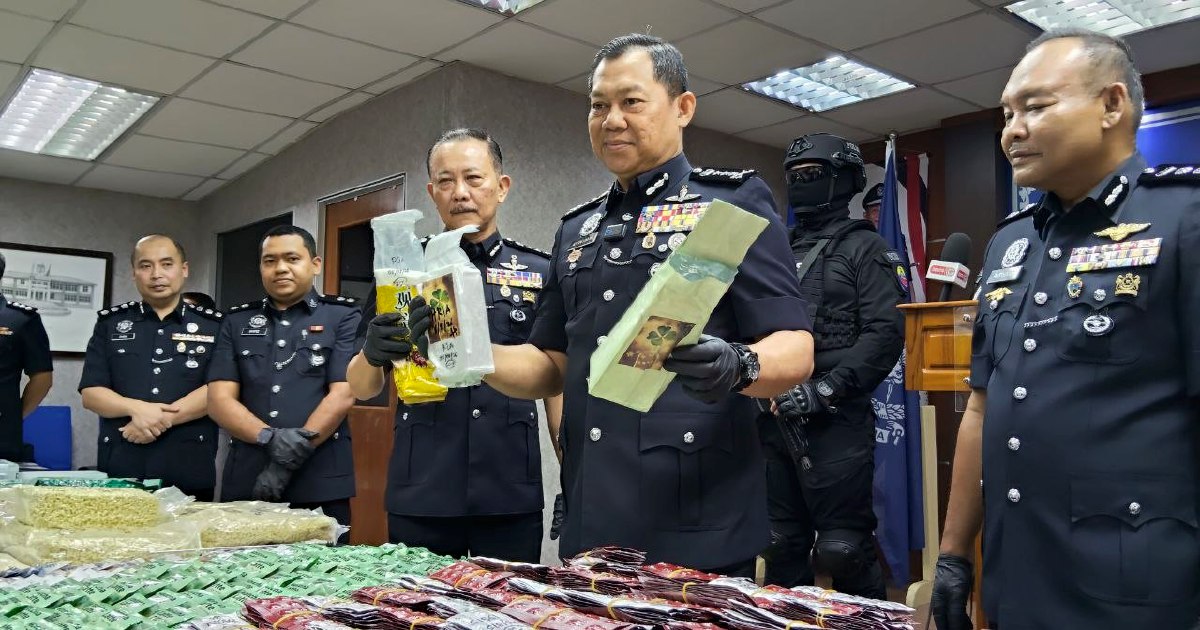
Law enforcement in Johor Baru has struck a significant blow against organised drug trafficking with the discovery of a large-scale distribution operation in the Masai area. Acting on intelligence, police conducted a raid on a residential unit located along Persiaran Senibong, where they uncovered approximately 96.76 kilograms of assorted narcotics with an estimated street value of RM8.49 million. The operation has resulted in two arrests and raises fresh concerns about how criminal organisations are exploiting residential properties as distribution hubs across the state.
The arrested apartment appears to have been deliberately leased and maintained by the syndicate specifically for storage and distribution purposes rather than habitation, according to the police investigation. This operational method reflects increasingly sophisticated approaches adopted by drug trafficking networks in Malaysia, who are moving away from traditional hideouts and towards seemingly legitimate rental arrangements that can mask their activities. The choice of a residential location in an urban setting demonstrates how these criminal enterprises have learned to blend into normal neighbourhoods, making detection more challenging for authorities.
The Masai area, situated in the southern reaches of Johor Baru, has emerged as a notable focal point for drug-related enforcement activities in recent years. Its proximity to major transport routes and commercial zones makes it an attractive location for criminal syndicates seeking to distribute narcotics across the region and beyond. The seizure represents one of the more substantial hauls recorded in the area this year and underscores the persistent struggle law enforcement faces in containing drug trafficking networks that continue to adapt their methods.
The variety of narcotics recovered during the operation suggests the syndicate was engaged in bulk trafficking rather than retail-level distribution, indicating connections to higher-tier supply chains. Police have not yet disclosed the specific composition of the drug cache, though the substantial quantity points to involvement with multiple controlled substances. Such large consolidated stockpiles typically indicate that the apartment served as a transshipment point where drugs would be repackaged and sorted for distribution to smaller dealers or onward transport to other states.
This operation illustrates a broader challenge facing Malaysian law enforcement agencies: the need to detect and disrupt mid-level drug trafficking operations that sit between international smuggling networks and street-level dealers. Authorities across Southeast Asia have long grappled with the reality that border interdiction alone cannot effectively address the drug problem, and domestic enforcement must target the sophisticated distribution infrastructure that moves substances from ports of entry to end users across the region.
The two individuals arrested in connection with the operation now face prosecution under Malaysia's Dangerous Drugs Act, which carries severe penalties including potential capital punishment for trafficking offences involving substantial quantities. The investigation will likely focus on identifying higher-level operatives who may have controlled the apartment and the supply chain, as well as downstream recipients who were receiving shipments from this storage facility. Such intelligence could lead to additional arrests and further disruption of the broader trafficking network.
The discovery also highlights the importance of community vigilance and tip-offs to law enforcement. Neighbours or other residents may notice unusual patterns associated with illicit drug operations—frequent visits by different individuals, excessive security measures, or general avoidance of normal residential activities—and reporting such suspicions to police can prompt investigations that yield substantial results. Public engagement remains an essential component of drug enforcement strategy, particularly when criminal organisations deliberately conceal their operations within residential spaces.
For residents across Johor and other Malaysian states, the seizure serves as a reminder that drug trafficking infrastructure can exist anywhere and often remains invisible until law enforcement takes action. Property owners and landlords are increasingly being urged by authorities to conduct background checks on prospective tenants and to report any suspicious activity that might indicate their premises are being misused for illegal purposes. Some states have implemented measures holding property owners accountable if their units are knowingly leased for criminal activity.
The operation also underscores the resource intensity required for effective narcotics enforcement. Identifying, surveilling, and executing raids on suspected drug distribution points demands significant investment in intelligence gathering, specialist personnel, and coordination between various police units. As trafficking networks grow more organised and well-resourced, law enforcement must continuously evolve its capabilities to maintain operational effectiveness. The Masai seizure demonstrates that when these resources are properly deployed, they can generate substantial results that disrupt criminal operations and remove dangerous substances from circulation.

