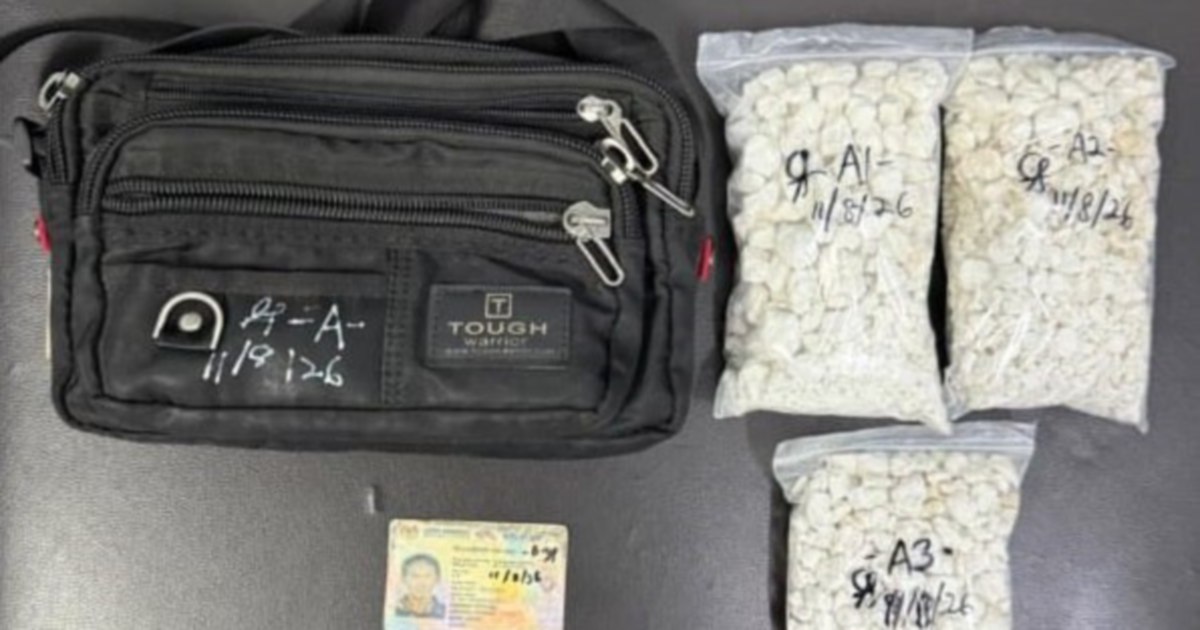
Drug enforcement operations in Johor intensified with a successful narcotics bust in Simpang Renggam, where authorities uncovered a substantial quantity of heroin and detained a suspect during a pre-dawn raid. Officers from the Kluang police district secured 1.055 kilogrammes of what testing will confirm as heroin, valued at RM10,128 on the street market. The seizure represents a notable contribution to law enforcement's ongoing campaign against hard-drug distribution networks that continue to plague Peninsular Malaysia.
The arrested individual, a 42-year-old male, was detained at the scene for further questioning and subsequent investigation under the Dangerous Drugs Act 1952. The early morning timing of the operation—a standard tactic employed by narcotics units to maximise the element of surprise and prevent suspects from destroying evidence—proved effective in this instance. Intelligence-gathering and surveillance work typically precedes such raids, suggesting that police had been monitoring suspected drug activity in the Simpang Renggam locality for some period before moving in to make arrests.
Simpang Renggam's location along major transportation corridors makes it a strategically important area for drug enforcement attention. The small township sits within Kluang district in the Johor interior, positioning it as a potential transit point or distribution hub for narcotics moving between Peninsula Malaysia and southern zones. Law enforcement agencies routinely identify such geographical flashpoints as priority areas for resource deployment, recognising that controlling supply lines at critical nodes can disrupt broader trafficking operations upstream.
The monetary valuation assigned to the seized heroin reflects typical street-level pricing in Malaysia, where pure heroin commands premium rates compared to other recreational drugs. The RM10,128 figure indicates this haul represents commercially significant quantities that, had they reached consumers, would have generated substantial proceeds for trafficking organisations. Understanding the economic motivation behind drug operations proves essential for policymakers seeking to dismantle supply chains through both enforcement and demand-reduction initiatives.
Police narcotics operations have become increasingly sophisticated in recent years, incorporating data analytics, community intelligence, and inter-agency coordination to identify and target major traffickers. The Kluang police district's success in this instance forms part of a broader enforcement strategy spanning multiple units and jurisdictions across Johor. Coordination between district-level operations and state-level drug enforcement task forces has produced measurable improvements in seizure rates and arrest productivity throughout the state.
The arrest of the 42-year-old suspect opens investigative pathways that may reveal upstream suppliers or downstream distribution networks connected to this particular operation. Detailed interrogation, combined with forensic analysis of the seized substances and examination of the suspect's premises, residence, and digital communications, typically yields leads pointing toward accomplices and organisational structures. Such intelligence proves invaluable for building comprehensive cases against trafficking syndicates rather than pursuing isolated individuals.
Johor's persistent battle against narcotics trafficking reflects challenges endemic to Malaysia's border regions and major urban centres. The state's extensive coastline, proximity to international waters, and network of road connections create vulnerabilities that criminal organisations routinely exploit. Seasonal variations in drug availability, shifting trafficking routes, and the emergence of new synthetic substances complicate enforcement efforts, requiring law enforcement to maintain constant vigilance and adapt tactics accordingly.
Community reporting plays an underappreciated yet vital role in generating the intelligence that leads to operations such as the Simpang Renggam raid. Public cooperation with police hotlines, tip-offs from neighbourhood watch schemes, and reports from concerned citizens provide crucial lead information that resource-constrained narcotics units can then investigate and act upon. Building public confidence in police professionalism and confidentiality protections encourages continued community engagement with law enforcement.
The seizure adds to cumulative enforcement statistics that demonstrate police commitment to containing drug supply in Johor, though the broader question of whether supply-side interventions can meaningfully reduce consumption rates remains contested among drug policy experts. Malaysia's dual emphasis on enforcement and rehabilitation through the drug treatment and rehabilitation centre network reflects recognition that sustainable progress requires addressing both supply and demand dimensions of the narcotics problem. The Simpang Renggam operation exemplifies the enforcement component of this comprehensive strategy.

