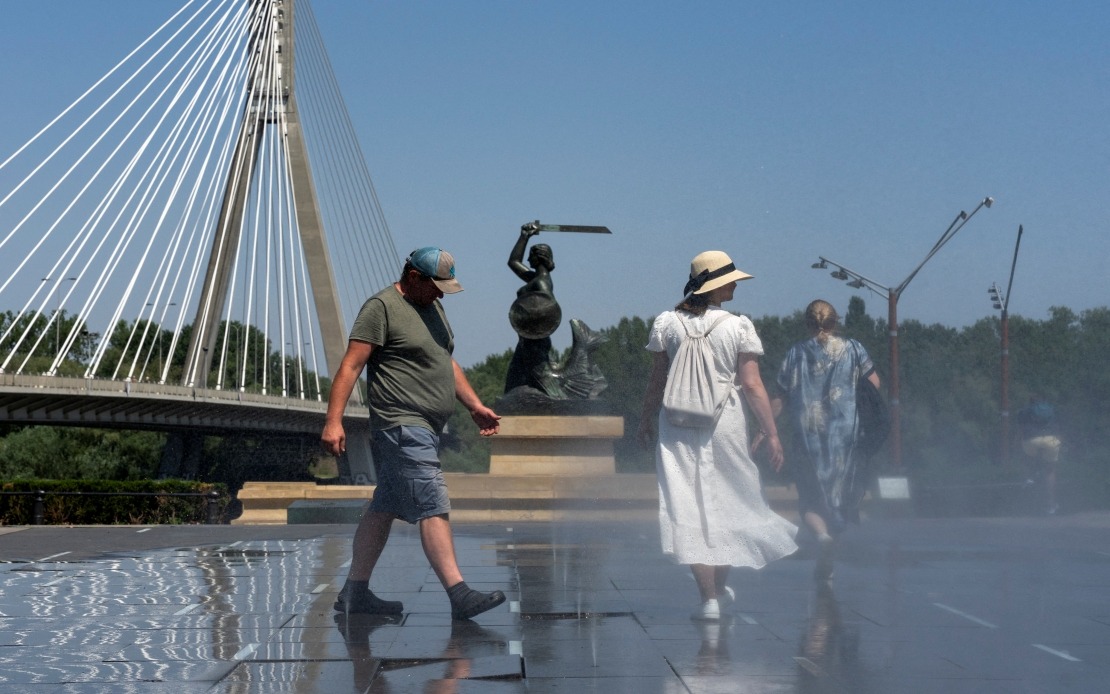
Poland experienced an extraordinary weather milestone on Sunday when thermometers across the country climbed to unprecedented levels, with the western border town of Slubice reaching 40.5 degrees Celsius. The reading represents a dramatic departure from the nation's longest-standing temperature record of 40.2 degrees Celsius, which had been recorded more than a century earlier in July 1921 at Proszkow, a location near Opole in southwestern Poland. This latest surge of extreme heat underscores the intensifying climate pressures affecting Central Europe and demonstrates how rapidly weather patterns are shifting across the continent.
Official confirmation of the new record remains subject to verification protocols managed by Poland's state meteorological agency, IMGW, though preliminary operational data strongly indicates the mark has been decisively broken. Agnieszka Prasek, a spokeswoman for the meteorological authority, outlined that existing measurements point conclusively toward the record's being surpassed, with formal validation expected to follow standard scientific procedures. Such verification processes ensure that temperature records maintain scientific credibility and remain comparable across decades and centuries of measurement.
The extraordinary conditions extended beyond Slubice's peak reading. The city of Torun, situated elsewhere in Poland, registered 40.3 degrees Celsius according to preliminary measurements, further confirming the breadth of the heat wave sweeping across the nation. Just a day before Sunday's record-breaking temperatures, Slubice itself had already established a June-specific record of 38.9 degrees Celsius, illustrating how rapidly conditions were escalating. The successive breaching of benchmarks in such quick succession underscores the intensity and persistence of the meteorological system driving these exceptional conditions.
For Malaysian and Southeast Asian observers, Poland's temperature surge carries significant implications for understanding global climate dynamics. The region's experience mirrors patterns increasingly observed across Asia, where nations like India, Thailand, and parts of Indonesia have grappled with dangerous heat waves in recent years. The breach of century-old records signals that climate change is not a gradual phenomenon unfolding over distant timescales, but rather a force producing immediate, measurable impacts on lived experience. Warsaw and other Polish cities have begun implementing infrastructure responses—public misting stations and water curtains—that parallel measures adopted in tropical nations facing similar challenges, suggesting a convergence of urban heat management strategies worldwide.
The Polish government mobilised a comprehensive public health response to address the dangers posed by extreme temperatures. Safety advisories circulated nationwide, directing residents to minimise sun exposure, increase water consumption, and avoid demanding physical exertion during peak heat hours. Such guidance reflects established medical understanding of heat-related illness risks, though enforcement of voluntary advisories in urban settings presents ongoing challenges. Beyond governmental communication, emergency services elevated their operational readiness to address anticipated surges in heatstroke cases, dehydration episodes, and weather-related medical incidents.
Urban centres across Poland activated specialised cooling infrastructure, with Warsaw prominent among municipalities deploying misting stations and water curtains in public spaces. These interventions represent relatively low-cost adaptations that provide relief during dangerous temperature spikes, though they address symptoms rather than underlying causes. Their deployment across major cities signals that extreme heat now ranks among accepted urban planning considerations, comparable to provisions for flood management or winter weather preparedness. For rapidly urbanising regions in Southeast Asia, the Polish experience offers a practical template for rapid-response cooling measures that might be integrated into public space design.
Forest fire risk emerged as a secondary but serious concern accompanying the heat wave. Dried vegetation and elevated temperatures create conditions conducive to rapid fire spread, threatening both ecosystems and human settlements in proximity to forested areas. Poland's forested regions, which comprise substantial portions of the country's eastern territories, face particular vulnerability. The combination of sustained high temperatures and dry conditions can overwhelm firefighting resources, as demonstrated in Mediterranean nations and increasingly across Central Europe. Early warning systems and pre-positioning of firefighting assets represent essential components of heat wave response protocols.
Meteorologists offered a sobering forecast regarding the heat wave's conclusion, predicting that the transition away from extreme conditions would not bring gradual cooling but rather a sharp shift driven by the arrival of cooler air masses from northern regions. This atmospheric transition typically produces severe thunderstorms as warmer and cooler air collide, creating conditions favourable for intense convective activity. Heavy rainfall, damaging winds, and localised flooding represent the probable consequences of this meteorological reversal, potentially generating a secondary wave of weather-related hazards following days of dangerous heat. Such feast-or-famine precipitation patterns have become increasingly characteristic of extreme weather events across multiple continents.
The transition from record heat to severe storms encapsulates a broader climatic reality: the stability of weather patterns that characterised previous generations is diminishing. Rather than gradual seasonal transitions, Europe now experiences abrupt swings between opposing weather extremes. This unpredictability complicates emergency preparedness and infrastructure planning, as communities must simultaneously prepare for droughts and floods, heat waves and severe storms. The implications extend across borders, as displaced populations, agricultural disruptions, and economic losses associated with extreme weather create regional instability and migration pressures that ripple across the continent and beyond.
For Southeast Asia, Poland's experience provides a cautionary example of climate change's accelerating impacts. The region already contends with monsoon-driven flooding, tropical heat stress, and rising sea levels—challenges that will intensify as global temperatures continue climbing. The breach of century-old records in Europe suggests that similarly dramatic records may soon fall in Asian contexts, potentially affecting agricultural productivity, water security, and human health across the region. Investment in climate adaptation infrastructure, from early warning systems to cooling centres to resilient water management, represents essential preparation for the climatic reality already emerging rather than anticipated future scenarios.
Poland's response to its unprecedented heat wave, spanning from public health communications to infrastructure activation to emergency service mobilisation, offers templates and cautionary lessons for other nations. The adequacy of these measures remains uncertain, however, particularly as heat waves increase in frequency and intensity. More fundamentally, the successive breaking of century-old records raises questions about whether adaptation strategies can keep pace with environmental change, or whether mitigation of future warming represents the only viable pathway to preventing conditions that exceed human and ecological tolerance thresholds. The Polish experience thus becomes part of an emerging global narrative about climate change, no longer a distant theoretical concern but an immediate force reshaping the conditions within which contemporary societies function.

