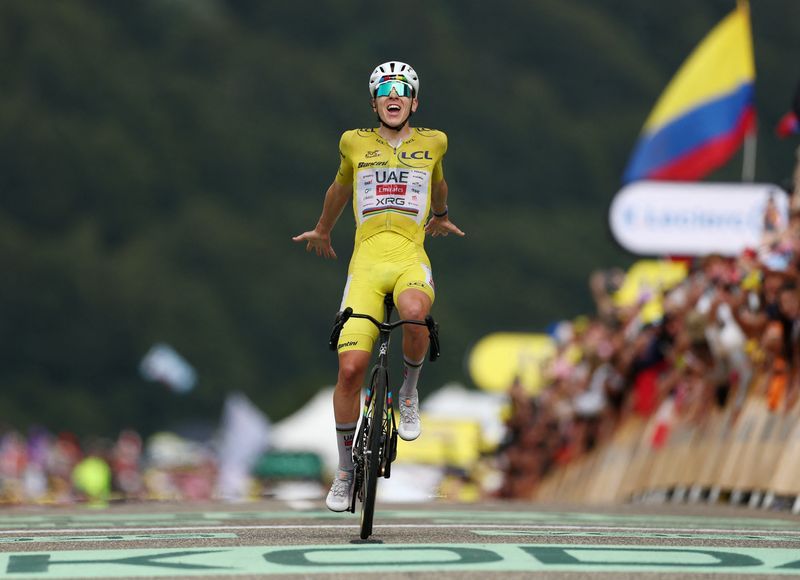
Tadej Pogacar has tightened his grip on the 2024 Tour de France, delivering a commanding solo performance on Saturday's mountainous 14th stage to extend his lead in what increasingly appears to be a procession towards his third consecutive title. The 27-year-old Slovenian rider, already a four-time Tour champion, launched a perfectly executed attack on the steepest pitch of the Col du Haag climb and held his advantage all the way to the finish line at Le Markstein Fellering, demonstrating the kind of tactical precision and physical dominance that has defined his campaign.
Pogacar's fourth stage victory of this year's race has inflated his cushion over second-placed Jonas Vingegaard to four minutes and 30 seconds—a margin that becomes increasingly significant with only a week of racing remaining. Vingegaard, the defending champion and winner of the previous two Tours before Pogacar's ascendancy, finished fourth on the day, a result that underscores the scale of the challenge facing any rider attempting to overhaul the Slovenian's advantage. The finish saw Pogacar's UAE Team Emirates-XRG teammate Isaac del Toro claim second place, ahead of local favourite Paul Seixas, highlighting the depth of resources the dominant team is deploying across the mountain stages.
The 155.3-kilometre route from Mulhouse tested the peloton relentlessly, with three category-one climbs woven throughout a landscape rendered treacherous by persistent rainfall. Early in the stage, Frenchman Valentin Paret-Peintre of Soudal Quick-Step established himself as a key protagonist, reaching the Grand Ballon peak ahead of Ecuador's Richard Carapaz while the main field trailed by nearly two minutes. Yet as the racing intensified and the climbs accumulated, Pogacar's team methodically controlled the tempo, gradually eroding the breakaway's advantage and positioning their leader for the decisive moment that would come higher up on the mountain.
Conditions deteriorated as the race pushed forward, with competitors navigating slippery descents during heavy downpours that made every technical decision fraught with risk. Carapaz and his EF Education–EasyPost teammate Ben Healy briefly lost the thread, taking a wrong turn during the climb to Ballon d'Alsace, but their experience allowed them to recover and rejoin the dwindling lead group. By the time the riders confronted the final major obstacle—the 11.2-kilometre ascent to Col du Haag—the dynamics had shifted considerably in Pogacar's favour, with his supporting cast having whittled the lead group down to manageable proportions.
On the approach to Col du Haag, Carapaz made a move designed to shake off rivals, with Norwegian rider Tobias Johannessen briefly following his wheel. Yet the general classification contenders, drawn together by the severity of the terrain, converged on the front of the race as the slope steepened. The decisive moment came about 2.5 kilometres from the summit, when the gradient exceeded 16 percent along the final two kilometres of the climb. Pogacar unleashed an acceleration that immediately distanced his rivals, establishing a 30-second advantage by the time he crested the summit, then extending that cushion further down the final descent to the finish.
The manner of Pogacar's attack reflects a rider operating at a level above his competition, particularly in the high mountains where the race is traditionally decided. He crossed the line 38 seconds ahead of del Toro, suggesting he was never in genuine distress even in the stage's closing moments. Del Toro's second-place finish moved him up the overall rankings to fourth place, overtaking Juan Ayuso, and demonstrated that Pogacar has the tactical flexibility to use his teammates offensively even when he is delivering the principal damage himself. Seixas, buoyed by the roaring support of spectators in his native Alsace region, managed to hold off the late challengers to claim third.
Pogacar himself acknowledged the supreme confidence flowing through his camp, suggesting the stage had been specifically targeted and executed with minimal deviation from the game plan. In a measured post-race reflection, the Slovenian described the day as characterised by perfect conditions and an ideal terrain for his particular strengths—the ability to generate explosive power on brutal gradients while maintaining superior positioning and tactical awareness. His familiarity with the region, combined with his team's meticulous preparation, created an environment where his victory felt almost inevitable once the Col du Haag came into view.
Yet for all the apparent inevitability of his dominance, Pogacar signalled that he does not expect the final week to unfold without challenge. Sunday's 15th stage, a 187.3-kilometre journey from Champagnole to Plateau de Solaison, presents another mountainous proving ground where the peloton's collective desperation to chip away at his advantage may create unpredictable moments. The route features similar demands to Saturday's stage, with sustained climbing and technical descents that could theoretically provide opportunities for coordinated attacks or unexpected breakthroughs. Pogacar's measured acknowledgement that harder days lie ahead suggests a rider sufficiently experienced to avoid complacency, even when leading by a considerable margin.
For Malaysian cycling enthusiasts and Southeast Asian fans of the sport, Pogacar's performance offers a masterclass in managing pressure and executing pre-planned strategy across a three-week grand tour. The Slovenian's consistency represents a striking contrast to earlier eras when Tour victories were contested more closely through the mountains, often decided by narrow margins and tactical brilliance in the closing stages. His fourth title in four years would represent one of the most dominant periods by any cyclist in Tour history, placing him alongside the legendary figures who have defined the race across generations. The remaining stages will determine whether Vingegaard or another contender can mount a credible challenge, but the evidence from Stage 14 suggests Pogacar's coronation is merely a formality awaiting the mathematical conclusion in Paris.

