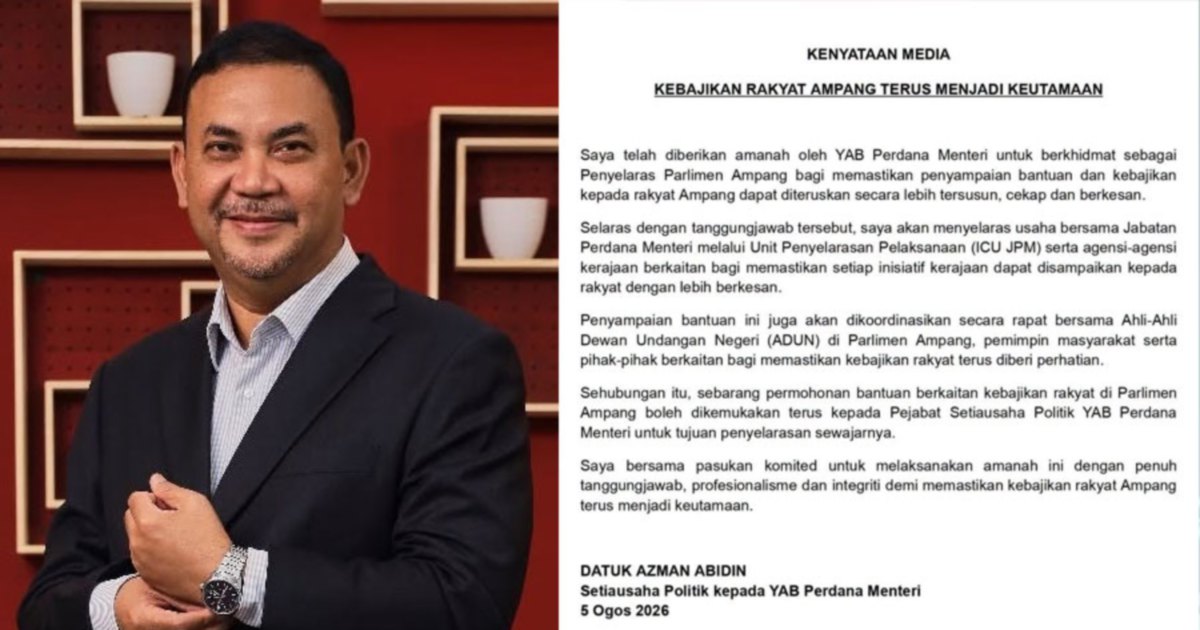
A political aide working directly under Prime Minister Datuk Seri Anwar Ibrahim has assumed the role of Ampang parliamentary coordinator, marking a significant shift in the management of parliamentary affairs in the constituency following recent administrative actions affecting the sitting member of parliament.
The appointment comes on the heels of PKR lawmaker Rodziah Ismail being suspended from accessing the MyKhas constituency allocation system, a digital platform that manages and distributes development funds to parliamentary constituencies. This move has effectively curtailed her ability to approve or oversee spending from the allocation, raising questions about the mechanisms of party discipline and administrative oversight within the Prime Minister's Office.
The appointment of a Prime Minister's political secretary to the coordinator role represents an unusual consolidation of administrative authority at the federal level. Parliamentary coordinators typically serve as liaison officers between individual MPs and the Prime Minister's Office, handling constituent matters and coordinating developmental initiatives within their constituencies. By placing one of the PM's own staff members in this position, the arrangement suggests heightened monitoring of parliamentary activities in Ampang, a constituency that has experienced organizational tensions within the PKR party structure.
Rodziah Ismail, the elected representative for Ampang, has represented the constituency as a member of the People's Justice Party under the Pakatan Harapan coalition. The suspension of her access to the MyKhas system essentially freezes her ability to authorize constituency development allocations, a critical tool that MPs use to address local infrastructure needs and constituent services. This digital control mechanism has increasingly become a method through which the federal government and party leadership can exercise administrative discipline over lawmakers.
The MyKhas system represents a centralized approach to constituency fund management introduced in recent years to enhance transparency and streamline the distribution of development resources. However, the ability to suspend individual MPs' access to the platform has transformed it into a powerful administrative tool that extends beyond mere financial oversight. Access suspensions can effectively sideline MPs from their fundamental roles as constituency representatives, as they cannot process routine funding requests for local projects or services.
The situation reflects broader tensions within PKR regarding internal party management and allegiances. The party, which serves as a key component of the ruling Pakatan Harapan coalition, has experienced periodic friction between various factions and competing interests. The suspension of Rodziah Ismail's fund access suggests that her actions or positions have drawn formal disapproval from party or federal authorities, though specific reasons for the suspension have not been publicly detailed.
For Malaysian constituencies like Ampang, which encompasses diverse residential areas and industrial zones in the Klang Valley region, the ability to access and distribute development funds directly affects the quality of public services and infrastructure improvements. When an MP loses such access, the pace of addressing local concerns often slows dramatically, placing constituent services in limbo. The appointment of the PM's aide as coordinator may theoretically speed up decision-making by centralizing authority, though it also raises concerns about democratic representation and the independence of local elected officials.
This arrangement also illuminates the power dynamics within Malaysia's federal system, where prime ministerial authority and party hierarchy can interact to constrain individual MPs' autonomy. While party discipline mechanisms are not uncommon in parliamentary democracies, the degree to which such mechanisms can prevent MPs from exercising their primary functions—securing development resources and addressing constituent needs—remains a matter of ongoing debate among governance observers.
The situation may carry implications for Southeast Asian governance more broadly, as several nations in the region employ similar digital fund management systems and face comparable challenges in balancing central authority with local democratic accountability. The Ampang case demonstrates how digital administrative tools, designed ostensibly to improve transparency, can be deployed to manage internal political conflicts within ruling coalitions.
Looking ahead, the suspension raises questions about potential remedies available to Rodziah Ismail and the timeline for resolution. It also underscores the importance of clearly defined procedures and appeal mechanisms for such administrative actions to ensure they do not undermine democratic principles or constituent representation. Whether this represents a temporary disciplinary measure or a longer-term shift in how Ampang's parliamentary affairs are managed will likely become clearer as political developments unfold in coming weeks.

