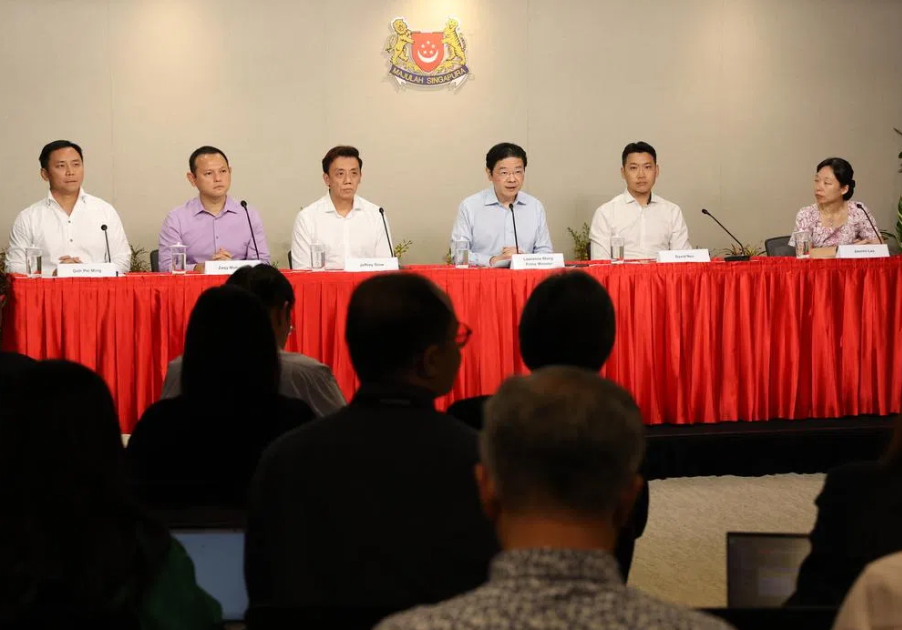
Prime Minister Lawrence Wong has unveiled a restructured Cabinet that marks a significant step in Singapore's ongoing generational leadership renewal, following recent political resignations that prompted the administration to accelerate the transition to a younger cohort of office-holders. The reshuffle, announced on July 22, represents a deliberate strategy to balance the immediate need for experienced hands with preparations for the future, establishing a framework where seasoned leaders mentor and guide an emerging generation of decision-makers. This approach reflects Singapore's distinctive model of orderly institutional succession, where new talent is progressively introduced rather than suddenly thrust into senior positions.
Two politicians entering their first term in elected office will now step into full ministerial rank. Jeffrey Siow, who has served as Acting Transport Minister since the previous Cabinet changes in May 2025, and David Neo, currently Acting Minister for Culture, Community and Youth, have both been judged ready for promotion despite their limited parliamentary experience. Their elevation signals confidence that these individuals have demonstrated sufficient competence and earned sufficient respect among colleagues and the civil service. Both will continue leading their current ministries following their formal appointments, ensuring policy continuity while formalising their expanded responsibilities.
Sim Ann, another first-term politician, has been appointed Second Minister for Foreign Affairs and Home Affairs, a coordinating role that bridges two crucial portfolios at a time of evolving regional security challenges and diplomatic engagement. Jasmin Lau, similarly serving her first term, will assume the position of Acting Minister for Manpower, taking over from Tan See Leng, who transitions to lead the Ministry of Trade and Industry with a focus on energy and industrial matters. This redistribution of portfolios demonstrates the government's confidence in newer faces while allowing experienced ministers to pursue different policy areas aligned with their expertise.
The reshuffle also brings back Ng Chee Meng, the labour movement's chief organiser, to Cabinet as Minister in the Prime Minister's Office. K. Shanmugam, meanwhile, has been elevated to Senior Minister, a title acknowledging his standing as one of the two most experienced members of the Cabinet alongside Lee Hsien Loong. These appointments underscore the government's philosophy of retaining veteran expertise in visible leadership roles where they can provide strategic guidance and mentor the younger generation ascending through the ranks. The gerontocracy-conscious positioning allows Singapore to address both immediate governance demands and institutional knowledge transfer.
Two additional first-term backbench MPs, Foo Cexiang and Shawn Loh, both former senior civil servants, will join the ministerial bench as Ministers of State. Their backgrounds in the administrative service provide them with institutional understanding and networks, potentially easing their transition into elected office at a higher level. This pattern of recruiting accomplished technocrats from the civil service into Parliament, then rapidly advancing them, reflects Singapore's emphasis on merit-based selection and the fungibility of expertise across government sectors.
The changes occur against a backdrop of unexpected departures that necessitated the reshuffle's timing. Faishal Ibrahim, Acting Minister-in-charge of Muslim Affairs and Senior Minister of State for Home Affairs, resigned on July 20 following what he described as a "lapse of judgment" in managing personal interactions. Earlier, Koh Poh Koon, a senior minister of state, stepped down on June 1, citing family reasons. These two resignations within six months imposed unscheduled demands on the Cabinet's composition and accelerated the timeline for promoting newer figures who might otherwise have developed more gradually through the system.
Prime Minister Wong acknowledged that while Cabinet composition is subject to annual review, the resignations necessitated faster-than-planned adjustments. He framed the situation as an opportunity to continue building what the government terms a "strong pipeline" of talent, emphasizing that development extends beyond ministerial ranks to include promising backbenchers and mid-level office-holders. The implication is that Singapore views political succession as an ongoing institutional process rather than a discrete event, requiring constant attention to identifying, testing, and promoting capable individuals across multiple levels simultaneously.
Wong addressed questions about the decision not to appoint a second deputy prime minister alongside the serving Gan Kim Yong. He indicated that the current structure—featuring a strong senior leadership team and three Coordinating Ministers overseeing different government domains—provides sufficient institutional depth without additional deputy appointments. This structural choice reflects confidence that the current arrangement can handle governance demands while remaining flexible for adjustments as the leadership transition continues. The emphasis on coordinating ministers rather than additional deputy positions suggests an administrative model prioritising cross-portfolio coordination over traditional hierarchical depth.
The Prime Minister also disclosed that he continues holding the Finance portfolio since 2021 while actively seeking a successor, describing the search as "a work in progress." Wong characterised the succession process as gradual and individualized, noting that different people develop at different rates and require varying timeframes to reach readiness for major appointments. His approach emphasizes personal assessment and matching capabilities to positions rather than mechanical advancement based on seniority or tenure. This personalised development model, while flexible, also concentrates significant succession planning authority in the prime ministerial office.
For Malaysian observers, Singapore's Cabinet reshuffle carries instructive dimensions regarding institutional governance and generational transitions. Singapore's approach prioritises careful mentoring of newer politicians within structured roles before advancing them to full ministerial responsibility, contrasting with systems where political appointments may reward party loyalty or factional allegiance. The deliberate pairing of newly promoted ministers with experienced seniors provides institutional continuity and reduces the governance risks accompanying rapid generational turnover. Malaysia's own ongoing efforts to develop younger political leaders might benefit from examining how Singapore systematically tests capability through acting ministerial roles before confirmation, creating demonstrable tracks of competence.
Regionally, Singapore's reshuffle underscores the city-state's confidence in managing institutional transitions despite external pressures, including evolving security challenges and economic uncertainties. The promotions of first-term MPs to full ministerial rank signal that the government perceives itself as having successfully developed adequate talent depth, a prerequisite for orderly succession in any political system. The maintenance of senior figures like Shanmugam in advisory roles while elevating newcomers suggests Singapore is executing a transition neither precipitous nor stagnant—a balance that regional governments are increasingly recognising as essential for both legitimacy and effective governance.
The changes take effect progressively beginning July 27, with some adjustments scheduled for later implementation, allowing the administration to phase in new arrangements without creating governance gaps. This staged approach reflects bureaucratic sophistication, ensuring that transitions occur when predecessors have adequately briefed successors and institutional systems have accommodated new arrangements. Wong's description of these changes as reflecting "the Singapore way of leadership renewal" emphasises continuity of method even as personnel change, suggesting that institutional process and precedent matter as much as individual selection in maintaining political system stability.

