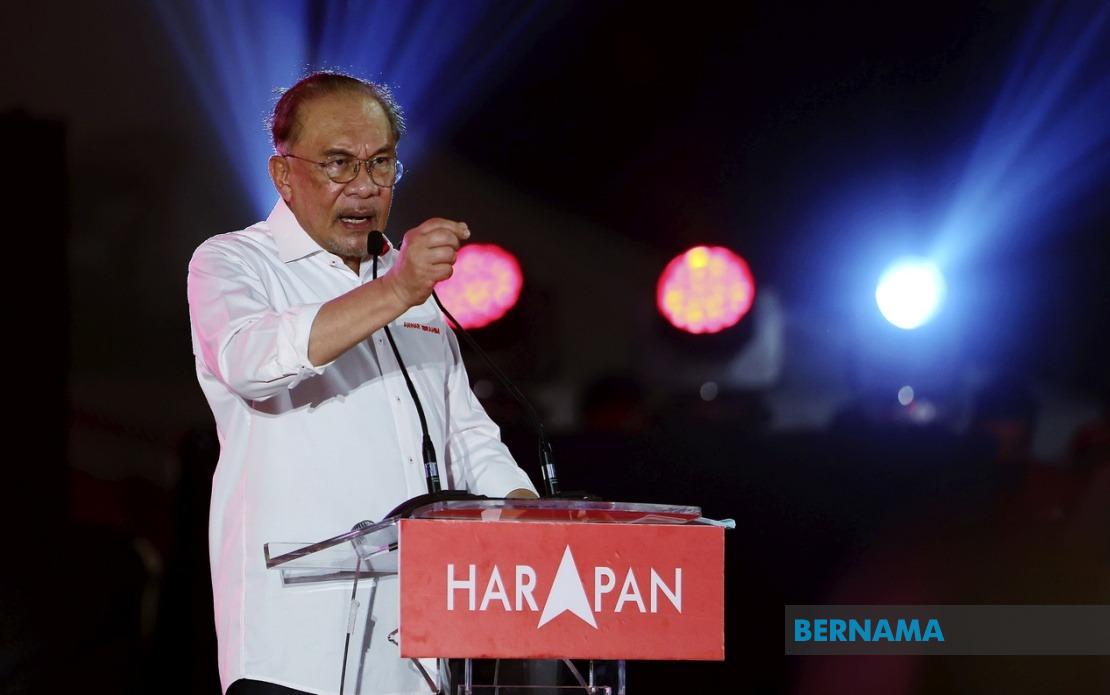
Prime Minister Datuk Seri Anwar Ibrahim delivered a stark warning to political contestants in Negeri Sembilan on July 14, cautioning that the upcoming state election should not become a platform for agitating issues surrounding the monarchy or constitutional matters. Speaking at the Pakatan Harapan candidate announcement ceremony in Kuala Pilah, the PH chairman stressed that while electoral competition forms a cornerstone of democratic engagement, it must be pursued with restraint and integrity.
Anwar's remarks reflect growing concern within Malaysia's political establishment about the potential weaponization of sensitive national institutions during campaign cycles. The monarchy holds deep constitutional significance in Malaysia's federal framework, and deliberate efforts to inflame public sentiment on such matters risk destabilizing the delicate institutional balance that has underpinned the nation's governance architecture. By framing his message around democratic responsibility rather than legal prohibition, Anwar attempted to appeal to all contesting parties' sense of patriotic duty and institutional preservation.
The Prime Minister articulated a vision of electoral competition that permits robust political disagreement while maintaining respect for foundational national pillars. He acknowledged that differing perspectives are inevitable in democratic contests, yet cautioned that such differences must not translate into attempts to undermine or delegitimize institutions that provide structural stability to the country. This distinction—between legitimate political debate and destructive institutional questioning—appears central to Anwar's framework for managing the upcoming election.
Negeri Sembilan's state election carries particular significance as a test case for Pakatan Harapan's campaign discipline and messaging coherence across multiple component parties. The presence of DAP secretary-general Anthony Loke, Amanah president Datuk Seri Mohamad Sabu, and other senior coalition figures at the ceremony underscored the coalition's attempt to present a unified front on institutional respect and electoral ethics. For Malaysian voters and political observers across Southeast Asia, such gestures signal the coalition's commitment to maintaining institutional boundaries during competitive periods.
Anwar emphasized that Negeri Sembilan's electorate deserves leadership characterized by transparency and ethical conduct, capable of propelling the state toward accelerated economic and social progress. This framing positions the election not primarily around constitutional or institutional disputes, but rather around tangible developmental outcomes and good governance standards. The rhetorical shift from potentially divisive constitutional debates toward concrete delivery of public benefits represents a strategic attempt to keep campaign discourse centered on issues with measurable impact on citizens' daily lives.
The Prime Minister expressed confidence that the state could advance in synchronization with federal government initiatives, warning against regional stagnation or disconnection from national development trajectories. This language reflects concerns about sub-national governments pursuing divergent policy paths that could create inconsistencies in service delivery or economic coordination. For a state economy dependent on integration with national supply chains and federal infrastructure investments, maintaining alignment with the federal administration carries practical implications beyond purely political considerations.
Anwar's endorsement of incumbent Menteri Besar Datuk Seri Aminuddin Harun as a cooperative and accessible leader signals PH's confidence in retaining state control. The characterization of Aminuddin as someone who works effectively with federal authorities subtly reinforces the argument for continuity and institutional coordination. In Malaysia's federal system, state-federal cooperation remains essential for implementing policies spanning multiple governance tiers, and visible harmony between leadership levels can influence voter perceptions of administrative effectiveness.
Pakatan Harapan's candidate slate for the 16th Negeri Sembilan State Election reflects a deliberate balance between fresh political entrants and seasoned operatives drawn from the three-party coalition structure. The inclusion of high-profile figures including Loke for the Chennah seat and Aminuddin for Linggi demonstrates efforts to deploy experienced campaigners in strategically important constituencies. The announcement of 36 candidates across the state election signals the coalition's comprehensive mobilization effort and confidence in competitive viability across Negeri Sembilan's diverse electoral geography.
The composition of PH's campaign team—featuring representatives from PKR, DAP, and Amanah—underscores the coalition's multi-ethnic and multi-ideological nature. This diversity, while potentially creating internal coordination challenges, also enables the coalition to appeal across Malaysia's plural society. For regional observers monitoring ASEAN democracies, Malaysia's multi-party coalition governance model presents a distinctive approach to managing electoral competition within institutionally complex environments.
Anwar's call for campaign discipline and institutional respect arrives amid broader regional conversations about democratic resilience in Southeast Asia. Countries across the region grapple with balancing competitive electoral dynamics against preservation of national institutions that transcend partisan politics. Malaysia's approach of appealing to party leaders' voluntary restraint, rather than relying solely on legal constraints, reflects confidence in political actors' understanding of institutional preservation's long-term benefits.
The timing of this appeal—during the formal candidate announcement rather than mid-campaign—suggests an attempt to establish parameters early before campaign rhetoric potentially escalates. This preventative approach contrasts with reactive interventions late in electoral cycles and may prove more effective in shaping candidate conduct and messaging priorities throughout the campaign period. Political scientists examining Southeast Asian electoral dynamics often highlight such early-stage boundary-setting as more effective than subsequent corrective measures.
For Malaysian voters assessing PH's fitness to govern, Anwar's emphasis on institutional respect and democratic propriety may serve as a positive differentiator, particularly among constituencies concerned about political stability and governance quality. The coalition's apparent willingness to constrain itself voluntarily on potentially mobilizing issues could appeal to swing voters prioritizing stability over divisive appeals. However, this restraint also carries political risks if opposition parties employ less disciplined messaging that resonates with specific voter segments, creating asymmetrical campaign dynamics that advantage less restrained competitors.
Looking beyond Negeri Sembilan, the principles Anwar articulated may establish precedents for future electoral contests across Malaysia's remaining states and eventual federal elections. A demonstrated ability to manage multi-party electoral competition without destabilizing national institutions would strengthen Malaysia's democratic credentials regionally and internationally. Conversely, failure to maintain such boundaries could undermine confidence in Malaysia's institutional resilience and influence the nation's standing within Southeast Asian democratic comparisons.

