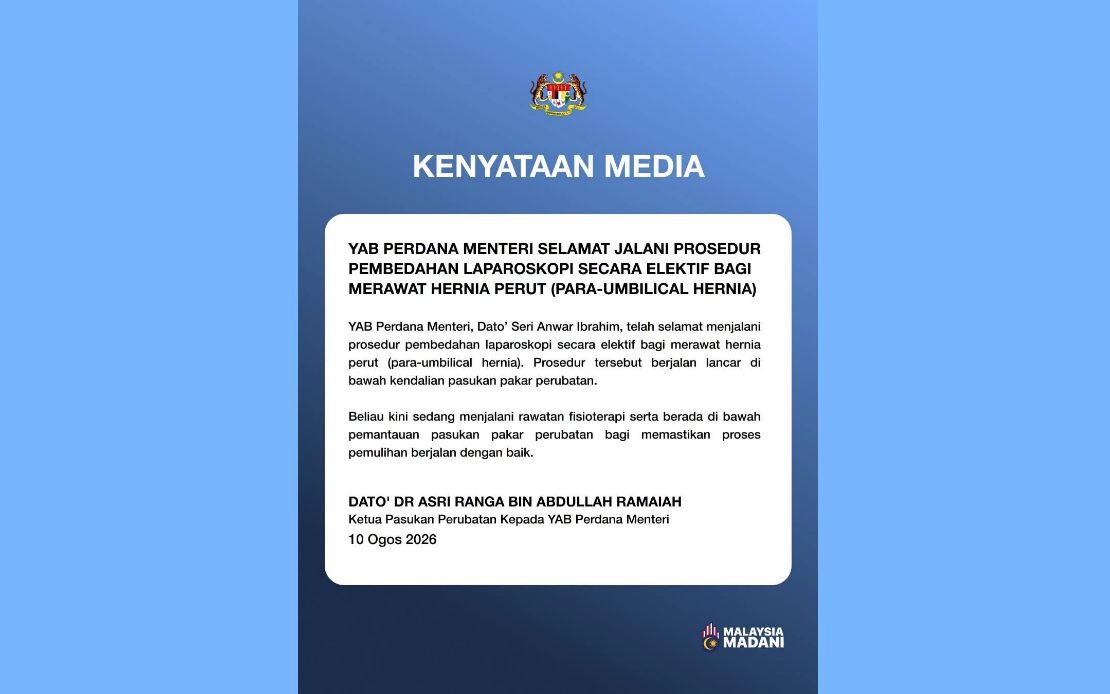
Prime Minister Datuk Seri Anwar Ibrahim has undergone successful elective surgery to address an abdominal hernia, with medical authorities confirming that the minimally invasive laparoscopic procedure proceeded without complications. The operation, which targeted a para-umbilical hernia, was conducted by a specialised surgical team and represents part of the Prime Minister's ongoing healthcare management.
Heading the Prime Minister's medical contingent, Datuk Dr Asri Ranga Abdullah Ramaiah provided official confirmation of the procedure's successful completion, noting that the surgical intervention unfolded smoothly under the supervision of experienced medical specialists. The use of laparoscopic techniques, which involve smaller incisions and typically result in faster recovery compared to traditional open surgery, underscores a modern approach to treating this type of abdominal condition. Para-umbilical hernias occur when tissue protrudes through weakened abdominal muscles near the belly button area and, while not necessarily life-threatening, warrant surgical intervention to prevent potential complications.
Following the completion of surgery, Anwar has transitioned into the next phase of his post-operative care regimen. The Prime Minister is currently engaged in physiotherapy sessions designed to restore strength and mobility whilst adhering to the comprehensive monitoring framework established by his medical specialists. This structured recovery approach reflects best practices in post-surgical management and aims to facilitate a full return to normal functioning within an optimal timeframe.
The medical supervision continues with intensive observation protocols, with the Prime Minister remaining under constant specialist evaluation during the critical initial recovery window. Dr Asri's statement, disseminated through official channels including the Prime Minister's social media platforms, emphasised that ongoing monitoring specifically targets ensuring that recovery progresses according to established clinical benchmarks. This deliberate approach to post-operative care seeks to identify any complications early and maintain optimal conditions for tissue healing and restoration of physical capacity.
The Prime Minister's senior press secretary, Tunku Nashrul Abaidah, had previously advised the public that Anwar would undergo prescribed examinations and therapeutic procedures as determined by the specialist team, with an anticipated two-day observation period following the intervention. This timeline reflects standard protocols for laparoscopic procedures, which generally entail shorter hospitalisation compared to open surgery. The public announcement regarding the anticipated duration of observation was intended to provide transparency about the Prime Minister's temporary reduction in official duties during the critical recovery phase.
The government, through official channels, extended an appeal to the Malaysian public to offer prayers and well-wishes for the Prime Minister's successful recuperation. Such public health matters involving national leaders often generate widespread interest, and the authorities sought to maintain public confidence through transparent communication about the nature of the procedure and expected recovery trajectory. The framing emphasised the temporary nature of the intervention and the expectation that Anwar would swiftly resume full performance of his prime ministerial responsibilities following completion of the prescribed recovery period.
From a governance perspective, the timing and management of the Prime Minister's medical procedure reflects institutional planning aimed at minimising disruption to executive functions. Elective surgical procedures are typically scheduled during periods when administrative demands can be managed through delegation to cabinet colleagues, ensuring continuity of government operations. This approach balances the Prime Minister's health requirements with the imperative to maintain effective governmental oversight and decision-making capacity.
The choice of laparoscopic over open surgical intervention carries implications for recovery duration and the speed at which Anwar can resume full operational capacity. Laparoscopic techniques typically result in reduced post-operative pain, faster return to normal activities, and lower infection risk compared to conventional surgical approaches. For a sitting head of government, such considerations carry particular weight, as extended periods away from full duties can create administrative challenges and potentially affect policy implementation timelines.
The emphasis on specialist medical oversight and structured physiotherapy reflects Malaysia's healthcare infrastructure capabilities, particularly for high-level patients requiring coordinated multi-disciplinary interventions. The involvement of a dedicated medical team headed by a named specialist indicates the formalised nature of Prime Ministerial healthcare provision and the resources allocated to ensuring optimal outcomes for the nation's top executive. This institutional approach to governmental health matters demonstrates established protocols and chain-of-command structures within Malaysia's medical and security services.
As Anwar progresses through his recovery trajectory, the pace of his return to full public engagement will likely provide an informal gauge of his healing progress. Medical specialists typically establish clear milestones for resuming executive duties following such procedures, with gradual expansion of responsibilities rather than abrupt resumption of full schedule. The public communications strategy surrounding the Prime Minister's recovery appears designed to maintain confidence in governmental stability whilst providing realistic expectations about any temporary adjustments to his availability during the immediate post-operative period.

