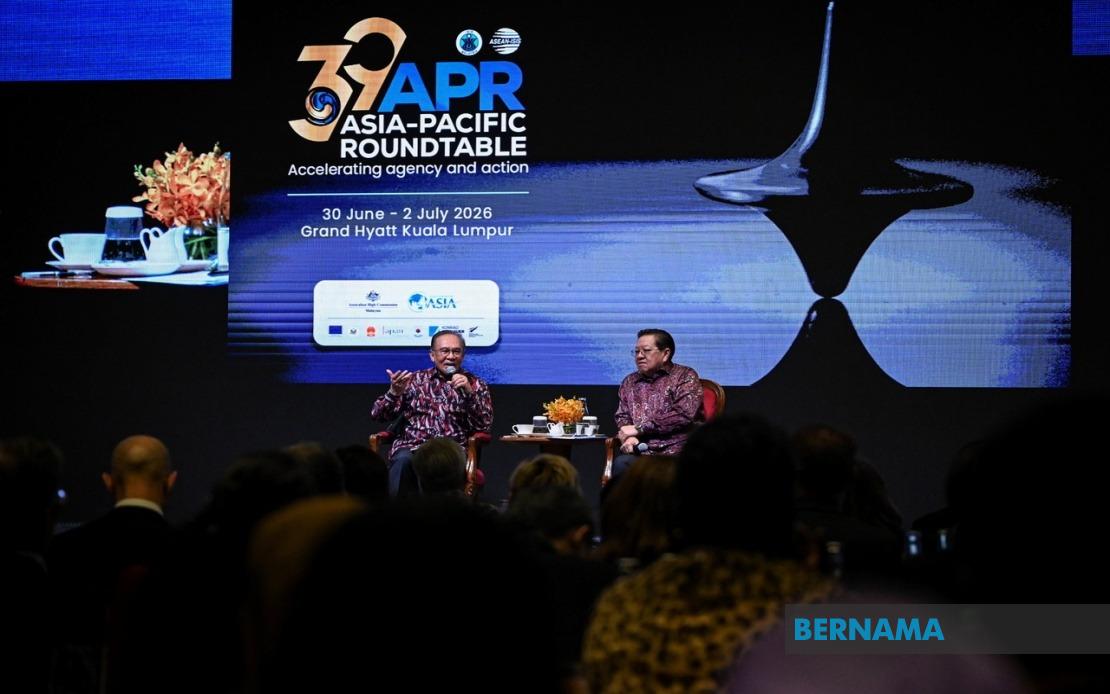
Malaysia's Prime Minister Datuk Seri Anwar Ibrahim has pushed back forcefully against what he characterises as alarmist narratives about inevitable conflict in the South China Sea, reaffirming his government's commitment to resolving maritime tensions through sustained diplomatic engagement. Speaking at the 39th Asia-Pacific Roundtable in Kuala Lumpur on Thursday, Anwar argued that the region's leaders must resist the temptation to accept conflict as predetermined, instead anchoring their approach in principles of dialogue, reciprocal trust, and adherence to established international law frameworks.
The Prime Minister's remarks reflect Malaysia's pragmatic positioning on one of the world's most sensitive geopolitical fault lines. Rather than viewing Beijing as an inherent threat, Anwar framed Malaysia's relationship with China as substantively productive, citing direct engagements with President Xi Jinping and Premier Li Qiang as evidence that disagreements need not metastasize into larger confrontations. His explicit rejection of what he termed a "phobia" about South China Sea threats signals a deliberate effort to steer regional discourse away from zero-sum competition frameworks that have dominated international commentary in recent years.
Central to Anwar's argument is Malaysia's lived experience managing the competing pressures of maritime disputes with China while maintaining robust economic and diplomatic ties. The Prime Minister underscored that despite overlapping territorial claims and fishing rights disputes in the South China Sea, his interactions with Chinese leadership have remained cordial and substantive, with no major flashpoints that have triggered genuine diplomatic ruptures. This characterisation reflects a broader Malaysian strategy of compartmentalising disagreements, allowing bilateral cooperation in trade, infrastructure, and security matters to proceed in parallel with managing contested claims in shared waters.
Anwar placed particular emphasis on the ongoing negotiations for an ASEAN-China Code of Conduct governing South China Sea behaviour, positioning this framework as the legitimate pathway toward conflict prevention. The Prime Minister noted that China has publicly endorsed the United Nations Convention on the Law of the Sea, creating common ground with Southeast Asian claimants on the rules that should govern maritime interactions. The code of conduct, which has been under negotiation for years, represents a carefully calibrated approach designed to establish behavioural guardrails without requiring any nation to abandon its legal positions or territorial claims—a compromise that Malaysia views as the most realistic achievable outcome.
The emphasis on dialogue reflects a distinctly Malaysian perspective shaped by the country's own experience of managing internal ethnic and religious diversity through consensus-building rather than confrontation. Anwar argued that ASEAN's several decades of relative peace among its members stemmed fundamentally from the practice of regular direct communication among leaders, who use these channels to address grievances before they crystallise into institutional disputes. This institutional memory of successful conflict avoidance through personal relationships and behind-the-scenes negotiation underpins Malaysia's resistance to more confrontational regional postures championed by some Western powers and their regional allies.
Anwar's remarks also contained an implicit critique of international media narratives and strategic commentary that emphasise worst-case scenarios in the Indo-Pacific. By rejecting what he framed as excessive focus on warfare prospects, the Prime Minister was essentially arguing that such narratives become self-fulfilling prophecies, constraining the diplomatic space necessary for genuine negotiation. This perspective resonates with Malaysia's historical role as a bridge-builder in regional affairs, positioning itself between major powers and seeking to maintain equidistance from competing strategic camps.
Beyond the South China Sea specifically, Anwar addressed the Cambodia-Thailand border dispute as another case study in conflict resolution through patience and dialogue. His welcome for both countries' commitment to continued negotiations illustrated Malaysia's broader conviction that many regional tensions represent historical legacies—consequences of colonial-era boundary-drawing—rather than contemporary ideological conflicts that require military resolution. By contextualising these disputes within longer historical arcs, Anwar suggested they might be susceptible to amelioration through technical discussions about border demarcation and confidence-building measures rather than power politics.
The Prime Minister also signalled Malaysia's commitment to pursuing systemic reform of global multilateral institutions, including the United Nations and World Trade Organisation, arguing that strengthened international frameworks would provide better mechanisms for resolving regional disputes. This position ties ASEAN's South China Sea approach to broader questions about global governance architecture, suggesting that regional stability depends not merely on bilateral relationships but on the robustness of international legal and institutional frameworks. For Malaysia, this represents an effort to anchor Southeast Asian security in rules-based systems where smaller powers retain voice and protection.
Anwar's remarks carry particular significance given Malaysia's economic dependence on trade flows through the South China Sea and its desire to attract Chinese investment in megaprojects. The government's rhetorical emphasis on dialogue alignment with these material interests, even as it attempts to maintain credibility with ASEAN partners who hold varying perspectives on China policy. His insistence that Malaysia has experienced positive engagement with Beijing, coupled with his commitment to ASEAN unity on maritime matters, represents an attempt to thread a difficult needle—accommodating Beijing's preferences for bilateral diplomacy while maintaining collective ASEAN positions.
The backdrop of Anwar's comments includes broader geopolitical tensions involving the United States, which has intensified its focus on Indo-Pacific competition with China in recent years. By emphasising dialogue and international law, Malaysia subtly resists American efforts to construct a more explicitly anti-China regional coalition. This approach reflects a longstanding Malaysian preference for non-alignment and strategic autonomy, particularly under Anwar's leadership, which has attempted to diversify partnerships rather than align decisively with either Washington or Beijing.
Moving forward, Anwar's framing suggests Malaysia will continue advocating for the Code of Conduct completion as the key mechanism for managing South China Sea tensions, while maintaining that military buildups and alliance structures explicitly designed to contain China are counterproductive to regional stability. Whether this strategy can withstand mounting great power competition in the coming years remains an open question, but for now, Malaysia's Prime Minister has staked a clear position: conflict is neither inevitable nor desirable, and diplomacy grounded in international law remains the only legitimate path forward.

