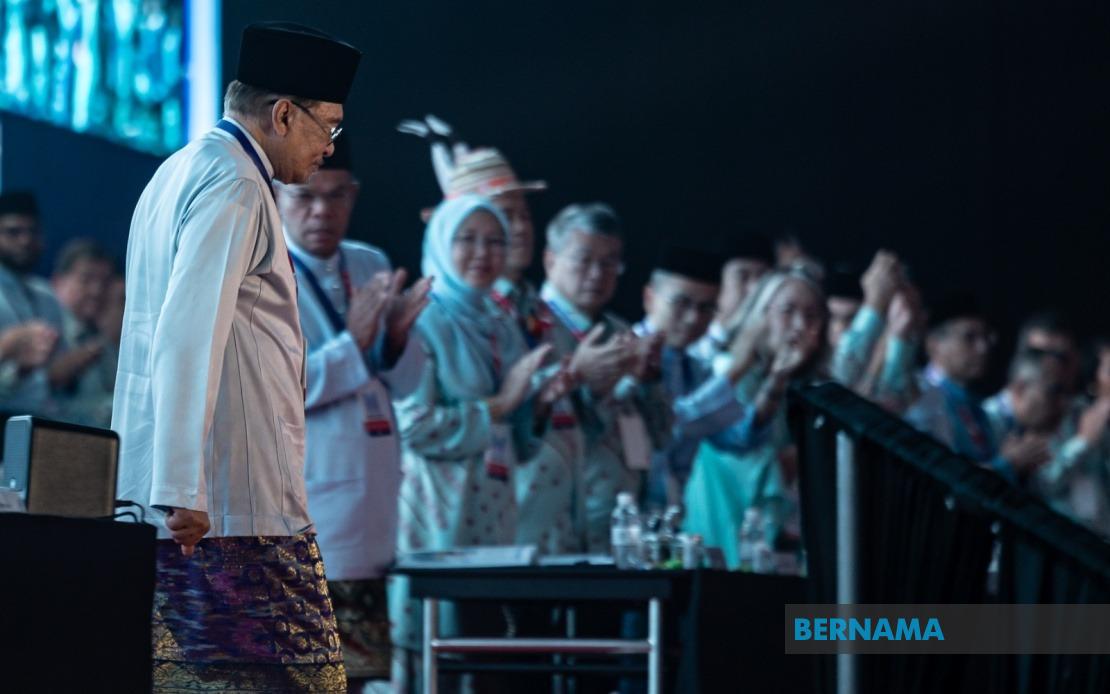
Prime Minister Datuk Seri Anwar Ibrahim has firmly pushed back against accusations that the MADANI Government is overlooking the development needs of certain Malaysian states, instead arguing that federal spending reflects strategic priorities that benefit all regions. Speaking at the PKR National Congress in Melaka on Thursday, Anwar countered the narrative of regional neglect by presenting an array of budget comparisons that he says demonstrate sustained investment growth across the country, from major peninsular states to the East Malaysian territories of Sabah and Sarawak.
The Prime Minister's intervention comes amid ongoing political tensions between federal and state governments of different party alignments, a persistent feature of Malaysian politics where opposition-controlled states sometimes accuse the federal administration of withholding resources or favouring ruling coalition territories. By releasing concrete figures at a party gathering, Anwar appears intent on neutralizing such critiques before they gain broader traction among voters in states perceived as politically unfriendly to his government.
Among the fiscal evidence Anwar cited was a substantial 35 per cent increase in federal expenditure for Sabah, rising from RM13 billion in 2022 to RM17.6 billion in 2026. This represents one of the more dramatic improvements highlighted, reflecting perhaps heightened attention to the large East Malaysian state following various political realignments and defections within its ruling Gabungan Parti Sarawak. The Sabah example also serves to preempt any accusations of unfair treatment towards constituencies where the federal government's electoral performance has been inconsistent or contested.
Sarawak, another crucial political battleground despite its size and resource wealth, has seen its federal allocation climb from RM10.2 billion in 2022 to RM15.1 billion, representing a 48 per cent increase. This figure is particularly significant as Sarawak holds considerable symbolic importance in maintaining the federal coalition's stability, and such improvements in federal funding underpin the value of continued alignment with Putrajaya. The trajectory of spending suggests deliberate effort to maintain goodwill among the state's leadership.
Within peninsular Malaysia, the picture remains more mixed, though Anwar selectively highlighted states where increases were pronounced. Johor's allocation expanded from RM10.2 billion in 2022 to RM14.6 billion in 2026, a noteworthy rise for a state with significant population and economic output. Terengganu saw funding rise from RM6 billion to RM8.1 billion, while smaller or less politically contested territories including Perlis and Kedah also received increases. The inclusion of Kelantan among examples, despite the state being under PAS control, suggests an attempt to demonstrate even-handedness across party lines.
Anwar's framing of these allocations emphasizes that variation in spending reflects strategic priorities rather than political discrimination. This argument is crucial to his credibility, since Malaysian federal budgeting does inevitably involve competing demands from infrastructure needs, population size, economic capacity, and development gaps. By contextualizing spending growth within a framework of rational planning rather than partisan favoritism, the Prime Minister attempts to shift the conversation from zero-sum perceptions of winners and losers to a broader narrative of national development.
The timing of these revelations at a major political event also serves internal party purposes. The PKR National Congress provides an audience of party faithful and representatives, amplifying messages through party networks and social media. By demonstrating that his administration is delivering material benefits to regions across the political spectrum, Anwar reinforces his positioning as a leader concerned with national unity and inclusive governance—themes central to his political brand and his coalition's electoral messaging.
However, the Prime Minister's emphasis on comparing current figures to 2022 baselines reflects the political calculation required when defending government spending. The choice of baseline year matters significantly in budget debates; comparisons against earlier years might paint different pictures. Notably, Anwar deflected questions about whether previous state governments raised concerns about allocation levels, suggesting that scrutiny of federal spending disparities is itself a recent phenomenon rather than a longstanding issue.
For Malaysian readers, particularly those in states perceiving themselves as disadvantaged, these figures warrant careful examination. Federal allocations support significant portions of state government budgets, funding essential services from education and healthcare to infrastructure and administration. Sustained increases across multiple states suggest either genuine government commitment to broad-based development or, conversely, the mathematical reality that nominal budget sizes have grown alongside overall government spending and inflation.
The implications for Southeast Asia extend beyond Malaysia's borders. As regional governments increasingly face pressure to demonstrate equitable development and inclusive growth, federal spending patterns become flashpoints for political legitimacy. Anwar's defensive posture at the PKR Congress, while framed as advancing national unity, also implicitly acknowledges that perceptions of regional inequality remain potent political weapons in Malaysian electoral contests.
Looking forward, the Prime Minister's presentation strategy—deploying budget data at party forums rather than through comprehensive public communications—suggests that winning the narrative on state development requires sustained, strategic messaging. Whether such allocations translate into tangible improvements on the ground remains a separate question, one that voters in these states will ultimately assess based on visible progress in their communities.

