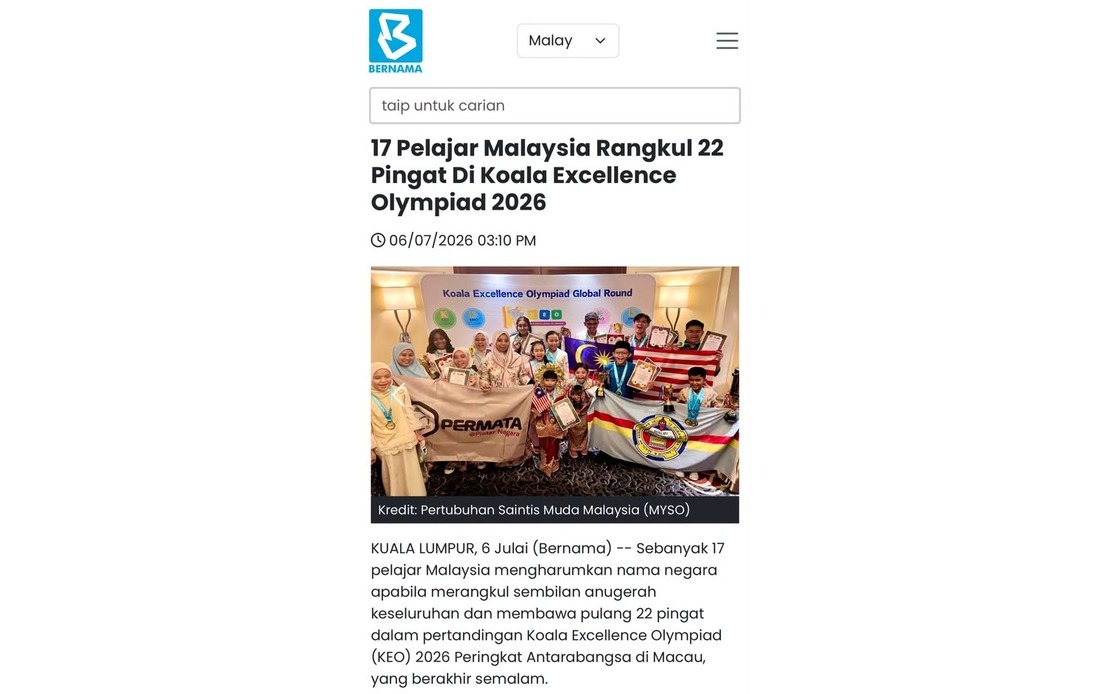
Prime Minister Datuk Seri Anwar Ibrahim has commended 17 Malaysian students for their impressive medal haul at the 2026 Koala Excellence Olympiad (KEO) Global Finals, held in Macau over the past week. The contingent delivered a strong performance by capturing nine overall awards alongside 22 medals across the international competition, reflecting the calibre of academic talent being developed within Malaysia's education system.
In a statement posted on social media, the Prime Minister extended his congratulations to the young achievers, urging them to sustain their drive towards academic excellence and to set their sights on even greater accomplishments ahead. His acknowledgement underscores the government's commitment to nurturing and recognising exceptional student performance in competitive international arenas, particularly in fields that demand rigorous intellectual discipline.
The medal tally comprised five gold, six silver and 11 bronze medals, according to Aidah Misran, coordinator of the Malaysia Young Scientists Organisation (MYSO) and head of the Malaysian delegation dispatched to Macau. This distribution across the podium positions demonstrates a broad-based strength among the Malaysian contingent rather than reliance on isolated champions, suggesting that the country's preparation pipeline for international academic competitions is producing consistent performers across different ability levels.
The KEO Global Finals brought together student competitors from multiple nations in a structured format encompassing four distinct academic domains: English, Mathematics, Science and Arts Olympiads. This multi-disciplinary approach tests both specialisation and intellectual breadth, requiring participants to demonstrate proficiency across the humanities and natural sciences rather than excelling in a single narrow field. For Malaysian students to succeed in such a diverse framework speaks to the quality of their foundational education and their capacity for cross-disciplinary thinking.
The competition itself represents a relatively recent addition to the international academic calendar, having been developed by a consortium of Australian educational specialists and alumni who sought to establish a comprehensive platform for young scholars. KEO's structure reflects contemporary educational philosophy, emphasising that excellence in the modern era demands competence across multiple knowledge domains rather than specialisation alone. The involvement of Miss Man International Group as a co-organiser reflects how private sector partnerships are increasingly shaping global academic competitions.
Within Malaysia, MYSO has assumed coordination responsibilities for KEO, positioning itself as the gateway institution for Malaysian participation in this particular olympiad stream. The organisation's role extends beyond mere administrative logistics; it functions as a talent identification and development mechanism, selecting and preparing students capable of representing the country's academic interests on the world stage. This institutional responsibility carries implications for how Malaysian education authorities structure their talent development frameworks more broadly.
The success of Malaysia's showing at the KEO 2026 Global Finals carries particular significance for Southeast Asia, a region where academic competitions increasingly serve as benchmarks for national educational standards. Malaysian participation in international olympiads has traditionally been strong in mathematics and science disciplines, but broader representation across English and Arts olympiads indicates an evolving educational landscape that values intellectual versatility. This shift suggests that Malaysian schools are responding to contemporary demands for graduates who can think critically across traditional subject boundaries.
For Malaysian policymakers, results from international competitions offer both validation and diagnostic information. Strong performances confirm that existing curriculum frameworks and teacher training methodologies are producing globally competitive graduates, while underperformance in specific areas identifies where curriculum or pedagogy require strengthening. The KEO results thus inform strategic educational planning at the national level, contributing to evidence-based policy development around academic standards and resource allocation.
The Prime Minister's public recognition of these student achievements carries symbolic weight beyond mere congratulatory gesture. It signals government prioritisation of academic excellence and international competitiveness, sending a message to schools, teachers and students alike that such endeavours command national support and attention. In a region where government endorsement can significantly influence cultural attitudes toward academic pursuits, such high-level acknowledgement potentially encourages broader student engagement with competitive academic programmes.
Looking forward, the 22-medal haul achieved by Malaysia's contingent positions the country competitively within the KEO ecosystem and may stimulate increased participation in subsequent competitions. As international academic olympiads proliferate and expand their reach across Asia-Pacific, Malaysian students' consistent performance creates institutional momentum and attracts media attention that can drive further talent pipeline development. Schools increasingly recognise that success in olympiads enhances institutional reputation and student prospects, creating organic incentive structures for expanded participation.
The geographical location of the KEO 2026 Global Finals in Macau places the competition within relative proximity to Malaysia, potentially reducing logistical barriers to participation compared to distant venues. This geographic advantage may explain the size and diversity of the Malaysian contingent compared to competitions hosted in remote locations. Future olympiad planners and Malaysian education authorities may strategically consider venue location when assessing cost-benefit ratios of international competition participation.

