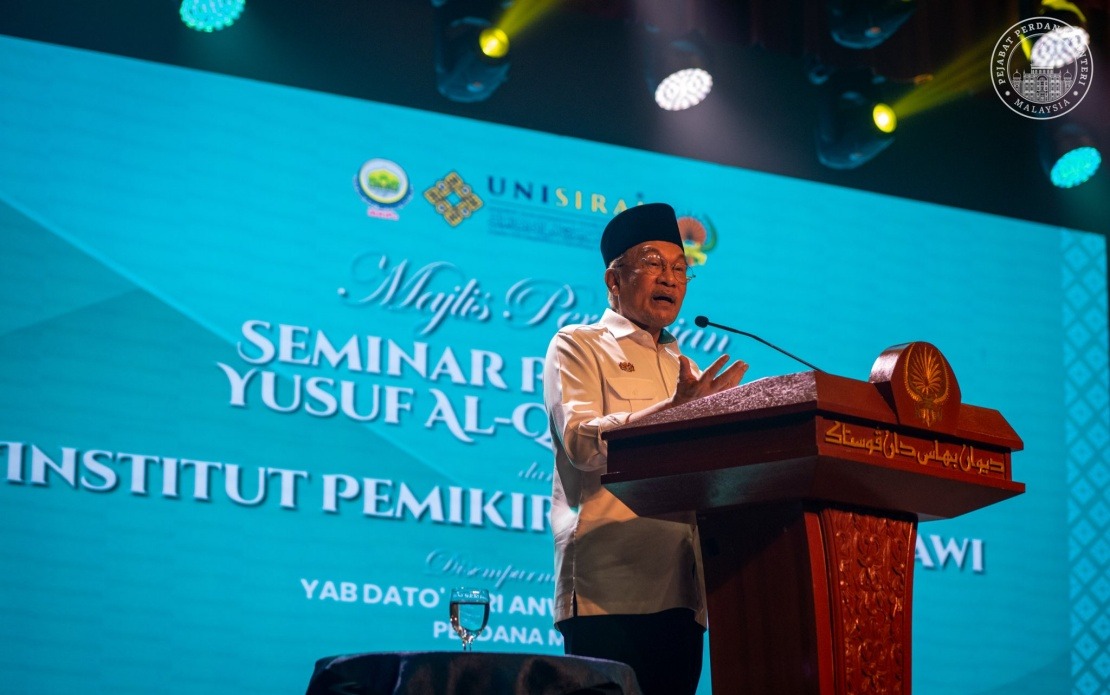
Prime Minister Datuk Seri Anwar Ibrahim has pledged RM2 million in MADANI Government funding toward the Al-Qaradawi Thought Institute, cementing institutional support for scholarly work centred on the legacy and contributions of Sheikh Dr Yusuf Al-Qaradawi. The commitment was unveiled during the opening ceremony of the Yusuf Al-Qaradawi Thought Seminar and the institute itself, held at Wisma Dewan Bahasa dan Pustaka in Kuala Lumpur on July 21.
Anwar's personal connection to Al-Qaradawi runs deep, extending across decades of intellectual and spiritual exchange. In remarks shared on social media, the Prime Minister acknowledged his profound debt to the Islamic scholar, describing a relationship built on ideological alignment, moral encouragement, and genuine friendship grounded in sincerity. He expressed hope that such institutional initiatives would earn divine blessing, generate practical benefit to the Muslim community, and contribute to intellectual enlightenment within the ummah.
The government's financial backing reflects broader recognition of Al-Qaradawi's outsized influence on Islamic activism and thought in Malaysia during formative periods of the country's modern history. Anwar drew particular attention to his own early engagements with Al-Qaradawi while serving in leadership roles at the Malaysian Islamic Youth Movement, or ABIM, an organisation that shaped a generation of Malaysian Islamic leaders and activists during the 1970s and 1980s.
Characterising Al-Qaradawi as a transformative intellectual force, Anwar described him as an agent of change and a defining spirit of his era—someone who championed openness in theological and social thought while simultaneously pushing for Islamic reform adapted to contemporary realities. This characterisation positions Al-Qaradawi not as a rigid traditionalist, but as a reformist figure capable of engaging with modern challenges through Islamic frameworks.
A pivotal moment in Anwar's narrative involved Al-Qaradawi's direct intervention in ABIM's strategic direction during the early 1980s, when Islamic revival movements across the Muslim world were gaining momentum and cultural influence. During this charged period, Al-Qaradawi transmitted a formal treatise to ABIM's leadership councils, urging the organisation to deliberately step back from hardline ideological positions and instead embrace wasatiyyah—the Islamic principle of moderation and balance in belief and practice.
This counsel carried immense weight within the context of the times. The early 1980s represented a period when Islamic activism globally was becoming increasingly polarised, with competing factions advocating either accommodation with secular frameworks or comprehensive rejection of non-Islamic governance models. Many Islamic movements worldwide were shifting toward more rigid, confrontational stances. Al-Qaradawi's intervention in the Malaysian context, according to Anwar's account, steered ABIM away from such trajectories and reinforced commitment to a middle path—one receptive to intellectual diversity and capable of engaging with perspectives beyond the Islamic tradition.
Anwar emphasised that this guidance proved strategically vital during a moment when Malaysian Islamic circles faced intense pressure to adopt closed-off, doctrinally exclusive positions resistant to dialogue and intellectual cross-pollination. The timing and content of Al-Qaradawi's message thus shaped Malaysia's subsequent trajectory within the Islamic world, positioning the country as a space where Islamic thought could develop dynamically without abandoning core principles.
The establishment of the Al-Qaradawi Thought Institute institutionalises this legacy at a moment when Malaysia's government, under Anwar's leadership, appears keen to cement the intellectual foundations of moderate, reform-oriented Islam as central to national identity and policymaking. By anchoring the institute with substantial government funding, the MADANI administration signals commitment to scholarly research that examines Al-Qaradawi's methodologies, outputs, and influence—work that could inform contemporary policy and grassroots Islamic discourse.
For Malaysian readers and observers across Southeast Asia, the initiative carries multiple implications. It reflects the continuing influence of Cold War-era Islamic activism on present-day governance structures and ideological commitments. It demonstrates that figures like Al-Qaradawi, despite passing from the scene, retain considerable institutional and symbolic weight in shaping how Muslim-majority nations approach the balance between Islamic identity and pluralistic engagement. The funding decision also signals that wasatiyyah—often translated as moderation or the middle way—remains a guiding principle for Malaysia's current political leadership in navigating complex questions around Islamic law, democratic governance, and social cohesion.
The seminar and institute launch represent a deliberate effort to generate scholarly depth around these themes, creating spaces where researchers, theologians, and policy practitioners can examine how Islamic reform thought applies to present-day challenges. This comes at a time when Southeast Asia confronts questions about religious harmony, minority protection, and the integration of Islamic principles into secular legal frameworks—all domains where Al-Qaradawi's own intellectual work offered innovative approaches.

